Pick up a cot mattress and the label can read like a chemistry exam: polyester fibre, coir, foam, anti-allergy treatment, flame-retardant standards. Parents often ask the same questions. What are baby mattresses made of? Are the materials safe? Is that new mattress smell harmful? This guide explains the common cot mattress materials, what to look for and avoid, how to deal with a new-mattress smell, and what anti-allergy treatments actually mean.
Quick Answer
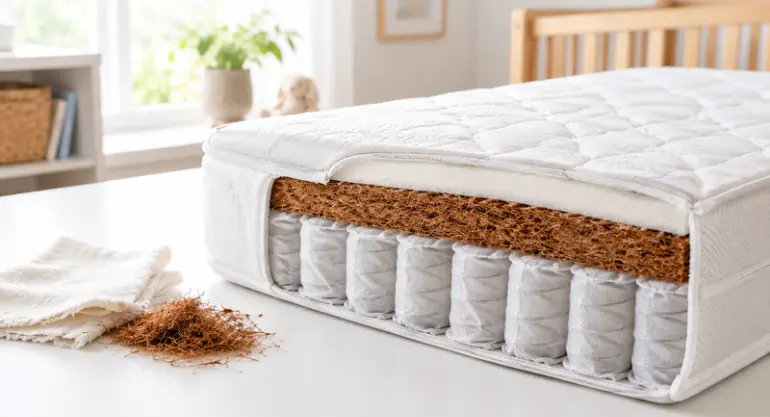
Most baby mattresses are made from a core (pocket springs, coir, fibre, foam or latex), wrapped in a cover (often a polyester or cotton blend with a waterproof layer). A good baby mattress should be firm, flat, well fitted and waterproof, and should meet UK cot mattress standards such as BS 1877 Part 10 and BS 7177. There’s no single “best” material. The safest choice is a mattress that is firm, meets the standards, has a removable washable cover, and comes from a brand that will tell you plainly what it’s made of. New mattress smell usually fades with airing, but no mattress is guaranteed to have zero emissions.
What Are Baby Mattresses Made Of?
A baby mattress has two main parts: the core (what supports your baby) and the cover (what your baby lies on). Many also have layers in between.
Mattress cores
| Core material |
What it is |
Things to know |
| Pocket springs |
Individual springs, each in its own fabric pocket |
Firm, supportive, and more breathable than solid foam. Usually combined with layers of fibre or coir. |
| Coir |
Fibre from coconut husks |
A natural, firm material often used on the sleep surface. |
| Fibre (e.g. polyester or natural fibre) |
Bonded or loose fibre padding |
Lighter and often used in combination with springs or coir. |
| Foam |
Polyurethane or similar |
Lightweight and often cheaper. See our guide to ARE FOAM & MEMORY FOAM MATTRESSES SAFE FOR BABIES?. |
| Latex |
Natural or synthetic rubber |
Springy, but a possible concern for anyone with a latex allergy. |
For a comparison of how these perform, read our guide to TYPES OF BABY MATTRESS: FOAM VS SPRUNG VS FIBRE VS LATEX.
Mattress covers
The cover matters as much as the core, because it’s the part your baby actually touches. Common cover materials include:
- Cotton or cotton blends, soft and breathable.
- Polyester or polyester blends, durable and easy to wash.
- Waterproof layers, which protect the core from leaks. Safe sleep guidance is that a baby’s mattress should be waterproof.
Look for a cover that unzips, can be removed and can be washed at 60°C, which helps with hygiene.
What Babymore’s mattresses are made of
Babymore’s Premium Core cot mattress has a natural coir and fibre core with micro pocket springs, a reinforced mattress wall, and a BabyTec cover that is hypoallergenic, water-resistant, wipe-clean and removable with a side zip, washable at 60°C. The page says no PVC is used and lists the standards BS EN 16890:2017, BS 1877 Part 10 and BS 7177 (Low Hazard). The pages describe the mattresses as foam free. You can see the whole baby mattress range and the cot bed version.
What Is the Best Material for a Baby Mattress?
There’s no one winner, but these are the qualities that matter more than the material name:
- Firmness. A baby’s mattress should be firm and flat, and a baby’s head shouldn’t sink into it. Soft mattresses are known to increase the risk of SIDS, according to the Lullaby Trust. Our guide to the best mattresses and bedding for babies covers this too.
- A proper fit. No gaps at the sides.
- A waterproof, removable, washable cover.
- Compliance with UK standards. Look for BS 1877 Part 10 for cot mattresses and BS 7177 for fire safety.
- Transparency. The brand should say what’s inside.
Natural cores such as coir and pocket springs are popular with parents who prefer to avoid foam, and our post on pocket sprung mattresses for cots explains why. Our cot mattress guide covers firmness, support and mattress types in more detail.
What Should a Baby Mattress Be Made Of? What Fabric Is Best?
A good baby mattress cover should be:
- Soft but not padded or plush. Firm support underneath is what matters.
- Breathable and easy to clean. But be careful with “breathable” claims. The Lullaby Trust advises treating breathable and temperature-control claims with caution, because no mattress has been shown to reduce SIDS risk. Our guide to BREATHABLE BABY MATTRESSES: FACT VS MYTH explains more.
- Waterproof. Safe sleep advice is that the mattress should be waterproof, so choose a cover that wipes clean.
- Washable at 60°C. This helps with dust mites and hygiene.
For fabric, cotton blends and polyester blends are both common. The more important question is whether the whole cover meets the standards and fits well.
What Materials Should Be Avoided in a Baby Mattress?
Rather than a blacklist, think about what to be careful with:
- Soft, sagging or worn surfaces. Replace a mattress that has lost its firmness.
- Unlabelled or imported mattresses with no standards information. UK cot mattresses should comply with BS 1877 Part 10, and sold mattresses should meet fire standards such as BS 7177. One retailer warns that cheap imported foam can fail these tests and that counterfeit labels exist, so buy from a trusted brand.
- Plastic or vinyl wipe-clean covers where phthalates may be a concern. Phthalates can leach from PVC and vinyl, so check what the cover is made from.
- Second-hand mattresses. A new mattress is preferred for each baby. See our guide to whether a second-hand car seat is safe for the same idea applied to another safety product.
- Extra layers. Don’t add toppers, pads or a second mattress to a firm cot mattress. Our cot safety guide has more on a safe cot set-up.
- Unverified claims. “Chemical free”, “toxin free” and “zero VOC” are hard to prove. Ask what they mean.
Is New Mattress Smell Harmful to Babies?
That “new mattress smell” comes from volatile organic compounds (VOCs) released from materials, a process known as off-gassing. Key points:
- Smell isn’t a reliable measure of harm. Many VOCs have no odour, and some smell at very low levels. A strong smell isn’t proof of danger, and a faded smell doesn’t prove emissions have stopped.
- No mattress is truly zero emissions. Be wary of “zero VOC” claims.
- Any smell usually fades within a few hours to a few days, according to mattress brands that publish guidance.
- Third-party testing is the best safeguard. Certifications such as GREENGUARD Gold test finished mattresses for chemical emissions, though they don’t verify that a mattress is organic or free of every substance.
If a mattress has a strong smell that doesn’t fade, contact the manufacturer or retailer. For other new-nursery smells, see how to get rid of new furniture smell.
Should You Air Out a Baby Mattress?
Yes, it’s a sensible precaution. Babymore’s product page gives no airing instructions, so follow the instructions that come with your mattress. A common-sense approach:
- Unwrap it in a ventilated room as soon as it arrives, not on the day your baby first sleeps on it.
- Leave it for a day or two, in a cool, well-ventilated space, with the window open if you can.
- Wash the cover if the instructions allow, at the temperature on the care label.
- Check the smell before use. If it’s still strong, contact the retailer.
- Keep it clean and dry. Don’t store it in a damp room.
Remember that Babymore’s mattresses can’t be returned for a full refund once opened, so check the size and type before you unwrap.
Could a Baby Be Allergic to a Mattress?
It’s possible for a baby to react to something in their sleep environment, such as dust mites, a material or a detergent, but it isn’t a common first suspect for every rash or snuffle. Points to keep in mind:
- Dust mites live in bedding and mattresses. Washing covers at 60°C and keeping the room clean helps. See how to clean a baby mattress.
- Latex can be a problem for people with a latex allergy, so check the materials if allergies run in your family.
- Detergents and fabric conditioners can irritate sensitive skin. Use a gentle, fragrance-free option.
- Symptoms to watch for include a persistent rash, sneezing, a runny nose or wheezing that seems worse at sleep times.
If you’re worried, speak to your GP or health visitor. Don’t diagnose a mattress allergy yourself, and don’t change the sleep surface to something soft.
Does It Matter to Have an Anti-Allergy Mattress for Babies?
An “anti-allergy” or “anti-mite” mattress has been treated, or made with a fabric designed, to discourage dust mites. Some points:
- It’s not essential. A clean, well-fitted, washable-cover mattress is the foundation.
- It’s a feature, not a guarantee. Treatments can reduce mites on the surface, but they don’t replace washing the cover and keeping the room dry and clean.
- Ask what the treatment is. Brands use different systems. Ask the manufacturer for a data sheet if you want details.
Babymore’s Premium Core pages describe the mattress as anti-allergy treated and the BabyTec cover as hypoallergenic.
Is Mitesguard Safe for Baby Mattresses?
Mitesguard is the name of an anti-mite treatment that some mattress brands list. I couldn’t find a manufacturer data sheet for it that I could verify, so we can’t state its safety profile here. The sensible approach is to ask the mattress brand or the treatment’s supplier for the safety data, and check that the finished mattress meets BS 1877 Part 10 and BS 7177. If a brand can’t answer, treat that as a flag.
Is Polyester Safe in a Baby Mattress?
Polyester fibre is a common filling and cover material in cot mattresses. What matters is not the word “polyester” but:
- Whether the mattress as a whole is firm and flat.
- Whether it meets UK safety and fire standards.
- Whether the cover is breathable enough for your comfort and easy to wash.
Polyester is not automatically unsafe, and natural materials are not automatically safer. Check the standards and the brand’s transparency.
Are Baby Crib Mattresses Really Toxic?
Be careful with sweeping claims on either side. Here’s a balanced view:
- Mattresses sold in the UK have to meet fire safety standards, which is partly why some chemical treatments exist.
- Some materials emit VOCs at first, and certifications such as GREENGUARD Gold exist to test for this.
- “Toxic” is a strong word. Most concerns are about specific chemicals at specific levels, not about mattresses in general.
- You can lower your worry by buying a mattress that meets UK standards, airing it before use, and choosing a brand that is open about its materials.
For related questions, read ARE FOAM & MEMORY FOAM MATTRESSES SAFE FOR BABIES? and our guide to DUAL-SIDED COT MATTRESS: WHEN TO FLIP TO THE SOFTER TODDLER SIDE.
Quick Checklist: Choosing a Safe Baby Mattress
- Is it firm and flat, with no soft spots?
- Does it fit the cot snugly, with no gaps?
- Does it meet BS 1877 Part 10 and BS 7177?
- Is the cover waterproof, removable and washable at 60°C?
- Does the brand say clearly what’s inside?
- Is it new, rather than second-hand?
- Have you aired it before first use?
Final Thoughts
A baby mattress is a simple product with a lot of marketing around it. Focus on what counts: firm and flat, a snug fit, a waterproof washable cover, UK standards and honest labelling. Air it before first use and replace it when it wears out.
Browse Babymore’s baby mattresses, see our cots and cot beds, read the full cot mattress guide, or visit our safety assurance page.
Frequently Asked Questions
01- What are baby mattresses made of?
Usually a core of pocket springs, coir, fibre, foam or latex, wrapped in a cover of cotton or polyester blends with a waterproof layer.
02- Is new mattress smell harmful to babies?
Smell comes from VOCs and isn’t a reliable measure of harm. It usually fades within days. Air the mattress first and contact the brand if it stays strong.
03- What material is best for a baby mattress?
Firmness, fit and standards matter more than one material. Pocket sprung and coir mattresses are popular, and any mattress must be firm, flat and waterproof.
04- What materials should be avoided in a baby mattress?
Soft or worn surfaces, mattresses without standards information, and covers that may contain phthalates. Don’t add toppers or pads.
05- What should a baby mattress be made of?
A firm core, a waterproof and removable cover, and materials that meet UK standards.
06- Is polyester mattress safe for babies?
Polyester is common and not automatically unsafe. Check the whole mattress meets safety standards and is firm.
07- Is Mitesguard safe for baby mattresses?
We couldn’t verify the treatment’s safety data, so ask the brand or supplier and check the mattress meets UK standards.
08- Should you air out a baby mattress?
Yes. Unwrap it in a ventilated room a day or two before first use and follow the manufacturer’s instructions.
09- What baby mattress fabric is best?
A removable, waterproof, washable cover. Cotton and polyester blends are both common.
10- Could a baby have an allergy to a mattress?
It’s possible, for example to dust mites or latex, but it’s not the usual first cause. Speak to your GP or health visitor if symptoms persist.
11- Are baby crib mattresses really toxic?
Not as a blanket rule. Buy a mattress that meets UK standards, air it, and choose a brand that is transparent.
12- Does it matter to have an anti-allergy mattress for babies?
It isn’t essential. Clean, washable covers and a dry room matter more.