Type “nursery table” into a search bar and you’ll get a genuinely mixed bag of results: changing tables, bedside tables, small toddler activity tables, even the occasional side table someone’s repurposed for a nappy caddy. That’s not a search engine problem, it’s an accurate reflection of the fact that “nursery table” isn’t one specific item, it’s a catch-all term covering several different pieces of furniture that all happen to live in the same room. At Babymore, we get asked variations of “do I actually need a table in the nursery?” fairly often, so it’s worth untangling what people actually mean by the term, and which version, if any, your baby’s room genuinely needs.
“Nursery table” most commonly refers to a changing table, a raised, stable surface for nappy changes, which in modern UK nurseries usually takes the form of a chest changer (a chest of drawers with a changing top) or a cot top changer (a compact platform that fits securely onto the cot rails). It can also refer to a small side table beside a nursing chair, used for feeding essentials, or, once your child is older, a low toddler activity table. Whether your baby’s room needs one depends entirely on which type you mean: a changing surface of some kind is genuinely useful for most parents, while a dedicated side table or toddler table is more of a nice-to-have that depends on your room’s size and layout.
The ambiguity here is worth addressing head-on, because it changes what advice actually applies to you. Broadly, “nursery table” tends to mean one of four different things, depending on the age of your child and the context:
Most of the genuine search interest, and most of the practical decision-making for new parents, centres on the first two: the changing table and the cot top changer.
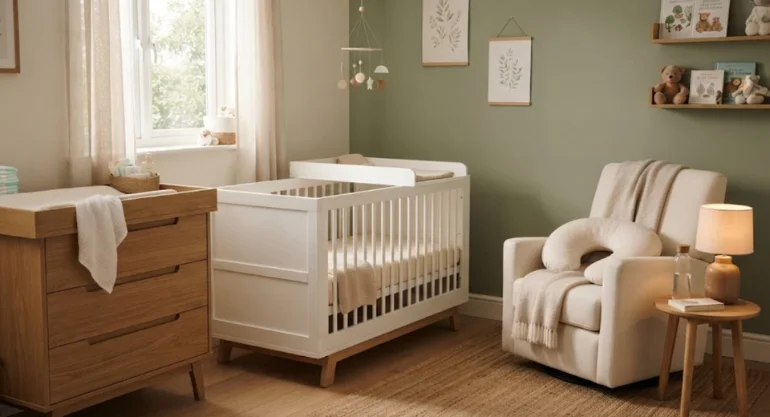
A changing table, in modern UK nursery furniture, is rarely a standalone table on legs the way it might have been decades ago. Today it’s almost always built into a chest changer, a chest of drawers with a raised, safety-railed changing top built into the surface. This combination matters because it solves two problems at once: a stable, waist-height surface for nappy changes, which spares your back from bending over a cot or floor mat repeatedly, and built-in storage directly beneath it for nappies, wipes, and spare clothes, keeping everything you need within arm’s reach during a change.
Babymore’s Universal Nursery Chest Changer is a good example of how this works in practice: a chest with full-sized drawers and a changing top rated for babies up to 11kg, designed to take a standard 75 x 45cm changing mat. Once your baby has outgrown nappy changes, many chest changers, including this one, have a removable changing top, so the piece simply becomes a regular chest of drawers rather than something you need to replace entirely.
If a full chest changer doesn’t suit your room, either because of space or budget, a cot top changer solves the same core problem differently. Rather than standing as its own piece of furniture, it’s a compact platform that fits securely onto the top rails of your cot or cot bed, giving you a dedicated changing surface without using any additional floor space at all. Babymore’s Cot Top Changer fits most cots and cot beds using a 60 to 70cm width mattress, meets British and European safety standard BS EN 12221 for changing units, and simply lifts off when it’s not in use. It’s genuinely one of the most practical solutions for a smaller nursery, since you’re not sacrificing floor space for a piece of furniture that only does one job. We cover this in more depth in our guide on what a cot top changer is and how it helps, if you want to compare it more directly against a full chest changer.
In the practical sense, yes, most parents benefit genuinely from having a dedicated, stable changing surface rather than relying entirely on a floor mat or the bed. Bending repeatedly over a low surface for nappy changes, sometimes a dozen or more times a day in the newborn stage, adds up to real strain on your back over weeks and months. A raised changing surface, whether that’s a full chest changer or a cot top changer, removes that problem almost entirely.
Where the “table” part becomes optional is the format, not the function. If your nursery has the floor space and you want the extra storage, a chest changer earns its keep as both changing station and clothing storage in one. If space is tight, a cot top changer gives you the same changing height without taking up an inch of additional floor space, since it lives directly on the cot itself.
This is a genuinely separate question from the changing table, and it depends entirely on where your nursing or feeding chair sits. If you’re feeding in the nursery, particularly overnight, having a small, stable surface within arm’s reach, for a water bottle, a dim lamp, or a muslin, makes a real practical difference. It doesn’t need to be large or specifically marketed as a “nursery” table; any small, stable side table at a comfortable reach height will do the job, provided it’s positioned so you’re not twisting or reaching across your baby to use it.
Almost certainly not, and trying to fit every category of “nursery table” into a genuinely small UK nursery, a converted box room or a terraced house second bedroom, usually backfires by eating up floor space you need for other things. The most space-efficient combination for a smaller room tends to be a cot top changer (using zero additional floor space) paired with a wardrobe or chest of drawers for storage, rather than a full chest changer plus a separate storage unit plus a side table. Our guide on small nursery ideas goes into more detail on prioritising multi-purpose furniture over single-use pieces when space is genuinely limited, and our piece on nursery storage ideas that actually save space covers how to keep everything organised once your furniture is in place.
| Feature | Chest Changer | Cot Top Changer |
| Floor space needed | Yes, a standalone piece | None, sits on the cot |
| Storage included | Yes, full drawers | No, changing surface only |
| Best for | Larger nurseries, longer-term storage needs | Smaller nurseries, box rooms |
| Longevity | Often converts to a regular chest once changing days are over | Removed once no longer needed |
“Nursery table” covers more ground than the phrase suggests, and working out which version you actually need starts with being honest about how you’ll use the room. A dedicated changing surface, whether that’s a full chest changer or a compact cot top changer, is genuinely useful for almost every parent. A side table for feeding is a smaller, situational addition. And a toddler table is a problem for a later stage entirely.
If you’re planning out your nursery furniture from scratch, our guide to essential nursery furniture set pieces walks through how a changing table, wardrobe, and nursing chair work together as a complete setup, and Babymore’s nursery furniture range includes both chest changers and cot top changers if you’re still deciding which format suits your space.