Choosing where your newborn will sleep is one of the first big nursery decisions. A Moses basket is small, light and snug. A crib (including bedside and gliding cribs) is bigger, usually lasts a little longer and can make night feeds easier. So which is better, a Moses basket or a crib? This guide by Babymore compares them side by side, explains how long each lasts, covers safe sleep basics, and helps you decide.
Quick Answer
Neither is “better” for every family. A Moses basket is usually cheaper, smaller and easy to carry, but most babies outgrow it at around 3 to 4 months. A crib costs more and takes more space, but usually lasts until about 6 months, and bedside styles make night feeds easier. Both can be safe when used with a firm, flat, correctly fitting mattress, your baby on their back, and a clear sleep space. UK safe sleep guidance is to keep your baby in the same room as you for the first 6 months. If you only want one, a crib often covers more time. Many parents use a basket for daytime naps and a crib at night.
Moses Basket vs Crib at a Glance
|
Moses basket |
Crib (including bedside and gliding cribs) |
| Typical use |
Birth to about 3 to 4 months |
Birth to about 6 months |
| Weight limit |
Often around 9 kg, check the label |
Often around 9 kg, some slightly higher |
| Size |
Small and compact |
Larger |
| Portability |
Handles make it easy to carry room to room, but never carry a sleeping baby on the stairs |
Some are light and fold, others are fixed beside the bed |
| Stand |
Usually needed (sold separately or in a bundle) |
Built-in legs or frame |
| Night feeds |
You usually need to sit up and reach in |
Bedside cribs have a drop-down side; mesh sides help you see your baby |
| Typical cost |
Generally lower |
Generally higher |
| UK standard |
BS EN 1466 |
BS EN 1130 |
| Cleaning |
Woven baskets can be harder to deep clean |
Smooth frames and removable covers are often easier |
Typical ranges come from UK retailer guides. Always check the manufacturer’s age, weight and safety information for the exact product.
What Is a Moses Basket?
A Moses basket is a small, lightweight, portable bed with handles, usually made of woven palm, wicker or fabric. It sits on a stand or on the floor and fits easily into a small bedroom.
Moses basket pros
- Small and cosy. Fits into compact bedrooms and next to the bed.
- Portable. Move it between rooms for daytime naps while you stay close.
- Generally less expensive than a crib.
- Breathable materials. Natural palm and modern fabrics allow airflow.
- Quick to set up because most of the work is the stand.
Moses basket cons
- Short life. Most babies outgrow a basket at around 3 to 4 months, or as soon as they can push up on their hands, roll or sit.
- It needs a stand and the right mattress. A mattress is sometimes sold separately.
- Harder to clean if made from woven material.
- Not for carrying a sleeping baby. Handles are for moving an empty basket, or a sleeping baby on a flat surface only. Follow the manufacturer’s instructions.
- Less helpful for night feeds, since you have to lift the baby out or lean over.
How Long Can a Baby Sleep in a Moses Basket?
Most guides say about 3 to 4 months, or until your baby can sit up, push up on their hands or roll, whichever comes first. Many baskets also have a weight limit of around 9 kg, but check the label on yours. Once your baby starts rolling or pushing up, move them to a cot, crib or cot bed.
What Is a Crib?
A crib is a small baby bed that is larger than a Moses basket but smaller than a cot. Types include:
- Stand-alone cribs, which can sit next to your bed.
- Bedside cribs or co-sleepers, which attach to your bed with a drop-down side. See our co-sleeping safety tips.
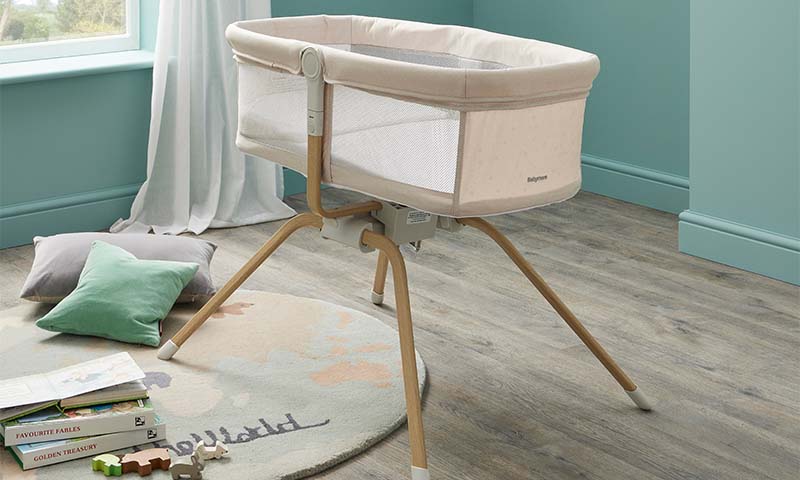
- Gliding or rocking cribs, which move gently, often with a lock.
Crib pros
- Lasts longer. Many cribs are usable until about 6 months, or until your baby can sit unaided or reaches the weight limit.
- Easy night feeds. Bedside models let you reach your baby from your bed, and mesh sides let you see them. This can be especially helpful after a caesarean birth, when moving is harder. See our guide to the best nursing chair after a C-section.
- Sturdy and stable with secure mattress supports.
- Gliding or rocking options can soothe some babies.
- Often easier to wipe clean.
Crib cons
- Higher upfront cost.
- Takes up more space, especially in a small bedroom.
- Heavier or harder to move than a basket. Some models are light, but check the weight.
- Short-lived. You’ll still need a cot or cot bed at around 6 months.
- Assembly and storage. Flat-pack cribs need building and space to store afterwards.
Babymore Cribs: What We Offer
Babymore’s crib range includes:
- Air Motion Gliding Crib (also in grey). A stand-alone crib that glides side to side in response to your baby’s movement, and the glide can be locked off. It is listed as suitable from birth to 6 months or 9 kg, weighs 6 kg, assembles without tools, has mesh sides, and is listed as complying with BS EN 1130 and EN 16890. Read our Air Motion Gliding Crib review and the Mumii review.
- Neera Bedside Crib (also in mocha). Converts between a stand-alone crib and a bedside co-sleeper, with a lockable rocking function, an adjustable tilt position, and wheels with brakes.
Check each product page for the latest details on mattresses and what’s included.
Safe Sleep: What Matters More Than Basket vs Crib
The type of bed matters less than how you use it. Safe sleep guidance from The Lullaby Trust includes:
- Back to sleep. Place your baby on their back for every sleep, in their own separate sleep space.
- Firm, flat mattress. It should fit snugly with no gaps, and a baby’s head should sink only a few millimetres. Soft surfaces are known to increase the risk of SIDS. Our cot mattress guide explains firmness and fit.
- A clear sleep space. Keep pillows, duvets, bumpers, pods, nests, toys, rolled towels and wedges out. See our guide to a safe nursery environment.
- The right bedding. Use a fitted sheet and a well-fitted baby sleeping bag instead of loose covers. See our guide to the best mattresses and bedding for babies.
- A comfortable room temperature. The ideal room temperature for a sleeping baby is 16 to 20°C. See our guide on winter-proofing your baby’s nursery.
- Stay close. Keep your baby in the same room as you for the first 6 months, day and night. Our newborn sleep setup guide can help.
Other tips:
- Use a proper stand for a Moses basket, never a table, chair or sofa.
- Don’t use a car seat, sofa or armchair for sleep. Car seats are for travelling. See our car seat 2-hour rule.
- Choose a new mattress where possible, and check second-hand baskets and cribs for damage. Our guide to the importance of a cot mattress explains why.
- Follow the manufacturer’s instructions for age, weight and assembly.
This is general information. For advice on your own baby, speak to your midwife or health visitor.
Which Is Better for Night Feeds?
Cribs, especially bedside ones, are generally easier. A drop-down side lets you reach your baby without sitting up or getting out of bed, and a gliding crib can help soothe a baby while you stay close. A Moses basket can still work if it’s next to your bed on a stand, but you’ll usually need to sit up to lift your baby out. For more help, see our top tips for night feeding and how to make night feeds more comfortable.
Which Is Better for Small Spaces?
A Moses basket is the more compact option, and it moves easily between rooms. But some cribs are compact too. Babymore’s Air Motion Gliding Crib is described as folding small for storage and travel. Measure your bedroom before deciding, and remember that your baby will need a cot or cot bed soon after. A space-saving cot can help.
Which Is Better Value?
- A Moses basket usually costs less, but it lasts for a shorter time (about 3 to 4 months).
- A crib costs more, but may last a couple of months longer, and some convertible models can be used longer.
- Neither is essential. Some families skip both and go straight to a cot. But a cot is large for a newborn, and many parents like the closeness of a smaller bed in the early weeks.
You could also save by using a basket for naps downstairs and a crib at night, but that means buying both. Compare what you need using our nursery checklist and newborn baby checklist.
What About Moving to a Cot?
Plan ahead. At around 3 to 6 months, depending on which you choose and how fast your baby grows, you’ll need a cot or cot bed. Browse our cots and cot beds, match them with a firm baby mattress, and read our guides on the suitable age to use a cot bed, safe use of a cot bed and moving from cot to toddler bed. To compare mattress types, read our guide to types of baby mattress, and if you’re not sure about materials, see what baby mattresses are made of.
How to Choose: A Quick Decision Guide
Choose a Moses basket if:
- You want the smallest, lightest, lowest-cost first bed.
- You plan to move your baby between rooms for daytime naps.
- You’re happy to move to a cot at around 3 to 4 months.
Choose a crib if:
- You want a bed that can last until about 6 months.
- You want easier night feeds or you’re recovering from a caesarean birth.
- You like the idea of a gliding or bedside option.
Consider both if:
- You want a portable daytime bed and a bedside crib at night.
Final Thoughts
Both a Moses basket and a crib can be a safe, cosy first bed. The best choice is the one that fits your space, budget and routine, and that you can use correctly. Keep the sleep space clear (our cot safety guide has more), the mattress firm and flat, and your baby close for the first 6 months.
Ready to choose? Browse Babymore’s cribs, plan ahead with our cots and cot beds, or read the full cot mattress guide.
Frequently Asked Questions
01- What is better, a Moses basket or a crib?
It depends on your space, budget and routine. A Moses basket is smaller and cheaper. A crib usually lasts longer and can make night feeds easier.
02- How long can a baby sleep in a Moses basket?
Usually about 3 to 4 months, or until they can push up, sit or roll, or reach the weight limit on the label.
03- How long can a baby sleep in a crib?
Often until about 6 months, or until they can sit unaided or reach the weight limit. Babymore’s Air Motion Gliding Crib is listed as birth to 6 months or 9 kg.
04- Is a Moses basket safe?
It can be, when used with a firm, flat mattress that fits snugly, on a proper stand, with your baby on their back and a clear sleep space.
05- Do newborns need a Moses basket?
No, it’s optional. A crib or cot can be used from birth, and many babies sleep in a crib in their parents’ room.
06- Can a newborn sleep in a crib from day one?
Yes, if it is designed for newborns, has a firm, flat mattress, and is used in line with safe sleep guidance. UK advice is to keep your baby in your room for the first 6 months.
07- Is a bedside crib better than a Moses basket?
A bedside crib is easier for night feeds and lasts longer. A Moses basket is smaller and cheaper. Many parents find a crib more practical for nights.
08- Do I need a stand for a Moses basket?
A stand is strongly recommended. It raises the basket, improves airflow and saves bending. Never put a basket on a table, chair or sofa.
09- Can I carry my baby in a Moses basket?
The handles are mainly for moving the basket without your baby in it. Follow the manufacturer’s instructions, and don’t carry a sleeping baby on stairs.
10- Can I use a second-hand Moses basket or crib?
You can if it’s undamaged and clean, but buy a new, correctly sized mattress.
11- Can my baby sleep in a car seat or pram instead?
Not as a regular sleep space. Car seats are for travel, and prams or carrycots should only be used in line with their instructions. Babies should sleep on a firm, flat surface.
12- When should I move my baby to a cot?
When they outgrow the basket or crib: they can push up, roll or sit, or reach the weight limit.