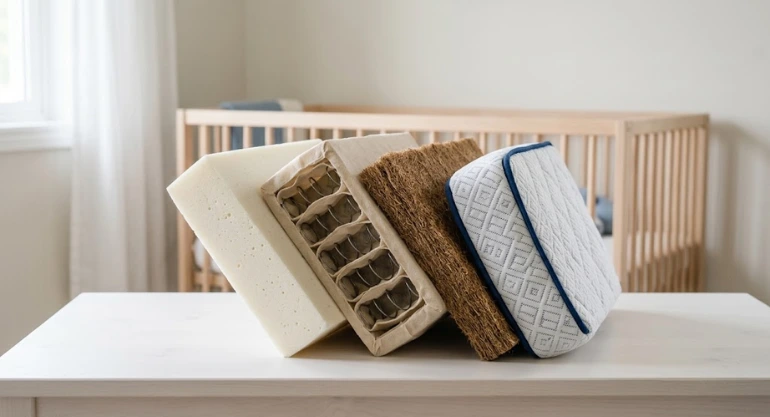
Choosing a cot mattress feels like it should be simple, until you’re faced with foam, sprung, pocket sprung, fibre, coir, latex and “orthopaedic” all at once. If you’re wondering what type of mattress is best for a baby, the honest answer is that the type matters less than getting the basics right: a mattress that is firm, flat, snug-fitting, clean and made to a recognised safety standard. This guide compares the main types of baby mattress, answers the questions parents ask most (is a foam or spring mattress better for a baby, is a fibre mattress good for a baby, is latex safe), and helps you decide what mattress to buy for your baby’s cot or cot bed. For a wider overview, see our mattress guide.
The best mattress for a baby is a new, firm, flat mattress that fits the cot snugly, has a waterproof or wipe-clean cover, and meets UK safety standards. Foam, sprung, pocket sprung and natural fibre mattresses can all be safe choices if they meet that checklist. Sprung and fibre mattresses are popular because they hold their shape and are breathable, while foam is lighter and often cheaper. A mattress that is soft, worn, sagging or the wrong size is never a good choice, whatever it is made of.
Whatever type you choose, every baby mattress should tick these boxes. Safe sleep guidance from the NHS and the Lullaby Trust is for a firm, flat sleep surface, and that matters more than the filling. Our guide to the best mattresses and bedding for babies explains more, and our post on the importance of a good cot mattress covers why it matters.
| Type | What it is | Pros | Things to consider |
|---|---|---|---|
| Foam | A block of foam, often with a waterproof cover | Lightweight, easy to lift, usually the lowest price | Can lose its shape sooner, and can retain heat |
| Sprung (open coil) | A coil spring core, usually with padding layers | Firmer, holds its shape, air can flow between springs | Usually costs more than foam |
| Pocket sprung | Individual springs, each in its own fabric pocket | Very supportive and durable, good for a cot bed used for years | Highest price of the spring types |
| Natural fibre / coir | Coconut fibre, sometimes with wool, cotton or latex | Breathable, firm, appeals if you want natural materials | Cost varies, and fewer options |
| Latex | Rubber foam, usually a layer within a natural mattress | Springy, durable, often used in natural mattresses | Latex allergy is a consideration (see below) |
Babymore’s current mattress range is foam-free, using pocket sprung, dual core and eco fibre builds with a coir and fibre core. You can browse the full baby mattress range below, or read about Babymore cot mattresses.
Both can be safe, so it comes down to what matters to you.
Choose foam if you want a lightweight mattress that’s easy to lift when changing sheets, or if budget is the priority. Foam can lose its shape faster than spring or fibre, so it suits shorter use less well, and some foam mattresses can retain heat, so keep bedding light.
Choose sprung if you want a firmer, longer-lasting mattress. Coil mattresses usually hold their shape for longer, and air can circulate between the springs, which can help keep a baby cool.
Choose pocket sprung if you’re buying a cot bed mattress for the long term. The independent springs give responsive support and tend to keep their shape as your child grows. Our guide to pocket sprung mattresses for cots explains why.
Consider a dual-sided mattress if you want one mattress to last from baby to toddler. These have a firmer side for babies and a softer side for older children. Find out how they work and the right moment to turn one over in our guide to the DUAL-SIDED COT MATTRESS: WHEN TO FLIP TO THE SOFTER TODDLER SIDE.
So is a spring or foam mattress better for a baby? Neither is automatically safer. A firm, correctly fitting sprung mattress and a firm, correctly fitting foam mattress both meet the guidance. If you want a mattress to last for years or pass to a second child, sprung or pocket sprung is usually the better investment. Browse our pocket sprung cot mattress (120 x 60 cm), pocket sprung cot bed mattress (140 x 70 cm) and deluxe sprung cot mattress.
Yes, a fibre mattress is a good choice for many babies. Fibre mattresses are firm, flat and breathable, and the fibre core allows air to circulate. Natural fibre mattresses are often chosen by parents who want to avoid synthetic materials, and are sometimes recommended for babies with sensitive skin, though you should still look for a hypoallergenic, washable cover.
Is foam or fibre mattress better for baby? Foam is lighter and often cheaper, while fibre is typically firmer and more breathable. If airflow and a natural feel matter most, choose fibre. If weight and price matter most, choose foam.
Yes. Coir is made from coconut husk fibre, which is naturally firm and allows air to move through the mattress. That firm, supportive feel is why coir cores are used in many baby mattresses. Check that the mattress has a removable, washable cover and meets the safety standards above. Babymore’s Eco Fibre cot mattress comes in three sizes: 100 x 50 cm, 120 x 60 cm and 140 x 70 cm.
Latex mattresses are made from rubber, either natural latex from rubber trees, synthetic latex, or a blend. For most babies, a latex mattress that meets safety standards can be a safe choice, and latex is often used as a layer in natural fibre mattresses for its springy support. A few things to consider:
Are latex mattresses safe for babies? They can be if they’re firm, flat, correctly sized and meet safety standards, and there’s no latex allergy. If you’d rather avoid the question, a sprung or fibre mattress is a simple alternative. Babymore’s current range doesn’t include a latex mattress.
You’ll see “orthopaedic” on many mattresses, but for babies it’s mainly a marketing term, since there’s no formal definition. What a baby needs is a firm, flat surface that fits the cot rather than a mattress shaped to support an adult’s spine. A firm baby mattress that meets safety standards already does that job. So can babies sleep on an orthopaedic mattress? Yes, if it’s firm, flat and the right size, but you don’t need to pay extra for the label. If your baby has a specific medical condition, such as a hip or spine concern, ask your GP or health visitor before choosing a mattress.
Avoid them for baby sleep. Safe sleep advice is for a firm, flat mattress, and memory foam or a soft topper can mould around a baby’s face. Don’t add anything soft on top of the mattress, and keep pillows, quilts and bumpers out of the cot. We explain the difference between safe and unsafe foam in ARE FOAM & MEMORY FOAM MATTRESSES SAFE FOR BABIES?
| If you want… | Consider |
|---|---|
| The lowest price | Foam or a fibre mattress |
| A mattress that lasts for years in a cot bed | Pocket sprung |
| Firm, breathable and natural | Coir or fibre |
| A mattress for a smaller cot or crib | Check your cot’s size, then choose a made-to-fit mattress |
| To avoid the latex question | Sprung or fibre |
| Maximum safety | New, firm, snug-fitting, standards-tested, whatever the type |
Check the inside of your cot before buying. Babymore’s cots and cot beds are mostly designed for a 140 x 70 cm mattress, with smaller ranges taking 120 x 60 cm, and mattresses are sold separately. Check the product page for your cot’s size, such as the Kimi cot bed, Mira cot bed, Caro urban cot bed or the Space Saver cot.
There’s no single best type of mattress for every baby. Foam, sprung, pocket sprung and fibre can all be safe choices, and the right one depends on your budget, how long you want it to last and whether you prefer natural materials. Whatever you choose, make sure it’s firm, flat, snug-fitting, clean and tested to UK safety standards, and avoid anything soft.
Ready to choose? Browse Babymore’s baby mattresses, cots and cot beds and nursery furniture, or read our safety assurance page.