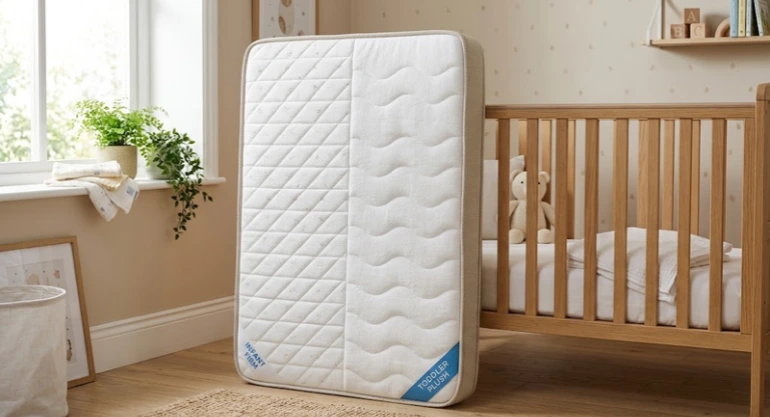
A dual-sided cot mattress has two faces: a firm infant side and a softer toddler side. It’s a clever way to get more years from one mattress, but the big question is timing. When should you flip a baby mattress? This guide explains which side your baby sleeps on, the age most manufacturers suggest for switching, how to tell whether your toddler is ready, and why you shouldn’t rush to the softer side.
Keep the firm infant side up from birth, and only flip to the softer toddler side once your child is over 12 months old, and only if your mattress is designed to be flipped. Most two-stage mattresses give around the first birthday as the guide, but the exact age differs by brand, so always follow your mattress label and instructions. A baby under 12 months, including a 6-month-old, should not sleep on a soft mattress. Safe sleep advice from the Lullaby Trust is that a baby’s mattress should be firm, flat and waterproof, and soft surfaces are known to increase the risk of SIDS.
A dual-sided (or two-stage) cot mattress is built with two different sleep surfaces:
Not every mattress works this way. Some are single-sided and are not meant to be flipped to a different surface. Check your product page, label or care card before you flip anything.
Babymore’s Premium Core cot bed mattress is described as having two-sided support, one side for infants and one for toddlers, and the page also suggests you flip and rotate the mattress for longevity. The Premium Core cot mattress is the cot-size version. You can browse the whole baby mattress range too.
For a baby, the firm infant side is the best and safest side. Here’s why:
Most dual-sided mattresses have a label or tag that shows which side is which. Check it rather than judging by feel, since a firm side can still seem soft to an adult hand. If you aren’t sure, keep the infant side up and check the manufacturer’s instructions.
The usual guide is around 12 months or later. Manufacturers are fairly consistent on this:
| Source | What it says |
|---|---|
| Naturepedic (2-stage mattress guide) | Generally flipped around 12 months, as your child enters the toddler stage |
| Simba (hybrid cot bed mattress) | Flip to the toddler side once your child is over 12 months old; toddler side suits ages 1 to 3 |
| Puffy (baby mattress guide) | Switch to the softer side around 12 to 18 months, after checking with your doctor and the manufacturer |
So, what age do you flip a baby mattress? Around the first birthday at the earliest. Because brands differ, your own mattress instructions should override any general guide. Babymore’s pages describe an infant side and a toddler side, but they don’t state a specific flip age, so please check the care card or contact our team if you’re unsure.
No. The switch is optional. A toddler can keep sleeping on the firmer infant side if they’re comfortable and sleeping well. There’s no rush to flip, and the second side is simply an option once your child is old enough.
Age is the main rule, but these signs can help you decide whether to flip once your child is past 12 months:
None of these signs is a reason to flip before 12 months. If your baby is younger than a year, keep the infant side up.
No. A 6-month-old should sleep on a firm, flat mattress. This is one of the most-searched questions, and the answer is simple:
So, when can babies sleep on a soft mattress? Not as babies. The earliest most dual-sided mattresses suggest is after the first birthday, and only on the toddler side that’s made for that age. Don’t add a soft topper, an extra pad or a second mattress to make a firm mattress “cosier”. Read more in our guide to BREATHABLE BABY MATTRESSES: FACT VS MYTH and ARE FOAM & MEMORY FOAM MATTRESSES SAFE FOR BABIES?.
Flipping once at the right age is the main purpose of a dual-sided mattress. Turning it again and again isn’t needed to make it last, and you should follow the instructions for your own mattress. For day-to-day care, see how to clean a baby mattress.
A few simple rules answer this common question:
For more on mattress types, see our guide to TYPES OF BABY MATTRESS: FOAM VS SPRUNG VS FIBRE VS LATEX and the main cot mattress guide.
Some mattresses have one firmness only. If yours isn’t designed to be flipped, don’t flip it unless the instructions say you can. If you’d like a softer feel for your toddler, check with the manufacturer first. A mattress is also a safety product, so replace one that’s sagging, damaged or soft rather than adding extra layers.
If you’re moving up from a cot to a cot bed, read our guide to moving from a cot to a toddler bed, and our cots and cot beds and cot bed mattresses are worth a look, and WHAT ARE BABY MATTRESSES MADE OF? MATERIALS, CHEMICALS & ALLERGIES explains the materials in more detail.
A dual-sided mattress is a good way to get more use from a single purchase, but timing matters. Keep the firm infant side up for your baby, wait until after 12 months before you flip to the toddler side, and always check your mattress instructions. If your child is happy on the firm side, there’s no need to change.
Explore Babymore’s baby mattresses, our pocket sprung options and the full cot mattress guide, or visit our safety assurance page for how we test our products.