You press your hand into your baby’s new cot mattress and it feels hard. Hard enough to worry you. Is that normal? Why do babies need such a firm mattress when adults prefer a soft one? And what happens if a baby sleeps on a soft mattress? The short answer is that a baby mattress should be firm, flat and springy, and yes, it should feel much firmer than your own bed. This guide explains why, how to test firmness at home in under a minute, what to do if your mattress seems too soft (or too hard), and the common worries parents raise, including flat head and comfort.
Quick Summary:
| Firm and flat (recommended) | Soft, plush or contoured (avoid) | |
|---|---|---|
| Feels like | Springs back when pressed; hand leaves little or no dip | Sinks, moulds to the body, stays dented |
| Baby’s head | Sinks only a few millimetres | Can sink in and close around the face |
| Edges and surface | Level, with no raised or cushioned edges | Raised sides, pillow tops, dips |
| Risk | Lowest when used with safe sleep habits | Higher risk of suffocation and overheating |
| Examples | Pocket sprung, sprung, fibre, coir or firm foam cot mattresses | Adult mattresses, pillow-top mattresses, toppers, beanbag-style pods and nests |
There are three main reasons:
That’s why safe sleep guidance from the Lullaby Trust recommends a firm, flat mattress in good condition for every sleep, and why items such as pillows, quilts, duvets and sheepskins are not recommended. The Lullaby Trust says quilts, pillows and duvets have been shown to increase the risk of SIDS by three times. See our summary of the Lullaby Trust’s mattress and bedding advice.
Because their job is different from an adult mattress. An adult mattress is built for comfort and pressure relief. A baby mattress is built for safety: to keep the face clear and the sleeping surface level. A baby’s body weight is tiny, so a mattress that feels rock-hard to you is already giving them a gentle, even surface. Babies don’t need a soft bed to sleep well. They often settle better when snug, swaddled correctly or in a sleeping bag, in a cool, dark room. See our newborn sleep setup guide for ideas. Our guide on the importance of a cot mattress explains more, and baby sleeping bag vs blanket covers how to dress them for sleep.
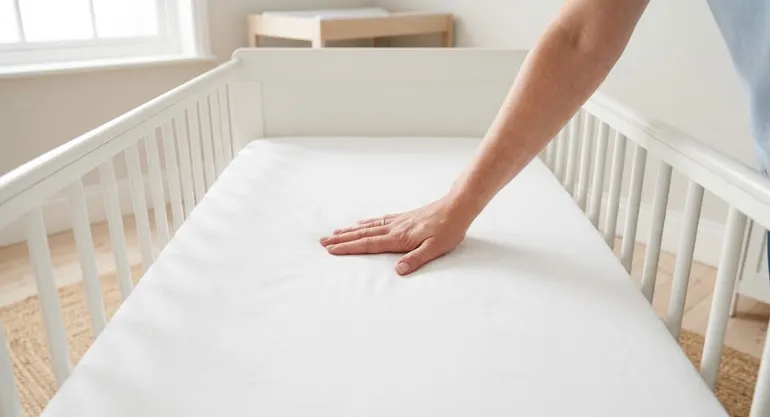
You don’t need any equipment. Try these three checks:
If you’re comparing mattresses, press the mattress itself, not just the quilted cover. A cover can feel soft because of its quilting even if the core is firm. A good sign is a mattress that feels supportive underneath the surface. Our guide to breathable baby mattresses covers airflow.
A soft mattress, or a surface made softer with padding, increases the risk that a baby’s face sinks in and their breathing is blocked. It can also make a baby hotter. The Lullaby Trust advises that sleeping surfaces should be firm, flat and free from soft items. Even a small amount of extra padding, such as a folded blanket under the sheet, can make the surface softer.
If your baby has slept on a soft surface a few times and seems fine, don’t panic. Simply switch to a firm, flat mattress and follow safe sleep guidance from now on. If you are worried about your baby, talk to your health visitor or GP.
A mattress can’t be “too hard” in the way that matters for a baby, as long as it:
If the mattress feels hard, that’s usually a good sign. What to avoid is a mattress that is also uneven, worn or rigid in a way that suggests damage. If you think your mattress has a problem, check it against the Lullaby Trust’s conditions or contact the manufacturer.
Parents sometimes worry that a firm mattress causes a flat head. According to the Lullaby Trust, flat head syndrome usually corrects itself within a year, and the recommended steps are to give your baby supervised tummy time while they’re awake, and to avoid long periods in car seats or travel systems. Babies still need to sleep on their back on a firm, flat surface, so a softer mattress is not the answer. If you’re concerned about the shape of your baby’s head, speak to your health visitor or GP.
No. Don’t add any of these:
If you want your baby to be warm and comfortable, dress them in suitable layers or a well-fitted baby sleeping bag, and keep the room at a comfortable temperature. A cot sheet pulled tight is all the mattress needs. If you use a waterproof protector, choose a thin, smooth, fitted one that adds no softness.
The advice doesn’t change much as your baby grows. The Lullaby Trust recommends a firm, flat mattress, and many manufacturers and retailers recommend a firm mattress for babies under 12 months. Toddlers moving into a bed may use a different mattress, but they still do best on a supportive surface. If you’re making the switch to a toddler bed, follow the bed manufacturer’s advice and see our guide to the suitable age of a cot bed and moving from a cot to a toddler bed.
A “medium-firm” or pillow-top adult mattress is not a safe substitute for a cot mattress for a young baby.
Material matters less than firmness, fit and condition, but all of these types can be firm and flat when well made. Our guides cover the types of baby mattress, what baby mattresses are made of and whether foam and memory foam mattresses are safe for babies:
| Type | Feel and support |
|---|---|
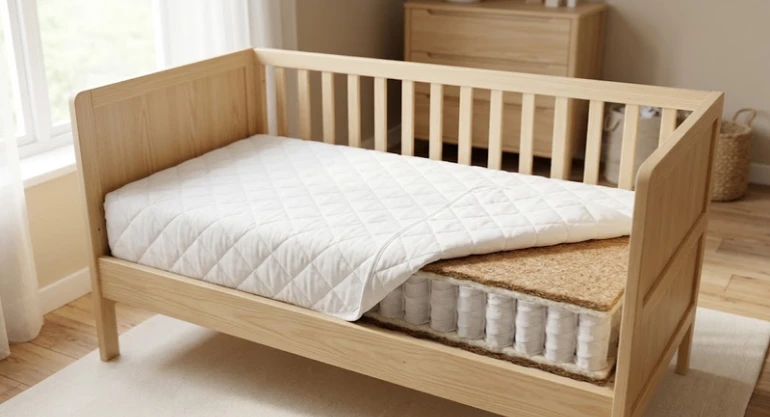
| Pocket sprung | Individually pocketed springs give even, responsive support |
| Sprung (Bonnell) | A traditional, firm feel from linked springs |
| Fibre or coir | A dense, dent-resistant fibre pad |
| Firm foam | Choose high-density, well-tested foam |
| Dual core / two-sided | One side firmer for infants, the other for toddlers |
Babymore’s Pocket Sprung, Deluxe Sprung, Eco Fibre and Premium Core mattresses are made to give firm, supportive sleep, are British made and are tested to BS EN 16890:2017. Our product pages describe them as supportive and dent resistant but don’t give a numeric firmness score, so the palm test is the best check. Browse the full baby mattress range. You can read more on our safety assurance page.
Mattresses lose firmness over time. Check regularly for:
If any of these appear, replace the mattress. Condition matters more than age. A mattress used for an older child, or stored badly, may have lost its firmness even if it looks fine. See our guide on using a second-hand or reused baby mattress for what to check. For two-sided mattresses, see when to flip a dual-sided cot mattress.
A firm mattress is the starting point, but it works best with a good fit and safe sleep habits:
Our full baby mattress safety guide pulls all of this together, and the mattress guide explains types and sizes.
Don’t be put off by a firm mattress. For a baby, hard is good: firm, flat and springy keeps the face clear and the sleep space safe. Test your mattress with the palm check, keep the cot free of soft extras, replace the mattress if it sags or stops springing back, and make sure it fits the cot without gaps.
Ready to choose? Browse Babymore’s cot mattresses and cot bed mattresses, or read our mattress guide.