Getting your baby’s sleep environment ready involves plenty of little decisions, and choosing the right bedding is one of them. Should you use a baby sleeping bag or a traditional blanket? Is one safer than the other? And how do you know if your baby is warm enough without adding too many layers?
When it comes to baby sleeping bag vs blanket safety, both options can be suitable when used correctly. However, they work differently, and understanding those differences can help you create a safer and more comfortable sleeping environment.
Baby sleeping bags are designed to stay in place as your little one moves during sleep, while blankets need to be tucked in securely and positioned correctly.
In this guide, we’ll compare the two options, explain UK safe-sleep recommendations, cover sleeping bag TOG ratings and help you decide what works best for your baby’s cot.
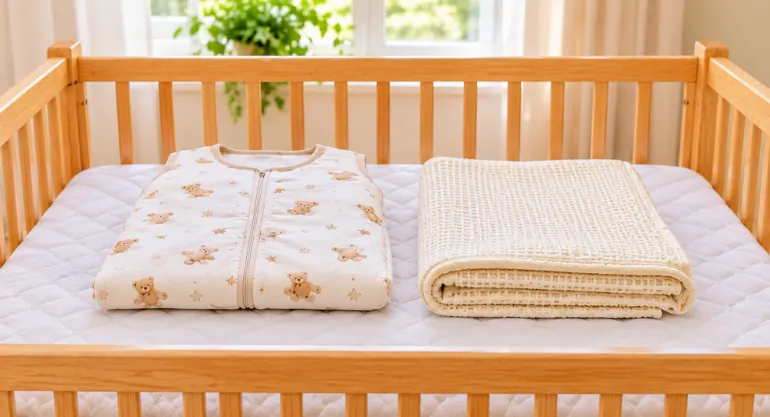
A baby sleeping bag is a wearable blanket designed to keep your baby comfortably covered during sleep. It usually has a zip or poppers, armholes and a fitted neck and shoulder area to help prevent your baby from slipping inside.
A traditional baby blanket, on the other hand, is a separate piece of bedding that is placed over your baby and tucked securely under the mattress.
Both options can be used as part of a safe sleeping arrangement, provided you follow the correct guidance.
Here’s how they compare:
| Feature | Baby sleeping bag | Baby blanket |
|---|---|---|
| Design | Wearable bedding | Separate bedding |
| Movement | Stays around the baby as they move | Can become displaced |
| Temperature control | Available in different TOG ratings | Depends on thickness and number of layers |
| Positioning | Needs to fit correctly around shoulders and neck | Must be tucked in securely |
| Ease of use | Convenient once the correct size is chosen | Requires careful positioning |
| Extra bedding | No additional bedding needed | Lightweight blanket may be used as appropriate |
The main difference is that a sleeping bag is designed to remain in place, while a blanket can move as your baby wriggles.
This is why many UK parents choose sleeping bags as an alternative to loose bedding.
A properly fitted baby sleeping bag can be a safer and more convenient option than loose blankets because it reduces the chance of your baby wriggling underneath the bedding or having it move over their face.
However, this doesn’t mean that all blankets are unsafe.
The NHS and The Lullaby Trust both recognise two suitable bedding options for babies:
If you choose a blanket, it should be tucked securely under the mattress and kept no higher than your baby’s shoulders. It should not be doubled over, as extra layers can increase the risk of overheating.
A cellular cotton blanket is a popular option because its open structure allows air to circulate.
If you choose a sleeping bag, make sure it fits properly around your baby’s neck and shoulders so they cannot slip down inside.
The important thing is to avoid loose or bulky bedding. Quilts, duvets, pillows, cot bumpers and soft toys should not be placed in a baby’s cot.
For more guidance on creating a safe sleeping environment, read Babymore’s Cot Safety Guide.
The Lullaby Trust provides evidence-based guidance to help parents reduce the risk of sudden infant death syndrome (SIDS).
Its advice recognises a well-fitted baby sleeping bag as a suitable alternative to blankets, provided parents choose the correct size and TOG rating.
Some of the key recommendations include:
The Lullaby Trust also recommends keeping your baby’s cot clear of unnecessary items and using a firm, flat mattress. See our guide to the best mattresses and bedding for babies.
You can read its full baby sleeping products and safer-sleep advice for more information.
TOG stands for Thermal Overall Grade. It is a measurement of thermal resistance, indicating how much warmth a fabric or product provides.
Baby sleeping bags are available in different TOG ratings to suit different room temperatures.
Choosing the correct rating is important because babies can become too hot if they wear too many layers or use a sleeping bag that is too warm for the room.
Here’s a simple sleeping bag TOG guide based on NHS recommendations.
| Sleeping bag TOG | Recommended room temperature |
|---|---|
| 0.5 TOG | 24–27°C |
| 1.0 TOG | 20–24°C |
| 2.5 TOG | 16–20°C |
These are general temperature guidelines. Always follow the specific manufacturer’s clothing and layering chart, as sleeping bag designs and materials can differ.
A 0.5 TOG sleeping bag is designed for warmer conditions, generally when the room temperature is between 24°C and 27°C.
It provides a lighter layer of warmth and can be useful during hot summer weather.
A 1.0 TOG sleeping bag is generally suitable for room temperatures between 20°C and 24°C.
It offers more warmth than a 0.5 TOG option without being as insulating as a winter-weight sleeping bag.
A 2.5 TOG sleeping bag is commonly recommended for room temperatures between 16°C and 20°C.
It is a popular option for cooler nights and centrally heated homes. See our tips to winter-proof your baby’s nursery.
Remember that a higher TOG rating does not automatically mean better comfort. The aim is to dress your baby appropriately for the room temperature rather than adding unnecessary layers.
Choosing the correct sleeping bag size is just as important as choosing the right TOG rating.
A sleeping bag that is too large can allow your baby to slip down inside it, while one that is too small may restrict movement or feel uncomfortable.
Most baby sleeping bags are available in different sizes based on your baby’s age, height or weight. However, weight is often the most important measurement to check because babies grow at different rates.
Here are some general size ranges you may come across:
| Sleeping bag size | Typical age range |
|---|---|
| Newborn | 0–6 months |
| Small | 6–12 months |
| Medium | 12–18 months |
| Large | 18–24 months |
These age ranges vary between brands and are not universal sizing recommendations. Always check the manufacturer’s minimum weight and measurements before choosing a sleeping bag.
Before buying, check that:
Never buy a much larger sleeping bag simply because your baby will eventually grow into it.
There isn’t one fixed age at which every baby should start using a sleeping bag.
Many manufacturers recommend waiting until a baby reaches a minimum weight, often around 4kg, but this varies between products.
The most important consideration is whether the sleeping bag fits your baby correctly.
Before using one:
If your newborn is too small for the available sleeping bag sizes, use an appropriate lightweight blanket that is firmly tucked in below shoulder level.
What about swaddling?
Swaddling is different from using a sleeping bag. If you swaddle your baby, stop as soon as they show signs of trying to roll over. Do not use weighted swaddles or weighted sleeping products.
You can also explore Babymore’s Newborn Sleep Setup Guide for more advice on preparing a suitable sleeping space from birth.
One of the biggest concerns for new parents is knowing whether their baby is warm enough during sleep.
While sleeping bags and blankets can both provide warmth, adding too many layers can cause overheating.
A comfortable room temperature is generally around 16°C to 20°C, according to UK safer-sleep guidance. Our guide to a safe nursery environment has more.
Here are a few things to keep in mind.
Feel your baby’s chest or the back of their neck to check their temperature.
If the skin feels hot, sweaty or clammy, your baby may be too warm. Remove a layer or switch to a lower TOG sleeping bag if appropriate.
It is normal for a baby’s hands and feet to feel cooler than the rest of their body.
Avoid adding extra layers based on their hands and feet alone.
Babies lose heat through their heads, so hats and hoods should not be worn indoors during sleep.
A sleeping bag should never have a hood, and blankets should not cover your baby’s head.
A sleeping bag’s TOG rating should be considered alongside the clothing your baby wears underneath it.
For example, your baby may need fewer clothing layers in a warmer room, even when using the same sleeping bag.
Always refer to the manufacturer’s clothing guide and check your baby regularly.
No. You should not add a blanket over a baby sleeping bag.
A sleeping bag is designed to provide the warmth your baby needs without additional bedding.
Adding a blanket, quilt or duvet can increase the risk of overheating and may create unnecessary loose bedding in the cot.
If your baby seems too warm, choose a lower TOG sleeping bag or reduce their clothing layers according to the room temperature.
If your baby seems cold, check the room temperature and adjust their clothing or sleeping bag appropriately rather than adding loose bedding.
If you prefer using traditional blankets, you can still create a suitable sleeping environment by following a few important precautions.
The NHS and The Lullaby Trust recommend using lightweight blankets that are firmly tucked in.
Here’s how:
Position your baby on their back with their feet touching the bottom of the cot. This helps prevent them from wriggling underneath the blanket. See our guide on how to put your baby to sleep in a cot.
A cellular cotton blanket is a popular option because it allows air to circulate.
The blanket should never come up higher than your baby’s shoulders.
Tuck the blanket firmly under the mattress along the sides and bottom so it cannot become loose.
A doubled blanket counts as two layers and can make your baby too warm.
Avoid adding pillows, duvets, cot bumpers, soft toys or other unnecessary items.
For more information about preparing your baby’s cot, read Babymore’s Cot Bed Safety Guidelines.
Both options can work, but a sleeping bag may be more convenient for parents who want to avoid repositioning blankets throughout the night.
Here’s a quick way to decide.
| Choose a sleeping bag if… | Choose a blanket if… |
|---|---|
| Your baby moves around a lot during sleep | You prefer traditional bedding |
| You want bedding that stays in place | You can tuck the blanket securely |
| You want to choose warmth using TOG ratings | You prefer adjusting lightweight layers |
| You want to avoid loose bedding | You can maintain the feet-to-foot position |
Neither option replaces the need for a safe cot, a firm and flat mattress, and correct sleeping positioning. Our guide to the importance of a cot mattress explains why.
The most important thing is to choose bedding that suits your baby’s size, room temperature and sleeping environment.
Choosing between a baby sleeping bag and a blanket doesn’t have to be complicated. Both can be suitable when used correctly, but a well-fitted sleeping bag offers the convenience of wearable bedding that stays in place as your baby moves.
If you prefer blankets, choose lightweight options, tuck them in securely and keep them below shoulder level.
Whichever option you choose, keep your baby’s cot clear, maintain a comfortable room temperature and always follow current safer-sleep guidance.
For more advice on creating a comfortable and safe nursery, explore Babymore’s sleeping tips and newborn sleep guides.