Choosing a mattress is one of the biggest safety decisions you’ll make for your baby’s sleep space. What is the safest mattress for a baby? Does a safe mattress have to be expensive? And what do the standards on the label actually mean? The short answer is that the safest baby mattress is the one that is firm, flat, well fitted, waterproof-covered, in good condition and tested to the right UK standard. Price, brand and fancy features come second. This guide explains each safety feature in plain English, how to read the standards, which materials suit a baby, and a simple checklist you can use in the shop or at home.
Quick Summary:
| Safety feature | What to look for | Why it matters |
|---|---|---|
| Firmness | Firm, springs back when pressed; a baby’s head sinks only a few millimetres | Soft surfaces can cover a baby’s face |
| Flat surface | No raised or cushioned edges, no contouring, no dips | Babies shouldn’t be able to roll into a hollow |
| Fit | Matches your cot exactly; no more than a 3 cm gap at any edge, per Babymore’s guidance | Gaps can trap a baby’s head, limbs or body |
| Cover | Waterproof or water-resistant, wipeable, removable and washable | Keeps the core clean and dry |
| Standard | Tested to BS EN 16890 for cot mattresses | A baseline check on entrapment, suffocation and choking hazards |
| Condition | No sagging, tears, stains or damp | A worn mattress is no longer firm or flat |
| Age | New for each baby where possible | See our guide on whether you need a new mattress for each baby |
There is no single “safest brand”. The safest mattress is the one that ticks every feature in the table above for your particular cot. A very firm, well-fitting mattress with a waterproof cover is safer than a thicker, softer mattress with a luxury label. The Lullaby Trust’s core rule is simple: use a firm, flat, waterproof mattress in good condition. See our summary of the Lullaby Trust’s mattress and bedding advice, and our guide on why a good cot mattress matters.
It also helps to think of the mattress as one part of a safe sleep space. The Lullaby Trust notes that pods, nests and sheepskins under a baby can be too hot or cover the face, so a plain cot with a fitted mattress is the safest set-up. Our newborn sleep setup guide and cot bed safety guidelines cover the rest of the cot.
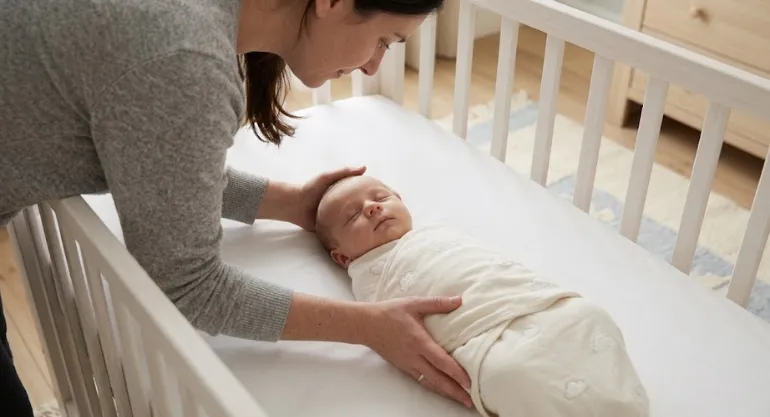
A baby’s mattress should feel much firmer than an adult’s. A baby cannot yet lift their head easily or move their face away from a soft surface, so a soft mattress is a suffocation risk. The Lullaby Trust says a baby’s head should only sink a few millimetres into the mattress. Thickness matters too, so see how thick a baby mattress should be.
A quick home check: press your palm flat into the middle and the edges, then lift it. The surface should spring back without leaving a dip. We cover this in more detail in our guide on how firm a baby mattress should be.
“Flat” matters too. Avoid mattresses with raised or cushioned edges, contoured shapes or padded toppers. Babies should sleep on a level surface. Our guide to breathable baby mattresses covers the airflow side.
Even the safest mattress becomes unsafe if it doesn’t fit. A baby can become trapped in a gap between the mattress and the cot frame. Babymore’s guidance is that there should be no more than a 3 cm gap between the mattress edge and the sides of the cot. A common rule of thumb elsewhere is “no more than two fingers”, which comes to roughly the same.
To check:
Standards can look confusing on a product page. Here is what the main ones mean, based on Lullaby Trust and manufacturer information:
| Standard | What it covers |
|---|---|
| BS EN 16890 | Mattresses for cots and cribs: safety requirements and test methods, including hazards such as entrapment, suffocation and choking |
| BS 1877 Part 10 | Safety and performance of cot mattresses |
| BS 7177 | Fire resistance of mattresses; “low hazard” is the level for cots |
| BS EN 716 | Cots and travel cots as furniture |
| BS EN 1466 / BS EN 1130 | Moses baskets and carry cots / bedside cribs |
The Lullaby Trust makes a useful point: no safety standard covers SIDS, so meeting a standard does not guarantee a product reduces SIDS risk. Treat a standard as a minimum check, not a promise, and combine it with safe sleep habits. Standards are also updated from time to time, so look for the current version on the product label.
Babymore states that its mattresses are tested to BS EN 16890:2017, BS1877 Part 10 and BS7177 (Low Hazard). You can read more on our safety assurance page.
Firmness and fit matter more than the material, but each type has different features. Our guides to the types of baby mattress and what baby mattresses are made of go into more detail:
| Type | How it works | Good to know |
|---|---|---|
| Pocket sprung | Individual springs in fabric pockets move independently | Supportive and breathable; usually a mid-to-higher price |
| Sprung (Bonnell) | Linked springs wrapped in fibre | Firm and traditional |
| Fibre (e.g. coir or eco fibre) | A dent-resistant fibre pad | Breathable and easy to recycle at the end of its life |
| Foam | A foam core with a wipeable cover | Usually the cheapest; choose a firm, high-density, well-tested one |
| Natural (coir, wool, latex) | Natural fillings | Fine if firm and flat, and certified to the standard |
Babymore’s range includes Premium Core, Pocket Sprung, Deluxe Sprung and Eco Fibre mattresses in cot and cot bed sizes. Babymore describes them as British made, foam-free and chemical-free, with a removable BabyTec cover that is water-resistant, hypoallergenic and washable at 60°C. Browse the full baby mattress range or the pocket sprung cot mattress guide to see what’s inside one.
A waterproof or water-resistant cover protects the core from spills, sick and nappy leaks. The Lullaby Trust recommends a cover that is clean and wipeable. A few tips:
Not necessarily. A higher price often buys extra comfort features, a more complex core or natural materials. A lower-priced mattress that is firm, flat, well fitted, waterproof-covered, tested to BS EN 16890 and in good condition can be just as safe as a premium one. If you’re on a budget, buy a new, basic, well-fitting mattress instead of a second-hand premium one. Our guide on reusing a baby mattress explains why.
There is no fixed expiry date. Condition matters more than age. Replace the mattress if you notice:
Rotate the mattress regularly, if the manufacturer says to, to keep wear even. A two-sided mattress with an infant and a toddler side should be turned and used as the instructions say. Our guide on when to flip a dual-sided cot mattress explains how.
A safe mattress works best with safe sleep habits. The Lullaby Trust advises:
Our safe use of a cot bed guide and newborn sleep tips for tired parents have practical ideas.
For the rest of the room, our nursery furniture checklist helps you tick everything off.
The safest baby mattress isn’t the most expensive or the most heavily marketed. It’s the one that is firm, flat, fits your cot properly, has a waterproof cover, is tested to the right standard and is in good condition. Check the fit when you set it up, check the condition every now and then, and combine it with safe sleep habits.
Ready to choose? Browse Babymore’s cot mattresses, cot bed mattresses or the full baby mattress range, or read our mattress guide.