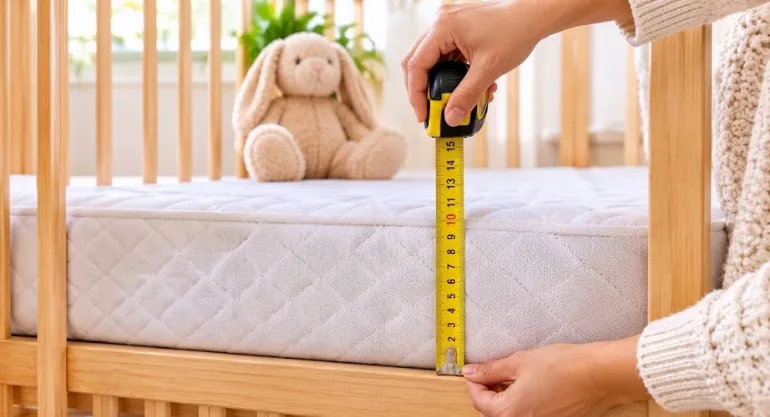
Choosing a mattress for your baby’s cot might seem straightforward, but there is more to consider than simply finding one that looks comfortable.
Mattress thickness, firmness, dimensions and fit all play an important role in creating a safe sleeping environment. Even a mattress that looks like the right size may not be suitable if it is too thick for the cot or leaves gaps around the edges.
So, how thick should a baby mattress be? Is a 10cm mattress suitable for every cot? And what should you do if your cot has unusual dimensions and needs a made-to-measure mattress?
In this guide by Babymore, we’ll explain everything you need to know about baby mattress depth, sizing and fit, helping you choose an option that works with your baby’s cot.
A baby mattress should generally be around 10cm thick, but the correct thickness depends on the cot’s design and the manufacturer’s recommendations.
Babymore’s standard cot and cot bed mattress ranges are 10cm deep. This provides a firm, supportive sleeping surface while remaining within the specified depth for compatible cot and cot bed frames.
However, 10cm should not be treated as a universal rule for every cot. Always check the cot’s instruction manual to confirm the maximum permitted mattress thickness.
This is particularly important because the mattress depth affects how much space remains between the top of the mattress and the upper edge of the cot sides. Our guide on adjusting the mattress base position in a cot bed explains how base height changes this.
A mattress that is too thick can reduce the effective height of the cot sides, potentially making it easier for an older baby or toddler to climb out.
When choosing a mattress, consider:
If you’re looking for a mattress with a suitable depth for a standard cot, explore Babymore’s cot mattress collection.
Yes. Mattress thickness matters because it affects how the mattress sits inside the cot and how much usable height remains around the sleeping area.
However, a thicker mattress is not necessarily better for a baby.
Unlike adult mattresses, baby mattresses should not be selected based on how plush or cushioned they feel. A firm, flat and properly fitted surface is much more important. See our guide to the best mattresses and bedding for babies.
Here are three reasons why mattress depth deserves attention.
Cot sides are designed to help prevent babies from climbing or falling out as they become more mobile.
The distance between the mattress surface and the top of the cot sides is therefore important. If the mattress is too thick, this distance becomes smaller.
For example, a cot designed for a mattress no thicker than 10cm should not be fitted with a 12cm mattress simply because it appears more comfortable.
Always follow the maximum mattress depth specified in the cot’s instructions.
The mattress needs to provide a firm, even sleeping surface.
Its thickness alone does not determine how supportive it is. The internal construction, quality of materials and overall design all contribute to its performance. Our guide to what baby mattresses are made of has more.
A well-designed 10cm mattress can provide suitable support without needing additional padding or layers. Our guide to the importance of a cot mattress explains why.
Mattress thickness is only one part of the equation. The length and width must also match the cot frame.
A mattress that is too small may leave gaps around the edges, while one that is too large may bend or become compressed when placed inside the cot.
Both situations can affect the safety of the sleeping environment.
For more guidance, read Babymore’s Cot Mattress Guide.
The best mattress thickness is the one specified by the cot manufacturer, provided the mattress also meets the relevant safety requirements.
For many standard UK cot and cot bed models, a depth of around 10cm is common.
However, cot designs can vary, so it is important to check the manufacturer’s instructions rather than assuming every mattress will fit every frame.
Babymore offers 10cm mattresses in its standard cot and cot bed ranges, with different internal constructions to suit different preferences.
These include:
Each option is designed around a firm sleeping surface, with construction and materials varying between models. See our guide to the types of baby mattress for more.
You can compare the available options in Babymore’s baby mattress collection.
The correct depth for a crib mattress depends on the crib’s design and the manufacturer’s specifications.
Cribs and smaller bedside sleeping products can have different dimensions and mattress requirements from standard cots and cot beds.
This means you should never assume that a standard 10cm cot mattress will fit a crib. Our guide to Moses basket vs crib explains the differences.
Before purchasing a replacement, check:
If you have a Babymore crib, check its product information or instruction manual for the recommended replacement mattress.
The same principle applies when buying mattresses for mini cots, travel cots and other compact sleeping products. Each product may require a different size and depth.
Getting the right fit is just as important as choosing the correct thickness.
A mattress should sit flat inside the cot frame, with no noticeable gaps between its edges and the sides of the cot.
For a properly fitted mattress, the gap should not exceed 3cm, in line with the guidance commonly used for cot mattress fit.
Here are a few things to check.
Always measure the inside of the cot rather than the outside dimensions of the furniture.
You need to know:
For example, common UK mattress sizes include:
| Mattress type | Typical dimensions |
|---|---|
| Standard cot mattress | 120 x 60cm |
| Standard cot bed mattress | 140 x 70cm |
| Smaller crib mattress | Varies by model |
| Mini cot mattress | Varies by model |
These are common sizes, not universal measurements. Always check the dimensions of your specific cot. For a full breakdown, read our cot mattress size guide.
Once the mattress is inside the cot, check that it sits neatly against the frame.
There should not be large gaps where a baby’s arms, legs or head could become trapped.
The mattress should not curl upwards at the corners, bend along the sides or sit unevenly.
If you have to force it into position, it is probably not the correct size.
Babymore’s Cot Safety Guide also explains why mattress fit and other cot safety checks matter.
Not every cot follows standard UK mattress dimensions.
Some older cots, imported models, antique-style furniture and specialist crib designs may have unusual internal measurements.
This is where a made-to-measure cot mattress may be worth considering.
A made-to-measure mattress is manufactured to match the dimensions required by a particular cot rather than relying on a standard size.
Before looking for one, there are a few important things to establish.
Measure the internal length and width of the cot at several points, as some frames may not be perfectly uniform.
Also check the maximum mattress thickness permitted by the manufacturer.
If the cot is old, second-hand or has no available instructions, consider whether it still meets current safety requirements.
A custom-sized mattress does not automatically make an unsuitable or unsafe cot safe to use.
A made-to-measure mattress should still provide a firm, flat sleeping surface and comply with the relevant requirements for children’s mattresses.
In the UK, look for mattresses tested to BS EN 16890.
Never use rolled towels, extra padding, foam inserts or other materials to fill gaps around a mattress.
The correct solution is a properly sized mattress that fits the cot as intended.
If your cot has non-standard dimensions, contact the manufacturer to check whether a suitable replacement mattress is available before purchasing an alternative.
Not necessarily.
It is easy to assume that a thicker mattress must be more comfortable, but this is not how baby mattresses should be chosen.
For babies, the priority is a firm and flat sleeping surface that provides consistent support.
A mattress with a soft, deeply cushioned surface may not be appropriate for an infant, even if it feels comfortable to an adult. See our guides to breathable baby mattresses and whether foam and memory foam mattresses are safe for babies.
Instead of focusing on thickness alone, consider the following:
For example, Babymore’s mattress range includes fibre and sprung options, allowing parents to compare different constructions while choosing a mattress designed for the appropriate cot size.
Although the terms are sometimes used interchangeably, cot mattresses and cot bed mattresses are designed for different frame dimensions. For the frames themselves, see the difference between a cot and a cot bed.
A standard cot mattress is typically 120 x 60cm, while a standard cot bed mattress is generally 140 x 70cm.
The difference matters because a mattress should be designed to fit the specific sleeping space rather than simply being close to the required dimensions.
These are designed for standard cot frames and are commonly used from birth until a child is ready to move into a larger bed or transition to a suitable toddler bed.
Babymore’s cot mattress collection includes fibre and sprung options in the 120 x 60cm size, as well as other sizes for selected models.
Cot bed mattresses are designed for the larger 140 x 70cm frame.
They are particularly useful for parents choosing a convertible cot bed, as the same mattress can generally remain in place when the cot converts into a toddler bed, provided it is still in good condition and the product is designed for continued use.
Explore Babymore’s cot bed mattress collection to compare the available options.
If you’re still deciding between a cot and cot bed, Babymore’s guide to choosing the right cot bed can help you understand the differences.
There is no fixed replacement schedule that applies to every baby mattress. Its condition, hygiene and continued suitability are more important than its age alone.
However, it is generally recommended to use a new mattress for each baby rather than automatically reusing one from an older sibling.
Over time, mattresses can develop:
Check your baby’s mattress regularly and replace it if it becomes damaged, loses its shape or no longer provides a firm, flat sleeping surface.
If you are buying a new mattress, consider practical features such as a removable, washable cover. Babymore mattresses feature removable BabyTec covers that can be washed at 60°C, making everyday cleaning easier. See our guide on how to clean a baby mattress.
Before ordering a baby mattress, run through these checks:
Taking a little time to check these details can make choosing the right mattress much easier. Our cot bed buying checklist covers the frame too.
Choosing the right baby mattress is not simply about finding one with the right thickness. Its firmness, dimensions, construction and compatibility with the cot all matter.
While a 10cm mattress is a common choice for standard UK cots and cot beds, always check the manufacturer’s instructions before making a purchase.
Whether you need a standard cot mattress, a larger cot bed mattress or an option for a less common cot size, taking the time to check the measurements and safety requirements will help you create a suitable sleeping space for your baby.
Explore Babymore’s full range of baby mattresses to find an option designed for your cot or cot bed.