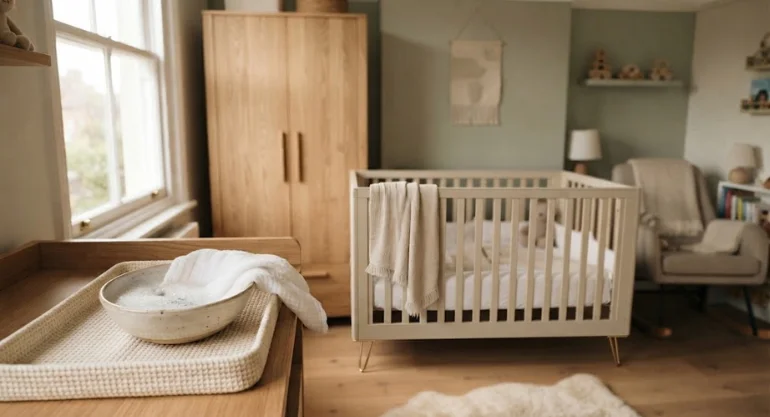
Search “how to clean wooden nursery furniture” and you’ll find some genuinely conflicting advice. One guide swears by vinegar and water spray. Another warns that the same solution will dull and damage a hardwood finish over time. When it’s a cot bed, wardrobe, or chest changer that’s meant to last through several years and possibly more than one child, getting this wrong isn’t a minor inconvenience, it can permanently mark a finish that was never designed to be scrubbed with the wrong product.
At Babymore, our own furniture care guidance is intentionally simple for exactly this reason: a damp cloth and mild soap is the safest default across our entire nursery furniture range, whether it’s a cot bed, a wardrobe, or a chest changer, and this guide explains why, along with what else genuinely helps (and genuinely harms) a wooden finish over time.
The safest way to clean wooden nursery furniture is with a soft, slightly damp cloth and a small amount of mild soap or detergent, wiped along the direction of the wood grain and dried immediately afterwards with a clean, lint-free cloth. Avoid ammonia-based cleaners, bleach, and abrasive scrubbers entirely, since these strip or dull a wooden finish. Vinegar solutions, popular in a lot of general cleaning advice, are genuinely more contentious for wood specifically. Always patch-test any solution, including a diluted vinegar mix, on a hidden area first, and avoid it altogether on oiled, waxed, or unsealed wood finishes, where the acidity can dull the surface over repeated use.
Nursery furniture finishes are usually more delicate than the finishes on adult furniture, partly because manufacturers use low-VOC, baby-safe coatings rather than heavier industrial lacquers, which is a genuinely good thing for air quality in the room but means the surface itself can be more sensitive to harsh products. Whether your furniture has a painted finish, an oak veneer like our Luno and Veni collections, a whitewash or greywash woodgrain treatment such as our Caro collection, or a natural oiled surface, the common thread is the same: the finish is a protective layer sitting on top of the wood, and the wrong cleaner can strip, dull, or discolour that layer well before the wood underneath is actually at risk.
For the vast majority of everyday cleaning, wooden nursery furniture responds best to the simplest approach: a soft cloth, lightly dampened with warm water and a small amount of mild soap or gentle detergent. Wipe along the grain rather than in circles, since this reduces the chance of visible streaking on a matte or satin finish. Follow up immediately with a dry, clean, lint-free cloth to remove any residual moisture, since letting water sit on a wooden surface, even briefly, is one of the more common causes of dulling or minor warping over time.
This is deliberately the same guidance Babymore gives across its own furniture range, precisely because it’s the version least likely to interact badly with any specific finish.
A diluted white vinegar solution, typically one part vinegar to four or five parts water, shows up constantly in general household cleaning advice, and it genuinely works well as a mild disinfectant on many hard surfaces. For wooden furniture specifically, though, the advice is more mixed than most single articles let on. Some nursery furniture guides recommend it as a natural, baby-safe alternative to chemical cleaners.
Others warn explicitly that vinegar’s acidity can dull, discolour, or gradually strip certain wood finishes, particularly oiled or waxed surfaces, with repeated use.
The honest, practical answer sits in the middle: on a sealed, lacquered, or painted finish, an occasional, well-diluted vinegar wipe-down is unlikely to cause visible harm, provided you dry the surface immediately afterwards. On an oiled, waxed, or otherwise unsealed wood surface, it’s safer to avoid vinegar altogether and stick with the mild soap and water method instead.
If you’re not certain which type of finish your furniture has, always test any solution, including a diluted vinegar mix, on a small, hidden area first, such as the back panel or underside, and check after a few minutes for any change in colour or sheen before using it more widely.
A few products are close to universally agreed upon as unsafe for wooden nursery furniture, regardless of finish type:
Most of what keeps wooden nursery furniture looking new isn’t deep cleaning at all, it’s regular, light dusting. A soft cloth or microfibre duster used two or three times a week prevents the kind of dust buildup that can scratch a finish when it’s eventually wiped away with more pressure than intended. This matters doubly in a nursery, since accumulated dust can also aggravate a baby’s developing respiratory system, so keeping surfaces genuinely dust-free is worth doing for reasons well beyond the furniture’s appearance.
For anything beyond routine dust and light marks, spot-clean rather than wiping the whole surface. Dampen a cloth with your mild soap solution, apply it only to the affected area, and dry immediately. For a stubborn, dried-on mark, a small amount of baking soda mixed into a thick paste with water can lift residue that soap alone won’t shift, but apply it gently with a soft cloth rather than scrubbing, and, as with any solution, test it on a hidden area first. Avoid letting any cleaning product sit on the surface for an extended period, since prolonged contact is generally what causes visible damage, not a single, well-executed wipe-down.
A few habits do more for a finish’s longevity than any specific cleaning product:
Cot beds benefit from slightly more frequent attention around the rails and corners, where hands and mouths make the most contact; a quick wipe with your mild soap solution after visible marks appear is usually enough, alongside your general dusting routine, see our cot maintenance tips for more.
Chest changers and their changing tops see the most day-to-day wear, so a protective cloth or liner under the changing mat itself helps minimise direct contact between spills and the wood surface underneath; our guide on the benefits of a chest changer covers more on getting the most out of this piece day-to-day, and our chest changer maintenance tips go into further detail.
If space is tight and you’re using a cot top changer instead, the same mild soap and cloth method applies (see our cot top changer safety guide), and it’s worth checking it’s fully dry before refitting it onto the cot rails. Wardrobes, seeing far less direct handling, generally only need the same light dusting and occasional wipe-down as the rest of the room, our guide to choosing a baby wardrobe has more on caring for this piece.
Across all of these, it’s worth periodically checking screws, hinges, and drawer runners for looseness while you’re cleaning, since a quick tightening with an Allen key or screwdriver (see our assembly tips and common errors guide) at the same time keeps the piece both looking good and functioning safely, in line with the fittings checks recommended under our UK nursery furniture safety standards.
Wooden nursery furniture is built to last years, not months, and the cleaning routine you settle into early on genuinely determines how it looks by the time your child has outgrown it. Sticking to the simplest, gentlest method, a damp cloth and mild soap, dried immediately, covers the vast majority of everyday cleaning safely across almost any finish, while the more specific advice around vinegar, polish, and long-term care is worth following once you know which type of finish you’re actually working with. Our nursery furniture checklist is a handy reference to keep this routine on track.
For a broader look at nursery furniture care beyond just the wood finish, our guide on how to clean nursery furniture covers fabric and hardware alongside wood. And if you’re still putting your nursery together, our essential nursery furniture set guide is a useful next read to make sure you’ve got the right pieces in place before worrying about how to keep them looking their best.