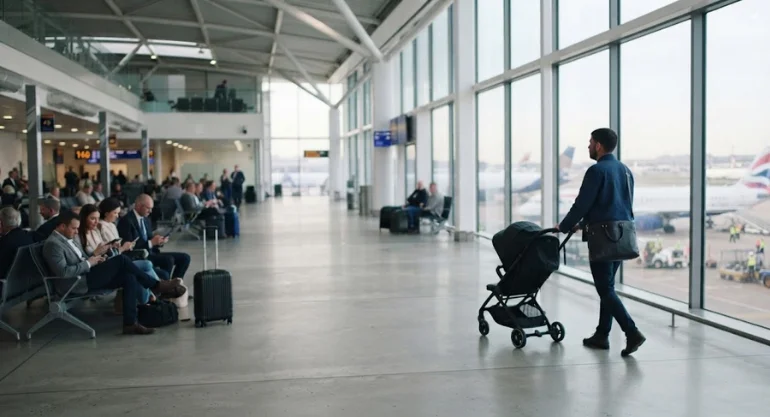
Yes, you can take a pushchair on holiday from the UK, and most airlines carry a collapsible one free of charge. Typically you keep it with you through the airport, hand it over at the aircraft door (gate checking) and collect it at the other end. Rules on size, weight and cabin storage differ by airline, so check yours before you travel. A lightweight pushchair that folds small and one-handed makes the whole journey easier, and a padded travel bag protects it in the hold.
Half-term is when plenty of families take their first trip with a pushchair. The airport itself is rarely the hard part. What catches people out is the stuff in between: which pushchair to bring, what happens when it goes into the hold, whether it will cope with the pavements at the other end, and how to get through security with a baby in one arm and a bag in the other. This guide covers all of it.
In most cases, yes. UK and European airlines generally let you bring a collapsible pushchair for each child at no extra charge, usually as part of a free infant equipment allowance. As an example of how that looks in practice, Jet2 allows up to two items per child or infant free of charge, including a collapsible pushchair, pram or buggy, a car seat or booster seat, a baby carrier and a travel cot. Each item must weigh no more than 32kg, and you can keep the pushchair with you right up to the plane steps or air bridge.
Other airlines work differently. Some will take a small, fully folding pushchair in the cabin if it fits the overhead locker, while others insist on it going in the hold. Our guide on whether you can take a pushchair on a plane goes through the airline-by-airline picture, and it’s worth checking your own airline’s baby and child page before you fly, because policies are updated and a quick check beats finding out at the desk.
These are the two ways a pushchair usually gets to the hold.
Gate checking means you push your baby all the way through the terminal, then fold the pushchair at the aircraft door or air bridge, where staff take it down to the hold. You get it back at the baggage reclaim, or sometimes at the aircraft door on arrival, depending on the airport. For most families it’s the better option, since you have somewhere to put your baby (and your bags) through security, passport control and the long walk to the gate.
Desk checking means handing the pushchair over at the bag drop with your suitcases. That’s simpler if you’re travelling light, but you’ll be carrying your baby through the whole airport, which gets tiring quickly with a toddler or a heavy infant.
If you’d like to gate check, tell the check-in staff when you drop your bags and ask for the gate tag, and check that your pushchair has your name and contact details on it.
Not every pushchair makes a good travel pushchair. A big all-terrain model is brilliant for muddy walks and awkward in a departure lounge. The features that matter most for travelling are:
Babymore’s Yara Compact Stroller was designed with this kind of trip in mind. It weighs 8.3kg, folds to 55 x 44 x 25cm without the bumper bar, and is described as having an IATA-compliant cabin-size design when folded without that bar. It has front and rear wheel suspension, puncture-proof EVA wheels, a near lie-flat recline, a UV-protective hood, and is suitable from birth up to 22kg. The bumper bar doubles as a carry handle. Two cautions: “cabin-size” means it fits the standard size guideline, but each airline makes its own decision about what it accepts in the cabin, and it may still be gate checked. Treat the cabin option as a possible bonus rather than a promise.
If you’re not sure which type of pushchair suits your family, our guide to the difference between prams, pushchairs, strollers and travel systems is a good place to start, and the full prams and pushchairs range shows the other options.
It depends on how long you’re away and what you plan to do. For a short break, a lightweight stroller is almost always easier than a full travel system. A travel system is handy if you’ll be doing a lot of car journeys or hiring a car, because the car seat clicks straight onto the chassis. But it’s heavier, bulkier, and has more parts to keep track of at the airport.
A common middle route is to take the lightweight stroller for the flight and the destination, and decide separately on the car seat. If you do need a seat abroad, our piece on taking your car seat abroad from the UK weighs up bringing your own against hiring, and the guide on taking a car seat on a plane covers the onboard rules. If a travel system is the right choice for you, Babymore’s baby travel systems pair pushchairs with car seats.
A few practical points make the airport easier:
Check where you’re going, because it affects what you pack. Cobbled old towns, steep hills, sandy paths and uneven pavements can be hard going with small wheels. A pushchair with suspension and sturdy tyres copes better, and a baby carrier is a useful backup for beaches or hikes. Smooth resort paths and shopping streets are no problem for most compact strollers.
It also helps to think about heat and sun. A big hood and a rain cover keep off both, and a UV-protective canopy helps in sunnier destinations. For a half-term trip to a cooler place, a footmuff and rain cover may matter more. Our guides on pram and pushchair accessories and keeping your pushchair in good condition are helpful for planning what to take and checking it over before you fly.
Once you’re back, check the frame, wheels and brakes for damage that you may not have noticed at the airport, and give it a clean, particularly if it’s been on a beach or in the hold. Folding hinges can pick up sand and grit, which makes them stiff. Our guide on how to clean a pushchair covers the steps, and if you’re short on space at home, how to store a stroller compactly has ideas.
Taking a pushchair on holiday is straightforward once you know how gate checking works and pick a model that’s light, small when folded and sturdy enough for where you’re going. Check your airline’s rules before you leave, protect the pushchair for the journey, and keep a baby carrier handy for security and rough ground.
Planning a trip? Browse Babymore’s prams and pushchairs, including the Yara Compact Stroller, or take a look at our baby travel systems if you want a pushchair and car seat combination.