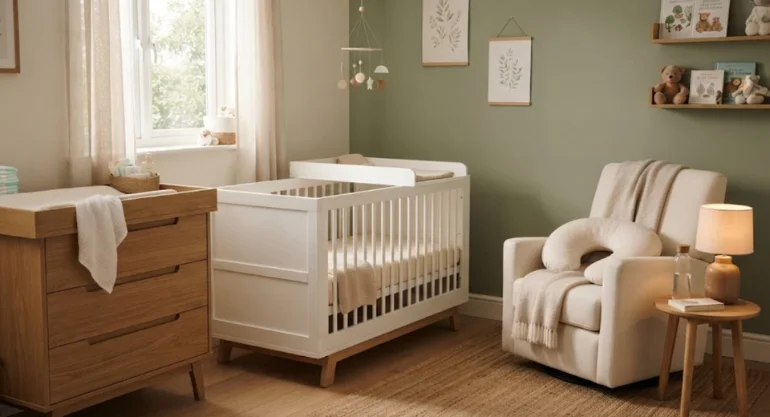
If you’ve spent any time in new-parent forums or scrolling through nursery inspiration on Pinterest, you’ve probably noticed almost every “dream nursery” has one thing in common: heavy, light-blocking window coverings. It’s easy to assume that’s just aesthetic, soft, cozy, coordinated with the crib bedding, but blackout blinds for a nursery are actually one of the more evidence-backed recommendations in baby sleep, not just a design trend.
Here’s what’s actually true, what’s marketing, and how to think about building a sleep environment that works for your baby, your budget, and your home. Before taking a deeper dive into this topic, you might want to pause a bit and end your endless search for your baby’s nursery furniture with Babymore. We offer a diverse collection of cot beds, nursery furniture and all products catering to your newborn baby’s needs.
To understand why blackout blinds get recommended so consistently, it helps to understand what light does to sleep biology in the first place.
Humans, babies included, regulate sleep through a system tied to light exposure called the circadian rhythm. Specialized cells in the eye detect light and send signals to the brain that suppress melatonin, the hormone that makes you feel drowsy. This isn’t just about it being “bright out.” Even relatively dim light can suppress melatonin production more than many people expect, especially in infants, whose circadian systems are still developing over the first several months of life.
Newborns are actually born with no established circadian rhythm at all. It typically starts to develop around 6 to 8 weeks and becomes more consistent by 3 to 4 months, which is part of why sleep researchers and pediatric sleep consultants pay close attention to light exposure during this window. It’s one of the most controllable external cues parents have to help that rhythm develop in a healthy direction.
The honest answer: blackout blinds aren’t medically required, but they solve a real, well-documented problem, and most sleep consultants and pediatric sleep specialists recommend them, particularly for naps.
Here’s the practical issue blackout blinds address. Daylight, especially in spring and summer in most of the US, means a baby’s 7 AM wake-up window and 6 PM bedtime often fall during full daylight. Without blackout coverage, a nursery can be nearly as bright at nap time or bedtime as it is at noon. Since light is one of the primary signals telling the brain “stay awake,” this can make it significantly harder for a baby to fall asleep and, more importantly, to stay asleep through natural early-morning light around 5 or 6 AM, a very common early-waking complaint parents bring to pediatricians and sleep consultants alike.
This is where blackout blinds do their real work: not by making a baby sleep who otherwise wouldn’t, but by removing a signal that actively works against sleep, especially during the lighter parts of the day and in the early morning hours when a baby’s sleep is already lighter and more easily disrupted.
We at Babymore are here to help you make the right decision for your baby’s nursery furniture. We have a complete guide that would help you decide the essential pieces of furniture you need for your baby’s nursery.
Blackout blinds are one piece of a broader sleep environment, and the research and pediatric sleep guidance points to a consistent set of factors that matter most. You might want to have a look at this detailed blog on how to create a safe nursery environment for your baby crafted by Babymore.
Darkness. As covered above, this is one of the highest-impact, most consistently recommended changes for both naps and night sleep.
Temperature. The American Academy of Pediatrics and most pediatric sleep specialists recommend a room temperature between about 68 to 72°F for infant sleep. Rooms that run warmer are associated with more disrupted sleep and, in some research, have been discussed in relation to SIDS risk factors, which is part of why overheating (through heavy blankets, over-bundling, or a too-warm room) is something pediatricians consistently caution against.
Noise. Complete silence isn’t actually the goal. Many babies sleep better with consistent, low-level background noise (white noise) that masks sudden household sounds like doors, siblings, or street noise, rather than an environment that’s totally silent but easily disrupted by one loud sound.
Consistency and routine cues. A sleep environment that stays the same night after night, same room, same light level, same sound, helps reinforce the association between that environment and sleep, which is a core principle behind most sleep-training and sleep-routine approaches.
Safety of the sleep space itself. A firm mattress, fitted sheet, and empty crib (per AAP safe sleep guidelines) matter more for safety outcomes than any lighting or curtain choice, and should be treated as the non-negotiable foundation before optimizing anything else.
Blackout blinds sit within the “darkness” category, but it’s worth understanding this as one lever among several, not a silver bullet on its own.
Both accomplish the same core goal, blocking outside light, but they work differently, and the right choice often depends on your specific windows and room.
Typically easier to install without tools (many use tension rods or simple brackets). Can leave light gaps at the edges and top of the window unless paired with a wraparound rod or side track. Often more budget-friendly and easier to swap out as nursery decor changes. Better for large or oddly shaped windows where a fitted blind isn’t practical.
Fit closer to the window frame, which generally blocks more light overall with fewer gaps. Cordless and cordless-adjacent designs are strongly preferred for nursery safety (more on this below). Tend to have a cleaner, more built-in look. Slightly more effort to install, and roman-style fabric blinds can cost more than basic curtains.
Many parents actually use both together, a blackout blind mounted inside the window frame, with blackout curtains layered in front to block any remaining light leaking around the edges. This “double layer” approach is one of the most frequently recommended setups among sleep consultants specifically because gaps around window frames are the most common complaint with either option used alone.
This deserves its own section because it’s a genuine safety issue, not just a preference. Corded blinds present a documented strangulation risk for infants and young children, and this isn’t a minor or outdated concern. It’s still one of the most common nursery hazards flagged by pediatric safety organizations and the Consumer Product Safety Commission.
If you’re choosing blinds for a nursery: Choose cordless blinds, or blinds with continuous-loop cords that are permanently anchored to the wall or floor, never a dangling pull cord. If you already have corded blinds installed, retrofit them with a cord cleat or tension device mounted high on the wall, well out of reach. Position the crib away from any window treatment entirely, regardless of cord type, since curtains and long fabric can also present a hazard if a crib is positioned close enough for a child to reach them as they grow.
This is one area of nursery setup where “good enough” isn’t really acceptable. Cordless or properly anchored options should be treated as the baseline requirement, not an upgrade.
Blackout blinds handle keeping outside light out, but nursery lighting for the times you do need some visibility (diaper changes, feeding, checking on your baby) matters just as much for supporting good sleep.
Use a dim, warm-toned light rather than a bright overhead light. A small nightlight or a plug-in light with a warm amber or red-toned bulb is far less likely to fully wake a baby (or reset melatonin production) compared to a bright white or blue-toned light.
Full blackout is generally the goal, but a small amount of very dim light for parent visibility (checking on the baby without opening the door) is fine and doesn’t meaningfully interfere with sleep quality.
Gradually dimming lights in the 20 to 30 minutes before bedtime helps cue the brain that sleep is coming, mirroring the natural dusk-to-dark transition that circadian rhythms are built around.
Avoid screens and bright blue-toned light in the room during wind-down, since blue-spectrum light is particularly effective at suppressing melatonin, more so than warmer, amber-toned light at a similar brightness level. Babymore has a well-curated blog on baby sleep schedule by age that you might not want to miss out on.
A dark room is a strong foundation, but it works best combined with a few other consistently recommended habits:
Babies who stay awake too long between sleep periods often become overtired, which paradoxically makes it harder to fall and stay asleep, not easier. Age-appropriate wake windows change frequently in the first year, so it’s worth checking current guidance for your baby’s specific age.
Even 10 to 15 minutes of the same steps (dim lights, a book, a certain song) before every nap and bedtime helps reinforce the sleep cue, similar to how the AAP recommends a consistent bedtime routine specifically for improving sleep onset and duration.
As mentioned above, overheating disrupts sleep and carries safety considerations, so err toward the cooler end of the comfortable range rather than the warmer end.
A sound machine that runs the same way every nap and every night becomes part of the sleep association, which loses effectiveness if it’s only used sometimes.
Even with an ideal environment, most babies don’t develop fully consolidated night sleep until several months in, and every baby’s timeline varies. A great sleep environment supports sleep, but it doesn’t override normal developmental variation.
It’s worth saying clearly: blackout blinds and a well-set-up nursery are genuinely helpful, evidence-supported tools, but they’re not a guarantee of a baby who “sleeps through the night” on a specific timeline. Sleep environment is one input among several, alongside age, temperament, feeding needs, developmental leaps, and plain individual variation.
What blackout blinds and a thoughtfully lit nursery do reliably deliver is removing common obstacles: early-morning light waking a baby up too soon, bright daylight making naps harder to achieve, disruptive light during a 2 AM feed making it harder to settle back down. Addressing those specific, well-understood friction points is exactly why this recommendation shows up so consistently across pediatric sleep guidance, not because it’s a trend, but because it solves a real, physiologically grounded problem.
Read more about 5 best sleep training methods for babies.
Babies don’t strictly need blackout blinds to sleep, but the research on circadian rhythm development and light’s effect on melatonin makes a strong, practical case for using them, especially for naps and in the lighter months of the year. Whether you choose curtains, blinds, or a layered combination of both, the two things that matter most are effectiveness (how much light is actually blocked) and safety (cordless, anchored, and positioned away from the crib). Paired with a cool room, consistent white noise, and a simple wind-down routine, a well-darkened nursery gives your baby’s developing sleep rhythm one less obstacle to work against.
There’s no strict age requirement, but many parents introduce them from birth for nap consistency, and most sleep consultants recommend having them in place well before the 4-month mark, when circadian rhythms begin consolidating more noticeably and light sensitivity becomes more relevant to sleep quality.
They often help, particularly with early-morning waking caused by sunrise light, but they’re not guaranteed to shift a baby’s internal wake time entirely on their own. Combined with consistent wake windows and bedtime routines, they tend to have the most noticeable effect.
Curtains alone can work well if they’re wide enough to fully cover the window with minimal edge gaps. If your curtains consistently leave light leaking in around the frame, adding an inside-mounted blind underneath is the most effective fix.
No, daytime naps in a dark room are widely recommended and don’t interfere with nighttime sleep or circadian development. In fact, consistent darkness for both naps and night sleep tends to support more consistent sleep overall.
Cordless blinds are the safest option. If you have existing corded blinds, add a permanently anchored cord cleat or tension device well out of a child’s reach, and always keep the crib positioned away from any window treatment.