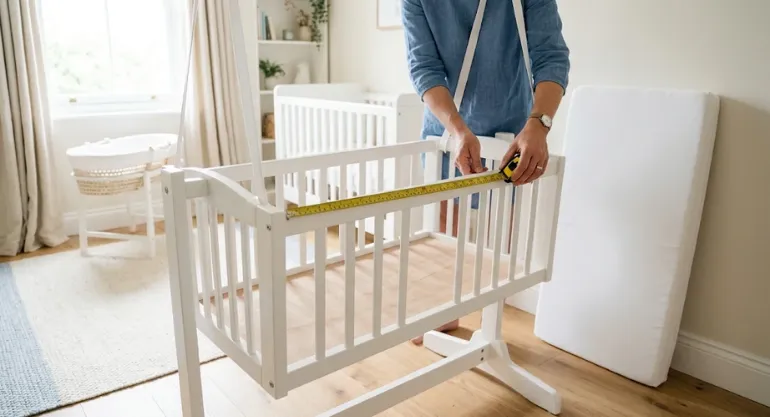
You’ve found the perfect crib, or been handed a second-hand one, and now you need a mattress. What size mattress fits a crib? Is a crib mattress different from a cot mattress? And what does “crib” even mean in the UK? The short answer is that there is no single “crib size” in the UK. Cribs, bedside cribs, Moses baskets, cots and cot beds all take different mattresses, and the mattress must fit your specific sleep space with no more than a small gap at the edges. This guide lists the common sizes for every baby sleep space, explains the UK and US meanings of “crib”, and shows you how to measure and check the fit.
Quick Summary:
Sizes below are common examples from UK retailers. They vary by brand, so always measure.
| Sleep space | Typical age or stage | Common mattress size (L x W) | Notes |
|---|---|---|---|
| Moses basket | Newborn to around 3 to 4 months (or until baby can roll or sit) | About 74 x 28 cm, or 66 x 28 cm | Size varies by basket |
| Crib / swinging crib | Newborn to around 6 months | Often about 84 to 90 cm long; no UK standard | Measure; shapes vary |
| Bedside crib / co-sleeper | Up to around 6 months or until baby rolls | About 83 x 50 cm to 89 x 38 cm, depending on model | Fit depends on the model |
| Petite or space-saver cot | Newborn to around 18 months | About 90 x 54 cm (one brand’s petite cot) | Brand-specific |
| Travel cot | Travel use | Often about 120 x 65 cm; varies by brand | Use the maker’s mattress |
| Cot | Birth to around 2 years | 120 x 60 cm | The most common size |
| Cot bed | Birth to around 4 years | 140 x 70 cm (some are 132 x 70 cm) | Converts to a toddler bed |
In the UK, a crib is usually a small bed for a newborn, such as a swinging crib or a bedside crib. It is smaller than a cot.
In the US, a “crib” is a full-size baby bed, which is what UK parents call a cot.
If you searched for “crib mattress” from the UK, check which one you need. A US-style crib mattress is close to a UK cot mattress, but sizes aren’t identical, so always confirm the dimensions rather than assuming. Our cot mattress size guide covers the standard UK sizes.
Moses baskets are small and portable, and the mattress is typically around 74 x 28 cm, though some baskets take a 66 x 28 cm mattress. There is no standard, so measure inside the basket. Babies usually outgrow a Moses basket by about three to four months, or sooner if they roll or push up. See our guide to Moses baskets and cribs.
There is no UK standard for crib mattresses. One retailer lists a common crib or Moses basket size as 50 x 90 cm, others list cribs at about 84 to 89 cm long, and shapes can be rectangular or oval. Measure the inside base of your crib, including any curved corners.
Bedside cribs sit next to your bed. Their mattresses are usually longer and narrower or wider depending on the model: for example, around 89 x 38 cm for one retailer’s bedside crib mattress and 83 x 50 cm for another brand’s co-sleeper. Brands also make their own sizes, so use the maker’s mattress where possible. Make sure the crib suits your bed height and frame, with no gaps.
The standard UK cot size; see our 120 x 60 cm cot mattress size guide. Babymore’s Pocket Sprung, Deluxe Sprung and Eco Fibre cot mattresses are 120 x 60 cm. Eco Fibre also comes in other sizes (our product page lists 100 x 50 cm and 140 x 70 cm as well).
Cot beds are bigger so the bed lasts into toddlerhood. The standard is 140 x 70 cm, though some cot beds are 132 x 70 cm. Babymore’s Premium Core is a 140 x 70 cm option. A cot mattress is usually smaller than a cot bed mattress, so check which you have. See our guide to adjusting the mattress base in a cot bed.
Sizes vary by brand. Use the mattress supplied with the travel cot, and don’t add extra padding or an extra mattress.
Some brands (for example SnuzPod, Chicco Next2Me, Stokke) use their own mattress sizes with rounded corners. For these, buy the manufacturer’s mattress or check the exact dimensions before buying any other.
The Lullaby Trust’s advice for any baby mattress is to choose one that is:
Also avoid sheepskins, pods and nests, which can make the surface too soft or cause overheating. Look for a mattress tested to BS EN 16890. Our guide to the types of baby mattress compares the options. Read more in our baby mattress safety guide and how firm a baby mattress should be.
A new mattress for each baby is preferred. Some research links mattresses from outside the family to a higher SIDS risk, though this isn’t proven. If you do use a second-hand one, it should be clean, undamaged and firmly fitted. See do you need a new mattress for each baby?
Always follow the manufacturer’s age and weight limits.
Use a fitted waterproof protector in the exact size, and keep a spare. Avoid toppers and pads. See our guides on mattress protectors and mattress toppers, and how to clean a baby mattress.
When it comes to crib mattresses, size and fit matter more than the name on the box: measure the inside of the sleep space, match the mattress, keep the gap to about 3 cm or less, and choose a firm, flat, waterproof-covered mattress. When your baby outgrows one sleep space, move up to the next size and check the fit again.
Browse Babymore’s cot mattresses and cot bed mattresses.