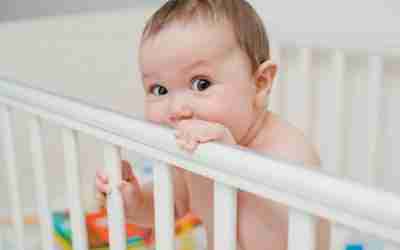
Your baby seems unsettled, the mattress feels hard to you, and a soft topper looks like a quick fix. Are mattress toppers safe for babies? Do you need a topper for a cot bed? The short answer is that a topper is not recommended for a baby. Safer sleep advice is a firm, flat, waterproof-covered mattress with nothing soft on top, and a topper makes the surface softer. This guide explains why, what to do instead if your baby seems uncomfortable, and what a fitted protector can (and can’t) do.
Quick Summary:
- Short answer: No, don’t put a mattress topper in a baby’s cot or cot bed.
- Lullaby Trust advice: A firm, flat, waterproof mattress with lightweight bedding and nothing soft added to the sleep space.
- Why not: Toppers, pads, nests and padding all soften the surface, and soft surfaces are linked with a higher risk of SIDS.
- Mattress feels hard? That is normal: babies need a firm surface.
- Safe alternative: Use a thin, fitted waterproof protector if you want extra protection, and ask your health visitor if you have specific concerns.
Toppers, Protectors and Pads at a Glance
|
Mattress topper |
Fitted waterproof protector |
Thick pad / quilted cover |
| Purpose |
Adds softness or cushioning |
Keeps the mattress clean and dry |
Cushioning or absorbency |
| Effect on firmness |
Makes the surface softer |
Should not change firmness |
Can soften the surface |
| For a baby? |
Not recommended |
Yes, if thin and snug |
Not recommended |
| Notes |
Soft surface and gaps are risks |
Choose the exact size; see our protector guide |
Avoid anything bulky |
Are Mattress Toppers Safe for Babies?
Not for a baby. Here’s why:
- Soft surfaces are a risk. A baby can’t yet lift or turn their head, and a soft surface can let their face sink in. Soft bedding and surfaces are linked with a higher risk of SIDS.
- The Lullaby Trust says keep the cot clear. Its advice is to keep the cot empty apart from a firm, flat, waterproof mattress and lightweight bedding, and to avoid soft spots, cushioned surfaces and extra padding such as nests or rolled towels. A topper isn’t named on the page we read, but it is exactly the kind of addition the advice warns against. See our summary of the Lullaby Trust’s mattress and bedding advice.
- Toppers can shift. A topper can slip, bunch or leave gaps at the edges of the cot.
- They can trap heat. Overheating is also linked with a higher risk, and some soft toppers hold warmth.
- They can undo the mattress’s safety work. A mattress is chosen to be firm, flat and tested to BS EN 16890. A topper changes that.
If you read about topper policy from other safe sleep organisations, such as Red Nose in Australia, the principle is the same: firm and flat, with nothing soft on top. (We could not open the Red Nose answer on toppers, so check before quoting it.)
Does a Cot Bed Need a Topper?
No. A cot bed is used first as a cot and later as a toddler bed, and the mattress should be firm in both uses. If your cot bed mattress has a firmer baby side and a softer toddler side, our guide on when to flip a dual-sided mattress explains how to use it. See also our cot bed safety guidelines.
“The Mattress Feels Hard”: Is That a Problem?
It is normal for a baby mattress to feel firm to an adult. Babies don’t need cushioning, and a firm surface is safer. Test it with the palm test: press the centre, and it should spring back without leaving a dip. Our guides on how firm a baby mattress should be and why a good cot mattress matters cover this in detail.
What to Do Instead If Your Baby Seems Uncomfortable
- Check the room temperature and clothing. Overheating or being cold can unsettle a baby.
- Check the nappy and feeding. Wind, hunger and wet nappies are common reasons.
- Use a well-fitting sleeping bag or lightweight bedding tucked in firmly, no higher than the shoulders. See baby sleeping bag vs blanket.
- Make sure the mattress is in good condition. If it sags or has lost its firmness, replace it. See how long baby mattresses last.
- Talk to your health visitor or GP if you think discomfort could be reflux, colic or something else. Our guide on elevating a baby mattress explains why propping isn’t advised.
What About Toddlers in a Cot Bed?
Safer sleep guidance is written for babies in their first year, so it doesn’t spell out advice for toddlers. Even so, a firm mattress is the safe starting point for a toddler who has just moved to a cot bed. If you are thinking about a topper for an older toddler, speak to your health visitor first, choose a thin, firm, fitted product that doesn’t leave gaps, and keep other soft items out of the cot bed. Our guides on moving from a cot to a toddler bed and the suitable age of a cot bed may help. (We could not find UK guidance on toppers for toddlers, so please check with the Lullaby Trust helpline, 0808 802 6869.)
The Safe Alternative: A Fitted Waterproof Protector
A thin, fitted waterproof protector keeps the mattress clean and dry without changing how firm it is. Choose the right size: 120 x 60 cm for a cot and 140 x 70 cm for a cot bed. Look for a snug fit, soft breathable top fabric and a machine-washable cover. See our guide to baby mattress protectors and how to clean a baby mattress.
A Better Way to Get Comfort: Choose the Right Mattress
Babymore’s Premium Core cot bed mattress is a 140 x 70 cm option, and our Pocket Sprung, Deluxe Sprung and Eco Fibre cot mattresses are 120 x 60 cm. Browse the baby mattress range and read our baby mattress safety guide and mattress guide.
Cot Bed Safe Sleep Checklist
- ☐ Firm, flat mattress that fits the cot bed
- ☐ Waterproof cover or thin, fitted protector
- ☐ No toppers, pads, nests, wedges or extra padding
- ☐ Baby on their back, feet to the foot of the cot
- ☐ Lightweight bedding, tucked in no higher than the shoulders, or a sleeping bag
- ☐ No pillows, duvets, bumpers or toys
- ☐ Room not too hot
Final Thoughts
A baby doesn’t need a topper: the safest cot is the clearest one, with a firm, flat mattress and a snug protector. If your baby seems uncomfortable, look at temperature, feeding and the mattress’s condition first, and get advice from your health visitor if you’re worried.
Browse Babymore’s cot mattresses and cot bed mattresses.
Frequently Asked Questions
01- Are mattress toppers safe for babies?
No. Toppers soften the surface, and safer sleep advice is a firm, flat mattress with nothing soft on top.
02- Can I use a cot bed mattress topper?
We don’t recommend one for a baby. For toddlers, speak to your health visitor first.
03- Do I need a mattress topper for a cot?
No. A firm cot mattress is designed to be used on its own with a fitted sheet.
04- Can I use a baby mattress topper if the mattress feels too hard?
A firm feel is normal and safer for babies. If the mattress is worn or sagging, replace it rather than adding a topper.
05- What is the difference between a mattress topper and a mattress protector?
A topper adds cushioning. A protector is a thin waterproof layer that keeps the mattress clean and dry.
06- Are mattress protectors safe for babies?
Yes, if they are fitted, thin and flat and made for your mattress size.
07- Are cot mattress pads safe?
Thick or quilted pads can soften the surface, so we recommend a thin, fitted protector instead.
08- Is it safe to use a crib mattress topper?
“Crib” is the American word for a cot. The same advice applies: nothing soft should be added to a baby’s mattress.
09- Can a baby sleep on a sheepskin or memory foam topper?
No. These are soft and can trap heat.
10- What can I do if my baby is unsettled in the cot bed?
Check temperature, nappy, feeding and mattress condition, and speak to your health visitor if you’re worried.
11- Can toddlers use a mattress topper in a cot bed?
Safer sleep guidance is written for babies. Ask your health visitor and the Lullaby Trust before adding one.
12- What size mattress protector fits a cot bed?
Most cot beds take a 140 x 70 cm mattress. Measure yours (our cot mattress size guide can help), and see our mattress protector guide.