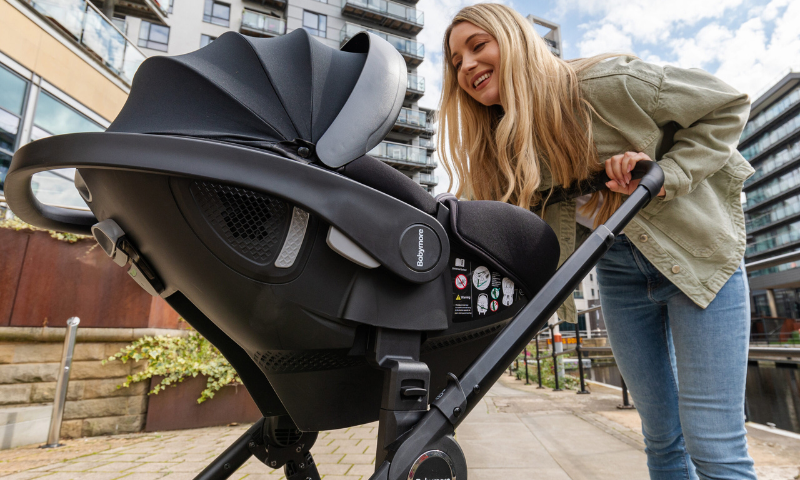
It’s one of the first big car seat questions every parent asks, usually around the time their baby starts outgrowing their infant carrier: when is it actually okay to turn the seat around? The honest answer depends on which type of car seat you have, because the UK currently runs two different sets of rules side by side. Here’s exactly what the law says, what car seat safety experts recommend instead, and how to work out which applies to your seat. If you’re still deciding on your first or next seat, our comprehensive guide to choosing a car seat is a good companion read alongside this one.
Under the newer i-Size (R129) standard, your baby must stay rear-facing until they are over 15 months old; this is a legal requirement, not a guideline. Under the older R44.04 standard, forward-facing is technically permitted from 9kg (Group 1), which many babies reach well before their first birthday. Both are legal in the UK today, but child car seat safety experts consistently recommend keeping children rear-facing well beyond either minimum, ideally to around 4 years old where the seat allows it — because rear-facing offers significantly better protection in a frontal crash, which is the most common serious collision type.
This is the part that confuses most parents, and it’s worth clearing up first. The UK doesn’t have one single car seat law, it has two regulations running in parallel, and which one applies to you depends entirely on which car seat you’ve bought.
R129, also known as i-Size, is the newer EU regulation and the one most new car seats are now built to. It classifies seats by your child’s height rather than weight, and it comes with a firm legal rule: your child must remain rear-facing until they are over 15 months old. There’s no exception for a big baby or a small one; the 15-month threshold is fixed. You can check whether your seat is R129 by looking for “i-Size” and the letter “R” followed by “129” on the approval label, usually found on the base or side of the seat.
R44.04 is the older, weight-based standard. It’s still legal in the UK, and plenty of seats sold today are still R44.04-approved rather than i-Size. Under R44.04, seats are grouped by weight: Group 0 and 0+ (up to 13kg) are rear-facing only, while Group 1 (9–18kg) can legally be either rear- or forward-facing. In practice, that means a baby on an R44.04 seat could legally be turned forward from around 9kg; often well before their first birthday, sometimes as early as 6–7 months for a larger baby.
Our guide on R44 vs R129 car seat regulations goes into more detail on how the two standards differ if you want the full picture, including what changes if you’re buying secondhand or bringing an older seat back into use. And if you’re not sure how long your current seat will actually last your child, Understanding Car Seat Limits breaks down height, weight, and age cut-offs in more detail.
Both are legal. Neither is necessarily the safest option available to you, which is the part most parents don’t realise until they start reading into it.
The law sets a minimum. It doesn’t set a safety target. Around 70% of serious car collisions are frontal impacts, and a rear-facing seat is dramatically better at managing the forces from that specific type of crash. When a rear-facing seat absorbs a frontal impact, the crash force is spread across the entire back of the seat and the child’s back, shoulders, and head move with the seat shell rather than being thrown forward.
Forward-facing, the harness holds the torso in place, but a young child’s head, which is proportionally much heavier and less supported than an adult’s, continues moving forward under momentum. Because a toddler’s neck and spine are still developing and the vertebrae aren’t yet fully fused, that forward motion places real stress on structures that simply aren’t ready for it. This is the core reason extended rear-facing has become the default safety recommendation across most of Europe, not just a UK quirk. For a broader rundown of what actually keeps a car seat safe day-to-day; not just rear vs. forward-facing; our car seat safety tips guide is worth a read too.
Extended rear-facing simply means keeping your child in a rear-facing seat well past the legal minimum; typically toward 4 years old, rather than switching at 15 months or 9kg the moment it becomes legally possible. Many i-Size seats are specifically built to support this, with rear-facing capacity up to around 105cm height or roughly 18kg, which covers most children until age 4 or later.
Babymore’s Kola 360° i-Size car seat (0–4 years) is built around exactly this approach, with rear-facing use supported right through to around 4 years old rather than the 15-month legal minimum. For families who want one seat that spans infancy through to the school years, the Shea 360° i-Size Every Stage car seat (0–12 years) and the Macadamia 360° i-Size All Stages car seat (0–12 years) both offer extended rear-facing phases before transitioning through the forward-facing groups as your child grows, so you’re not locked into turning the seat around the moment it’s technically allowed.
A 360° rotating base is genuinely useful here in a way that’s easy to underestimate until you’ve used one; it removes the awkward twisting and reversing-into-the-seat routine that puts a lot of parents off extended rear-facing in the first place, since you can simply spin the seat to load your child and spin it back to rear-facing for the drive.
If you’re choosing a seat alongside a pushchair, several of Babymore’s infant carriers, including Pecan and Coco, are also available as part of a full travel system, so the car seat, base, and pushchair are matched from the start rather than pieced together separately.
| Feature | Rear-Facing | Forward-Facing |
|---|---|---|
| Frontal crash protection | Spreads force across seat back and shell | Head moves forward under momentum |
| Neck & spine stress | Minimal — supported by seat shell | Higher — harness holds torso, not head |
| Legal minimum (i-Size) | Required to 15 months | Permitted after 15 months |
| Legal minimum (R44.04) | Required to 9kg (Group 0/0+) | Permitted from 9kg (Group 1) |
| Expert recommendation | Continue to ~4 years where possible | Only once rear-facing capacity is outgrown |
If you’re shopping for a new seat rather than working out the rules for one you already own, our car seat stages guide walks through which group or i-Size stage typically suits which age, and our i-Size car seats explained article covers how the height-based system works in more depth. You can also browse Babymore’s full car seats range to compare i-Size and extended rear-facing options side by side.
The law sets the minimum. Safety experts recommend going well beyond it. Whether your seat follows the i-Size 15-month rule or the older R44.04 weight-based rule, waiting as long as your seat’s rear-facing capacity allows,ideally toward 4 years old, gives your child meaningfully better protection in the crash type most likely to happen: a frontal collision.
Ready to find a seat built around this approach? Explore Babymore’s i-Size car seats, including the extended rear-facing Kola and Shea ranges, or read our car seat stages guide to plan out what your child will need at each age and stage.