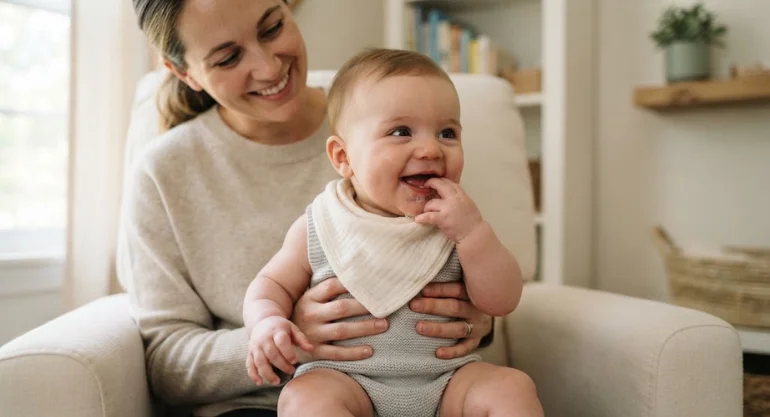
If your baby’s bib is soaked within the hour and their sleepsuit is damp at the neckline by lunchtime, you are far from alone. Is it normal for a baby to drool this much? Does it mean they are teething? And when should you worry? Heavy drooling, or dribbling as many UK parents call it, is one of the most common things new parents ask about, and in most cases it is a normal part of growing up. This guide explains why babies drool so much, what is typical at each age, how drooling links to teething (and when it does not), how to look after drool-sore skin, and the signs that mean it is time to speak to a GP, your health visitor or NHS 111.
Quick Summary:
- Is it normal? Yes, heavy drooling is normal in most babies.
- When it happens: Babies usually start drooling at around 2 to 3 months, drool the most between 3 and 6 months, and drool less from around 18 months to 2 years.
- Usual reasons: Maturing salivary glands, still learning to swallow, exploring everything with their mouth and, later, teething.
- Nothing to worry about: Drooling on its own, in a baby who is feeding, sleeping and behaving as usual.
- When to see a doctor: If it comes with a high temperature (38°C or above), trouble breathing or swallowing, refusing feeds, or a rash with spots in the mouth, hands or feet.
Why Babies Drool at Each Age at a Glance
| Age |
What is usually happening |
What helps |
| 0 to 2 months |
Very little saliva at first. Heavy drooling in the first days, especially with vomiting or feeding trouble, is rare but needs medical advice straight away. |
Tell your midwife, GP or health visitor at once. |
| 2 to 3 months |
Salivary glands start working harder and drooling becomes noticeable. Babies cannot yet swallow all the saliva they make. |
A bib and a spare muslin. |
| 3 to 6 months |
Peak drooling. Hands go in the mouth, chewing starts and the first teething signs can appear. |
Absorbent bibs, barrier balm for sore skin and a clean teether. |
| 6 to 9 months |
Solids and new tastes bring more saliva. First teeth often appear around now, though the age varies a lot. |
Wipe the chin after meals and watch for rash. |
| 9 to 12 months |
Mouth control improves, but drooling can come and go with new teeth and new skills. |
Keep bibs handy for mealtimes and teething spells. |
| 12 to 24 months |
Most babies drool less as swallowing and lip control improve. Molars can bring it back for a while. |
Mention heavy drooling that carries on past age 2 to your GP. |
These ages are typical, not deadlines. Every baby follows their own timeline.
How Much Drooling Is “Too Much”?
There is no set amount that counts as normal. Some babies are soaked by midday and others barely dribble, and both can be perfectly healthy. A better test than counting bibs is to look at your baby. Ask yourself:
- Is my baby feeding, having wet nappies and settling as usual?
- Are they otherwise well, with no fever, cough or unusual fussiness?
- Has the drooling built up gradually over weeks, rather than starting suddenly alongside illness?
If the answer to all three is yes, heavy drooling is almost always just development. If the answer to any of them is no, read the section on when to see a doctor below.
Why Do Babies Drool So Much?
There is rarely one single cause. Several things usually add up:
- Their salivary glands are switching on. Babies make little saliva in the first weeks. Around 2 to 3 months the glands mature and saliva production picks up. Saliva is useful: it helps with digestion and protects gums and, later, teeth.
- They are still learning to swallow. Swallowing uses many muscles in the mouth, tongue and throat. Until that coordination improves, saliva pools in the mouth and spills out, much like the milk that dribbles after a feed.
- Everything goes in the mouth. From around 3 months babies discover their hands and then toys, and mouthing stimulates saliva. A very damp bib is often a sign of a baby who is exploring, not a poorly one. See why babies put their hands in their mouth.
- Teething has started. Extra saliva is one of the earliest teething signs and can show up days or even weeks before a tooth appears. Our teething baby guide has the full picture.
- Food and smells. Once solids begin, the sight and smell of food can get the saliva flowing, just as it does for adults.
- A blocked nose. Babies breathe mainly through their nose. When a cold blocks it, they breathe through an open mouth and the saliva escapes more easily.
Is Drooling Always a Sign of Teething?
No, but it is often part of the picture. Teething signs can begin around 3 months, while the first tooth usually appears nearer 6 months, according to NHS Scotland’s Child Smile guidance on teething. That gap is why many babies drool heavily for weeks, or months, before any tooth shows.
Drooling alone does not confirm teething. Along with extra saliva, teething babies often have sore, red or swollen gums, a strong urge to chew on hands, toys and your shoulder, flushed cheeks, and fussiness or unsettled sleep. Our guide to the early signs of teething in babies, by age walks through these in more detail. See also how long teething lasts in babies.
What is probably not teething. Teething should not make your baby ill. A temperature of 38°C or above, vomiting, a runny nose or diarrhoea usually point to something else, and Patient.info says a high temperature should not be put down to teething. Our posts on whether teething can cause a mild fever and whether diarrhoea is normal during teething explain why. Ear tugging can be a teething sign too, but it can also mean an ear infection, so read ear pulling in babies: teething or infection if your baby is pulling at their ears and seems unwell.
What can help. A clean, chilled (not frozen) teether or a clean finger rubbed gently on the gums can ease sore gums. You will find more ideas, and what to avoid, in our guide to natural teething remedies for babies. Ask your pharmacist or health visitor before using any teething gel or pain relief.
What Parents Say About Heavy Drooling and No Teeth
On parent forums such as Reddit’s r/NewParents, Mumsnet and The Bump, the same worries come up again and again. Forum posts are not medical advice, but they show what is normal in real life, and the common answers line up with what health sources say:
- “They have drooled for months and there is still no tooth.” Parents report heavy drooling and chewing from around 3 to 4 months, with the first tooth arriving at 6, 10 or even 14 months. That is within the normal range.
- “My GP said it is not teething.” Some parents of 3-month-olds are told that constant drooling is development, not teething, because salivary glands typically start working at around 3 months.
- “It started when they began rolling over.” Some parents link heavier drooling to new skills and mouthing, not teeth.
- “Their clothes are soaked through.” Many babies drool enough to need two or three tops a day. A spare top in the changing bag is the most common tip.
- “I thought it was teething, but it might be an ear infection.” Parents often suggest having the ears checked if a baby seems more unsettled than drooling alone would explain. If your baby seems more than just grumpy, ask a doctor to take a look.
Drool Rash: How to Spot It and How to Treat It
A baby who is damp all day will often get sore skin. Drool rash, or dribble rash, shows up as red, dry or chapped patches on the chin, cheeks, neck and chest, where saliva sits on the skin. NHS Scotland notes that heavy drooling can leave skin dry, chapped or sore.
Is it drool rash or something else? A rash that stays around the mouth, chin and neck is usually drool rash. Spots or blisters on the hands and feet, or sores in the mouth, point to something else, such as hand, foot and mouth disease, so get your baby checked. If your baby already has eczema, drool can irritate it and make it flare, so mention this to your GP.
How to treat it:
- Pat the skin dry gently through the day instead of rubbing.
- Change damp bibs and tops as soon as they are wet, so skin is not sitting in moisture.
- Apply a thin layer of a simple barrier balm to the chin and neck, and reapply regularly. Ask your pharmacist which product suits your baby’s skin.
- Mind dry air in winter. Dry indoor air can make sore skin worse, so see our tips on how to winter-proof your baby’s nursery for sensible temperature and humidity advice.
- Speak to your GP, health visitor or pharmacist if the rash is cracked, weeping or spreading, or if it does not improve after a few days of careful care.
How to Cope With a Very Droolly Baby, Day to Day
You cannot stop drooling, and you should not try to. It is how your baby protects their gums, learns to swallow and gets ready for solid food. What you can do is make the days drier and more comfortable:
- Keep spare tops and muslins close. Put two or three spare tops in the changing bag and a muslin in every room.
- Choose the right bib. Soft cotton or towelling bibs absorb well, and a bib with a waterproof backing keeps the chest dry. Change it as soon as it is wet.
- Wipe, don’t rub. Dab the chin and neck with a soft, clean cloth.
- Protect the skin before it gets sore. A thin layer of a simple barrier balm can help.
- Offer safe things to chew. A clean, firm teether or a chilled (not frozen) washcloth gives your baby something to gnaw on.
- Wash hands and toys often. Babies put everything in their mouths, so keep teethers and favourite toys clean.
Bibs and sleep: a safety note. Take bibs off before your baby sleeps, and keep the cot clear of loose fabric, muslins and soft items. If your baby wakes damp from drool, change the sleepsuit and the fitted sheet rather than layering anything extra in the cot. Our newborn sleep setup guide covers a safe sleep space, and newborn sleep tips for tired parents has practical ideas for coping with broken nights. If drooling and sore gums are disturbing an older baby’s sleep, teething and sleep regression in toddlers explains what is going on and what helps. For routine across the first year, see our baby sleep schedule by age.
When to See a Doctor About Drooling
Most drooling is harmless, but see your GP, health visitor or call NHS 111 if:
- Your baby has a high temperature (38°C or above), is not feeding well, or seems very unwell.
- The skin around the mouth is cracked, weeping, blistered or spreading.
- There are spots or blisters on the hands and feet, or sores in the mouth.
- Your baby has a very sore mouth and refuses feeds or fluids.
- Your baby is still drooling a great deal after the age of 2, or drooling comes with difficulty swallowing, feeding or controlling the mouth.
- Your baby often chokes or gags on saliva, or drooling has suddenly increased for no obvious reason.
- You have a feeling that something is not right and you want it checked.
Call 999 or go to A&E if your baby is struggling to breathe, making grunting or noisy breathing sounds, has blue or grey skin or lips, or is floppy and hard to wake. Do not wait to see if it settles.
If you are ever unsure, a call to your health visitor, GP surgery or NHS 111 is always a reasonable step, and you will not be wasting anyone’s time.
Final Thoughts
Heavy drooling is a sign your baby is developing as they should: their salivary glands are working, they are learning to swallow and explore, and their teeth may be on the way. It is messy, but it is rarely a cause for worry. Keep skin dry, keep spare tops handy, and watch for the signs above that need a professional’s eye.
Once the first teeth arrive, protect them from the start. Our guide to looking after your baby’s teeth after teething covers brushing, toothpaste and your first dental visit, and when do babies start teething gives a timeline of when each tooth tends to appear.
Frequently Asked Questions
01- When do babies start drooling?
Most babies start drooling at around 2 to 3 months, when the salivary glands begin working properly. It tends to increase between 3 and 6 months as your baby mouths more and gets ready for solids. Every baby is different, so some start earlier and some later.
02- Is it normal for a 3-month-old to drool a lot?
Yes, very. Parents on Reddit and Mumsnet often ask this, and many report soaked bibs at 3 months with no tooth for months afterwards. At this age drooling usually comes from developing salivary glands, not from teething, and your baby has not yet learned to swallow all their saliva. Mention it to your health visitor if your baby has other symptoms, such as a fever or poor feeding.
03- Can a baby drool a lot without teething?
Yes. Babies drool because of salivary gland development, learning to swallow, mouthing hands and toys, and sometimes a blocked nose that keeps the mouth open. Many parents describe weeks or months of heavy drooling before the first tooth, which usually comes at around 6 months but can be later. Our guide on when babies start teething explains the range.
04- How long does heavy drooling last?
Most babies drool heavily for months, with the peak often between 3 and 12 months. It usually eases between 12 and 24 months as swallowing gets better and the mouth muscles mature, though some toddlers still dribble now and then, especially when tired, concentrating or teething. See your GP if heavy drooling continues after age 2.
05- Why does my baby drool more at night or when lying down?
When a baby is lying on their back, saliva can pool and run out of the mouth sideways, so you may find a damp patch on the sheet. Some babies also gag or cough briefly on saliva when they lie flat. This is usually harmless, but check with your GP or health visitor if your baby chokes often, struggles to breathe or has noisy breathing. Always follow safe-sleep advice and keep bibs and soft items out of the cot.
06- How do I stop drool rash on my baby’s chin?
Keep the skin as dry as you can: pat it dry, change wet bibs and tops quickly, and apply a thin layer of a simple barrier balm to the chin and neck. Reapplying through the day works better than doing it once. If the rash is cracked, weeping or does not clear in a few days, see your pharmacist or GP.
07- Can drooling be a sign that my baby is ill?
Sometimes. Drooling alone is rarely a worry, but see a doctor if it comes with a high temperature, a very sore mouth, refusing feeds, ear pulling and unsettled crying, or blisters on the hands, feet or mouth (which can be hand, foot and mouth disease). A sudden increase in drooling along with difficulty swallowing or breathing needs urgent medical help. Our guide to ear pulling in babies explains when it may point to an infection.
08- Does a lot of drooling mean my baby is ready for solids?
Not by itself. The NHS signs of readiness for solids are sitting up with little support, good head control, and being able to pick up food and move it to the mouth. Drooling is a normal part of mouth development, but it is not one of the readiness signs, so look for the others before you start. Our weaning schedule for babies shows what comes next.
09- Do teething gels and amber necklaces help with drooling and sore gums?
They are not a reliable fix. Parents often ask about amber necklaces, but they are a choking and strangulation risk and there is no good evidence that they work, so avoid them. Ask your pharmacist or health visitor before using any teething gel. Safer options include a clean teether, a chilled washcloth, or gently rubbing the gums with a clean finger. See natural teething remedies for babies.
10- When should I worry about my baby’s drooling?
Worry less about the amount and more about what comes with it: a temperature of 38°C or above, not feeding, trouble swallowing or breathing, a rash that spreads or weeps, or drooling that stays heavy after age 2. If any of these apply, call your GP or NHS 111, or 999 if your baby is struggling to breathe. Trust your instincts, because you know your baby best.