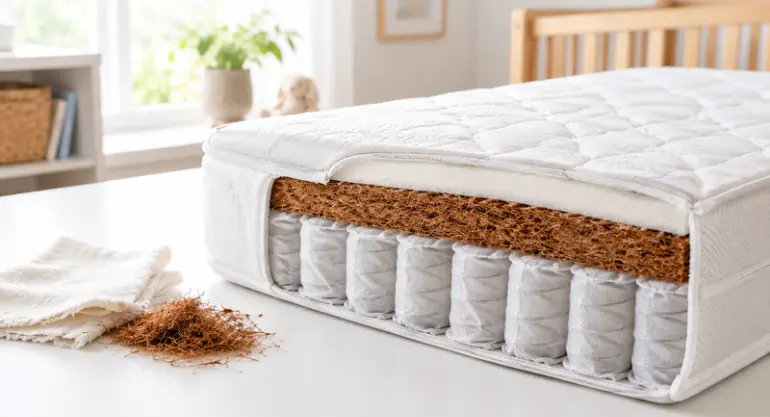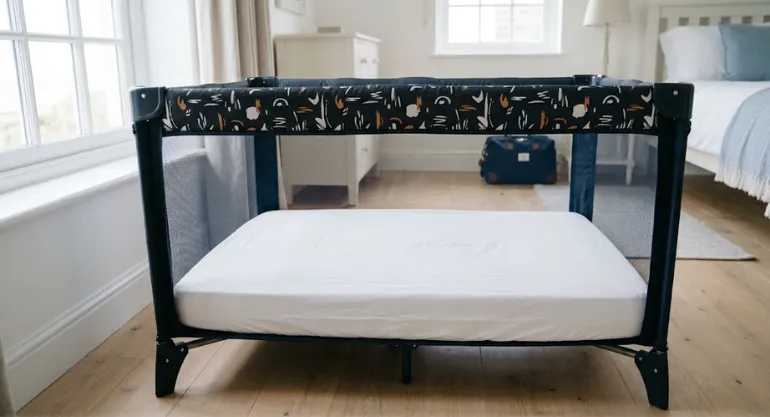
You’re packing for a weekend away, the travel cot is out of its bag, and the mattress looks suspiciously thin. Does a travel cot need a separate mattress? Can you add a topper to make it comfier? And what size mattress do you need if you have to replace one? The short answer is that a travel cot mattress should be the one made for that cot, it should be firm and flat, and you shouldn’t add a topper or extra padding. This guide covers sizes (which vary by brand), covers and protectors, foldable mattresses, and the questions parents ask most, including whether a baby can sleep in a travel cot without a mattress.
Quick Summary:
| Question | Short answer |
|---|---|
| Size | Varies by brand. Check the maker’s size; don’t assume |
| Extra mattress needed? | Not usually. The supplied base or mattress is designed for the cot |
| Topper or padding? | Not recommended |
| Cover or protector? | A fitted, thin, waterproof protector made for the size is fine |
| Thick or memory foam? | No. Thick mattresses can reduce side height and leave gaps |
| Without a mattress? | No. Never use a travel cot without its base or mattress |
| Second-hand? | Only with the original instructions, and in good condition |
There is no single travel cot mattress size. A mattress sized for one brand’s frame can be too big or too small for another’s. For example, the BabyBjörn Travel Cot Light mattress is listed as 60 x 105 cm and 3 cm thick, while a UK mattress retailer’s size guide describes travel cot mattresses as often around 120 x 65 cm, varying by brand. Sizes such as 95 x 65 cm and 100 x 70 cm are commonly searched for, but we can’t confirm which models use them, so check yours.
To find your size:
Our guide to cot and cot bed mattress sizes and our crib mattress size guide cover home sleep spaces.
Usually not. Most travel cots come with a base pad or fitted mattress designed for that frame. Parents often debate it: in a Mumsnet thread, some said the built-in base was enough, while others bought a separate mattress because the base felt thin or slippery. That’s a comfort opinion, not a safety recommendation.
On safety, the Lullaby Trust’s product guide says to use a firm, flat, waterproof mattress in a travel cot and not to add extra padding, and to follow the manufacturer’s instructions for any product. The NHS poster for staying away from home advises a solid, level mattress with a moisture-resistant cover and no soft padding under your baby. Red Nose, the Australian safe sleep charity, goes further and advises using only the mattress that came with the cot, because swapping it or adding another can leave gaps where a baby could be wedged. That is Australian guidance, but the reasoning holds for UK travel cots too. See our summary of the Lullaby Trust’s mattress and bedding advice.
If you do buy a replacement, choose the manufacturer’s own, or one the manufacturer states is compatible, and use only one mattress.
We don’t recommend it. A topper makes the surface softer and can shift or leave gaps at the edges, which is exactly what the safer-sleep advice warns against. A baby doesn’t need cushioning, and a travel cot is designed to be used with its own firm base. See our full guide on mattress toppers for cot beds and babies.
A folded blanket or towel under the base for “comfort” is also not advised, particularly for young babies. See baby sleeping bag vs blanket for safer ways to keep your baby warm.
A fitted, thin, waterproof protector can help keep a travel cot mattress clean on the road. Look for:
BabyBjörn’s mattress cover, for instance, is listed as machine washable at 40°C, though its own page also gives a 60°C figure elsewhere, so always check the care label on your own product. Our guide to baby mattress protectors explains what to look for, and how to clean a baby mattress covers washing.
Foldable (or “fold-away”) travel cot mattresses exist, and some are sold as replacements for specific cots. A foldable mattress is fine if it is firm, flat when unfolded, the exact size of your cot, and approved by the maker. Be careful with:
No. A travel cot should always be used with its base pad or mattress in place, set up as the manufacturer describes. Without it, the floor may not be firm or level, and the cot may not be stable. If the mattress is lost or damaged, buy the correct replacement before using the cot. The same applies to a play pen or “pack and play” used for sleeping: use the base the maker supplies, and no extra padding.
“Non-toxic” isn’t an official label, so look for specific testing. BabyBjörn states that the fabrics touching your baby’s skin in its Travel Cot Light meet OEKO-TEX Standard 100, Class 1 for baby products, and its page does not provide separate safety testing for the mattress itself. For other brands, check the product page or ask the maker what certifications apply and what the cover and filling are made of.
Travel cots are for occasional use. Our guide to travel cots vs standard cots explains the difference. If you’re using one as your baby’s main bed, read the maker’s guidance and our guides on how firm a baby mattress should be and baby mattress safety. For home use, read our mattress guide or browse Babymore’s cot mattresses and cot bed mattresses.
For a travel cot, the safest mattress is the boring one: the right size, firm, flat and made for that cot, with no topper and no extra padding. Check the size before you buy a replacement, pack a spare fitted sheet, and keep the cot clear of loose items. See our newborn sleep setup guide.
Browse Babymore’s baby mattress range for everyday sleep.