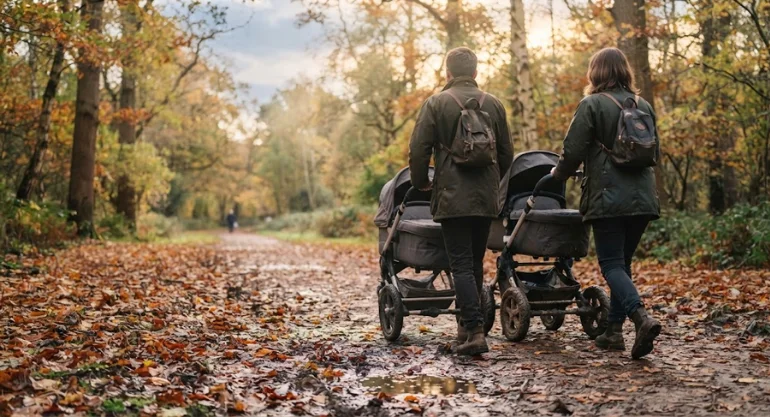
For most UK parents walking on muddy paths, wet leaves and uneven pavements this autumn, the most suitable pushchair wheels for uneven ground aren’t about wheel count at all; they’re about suspension, tyre width, and tyre material.
A well-sprung 4-wheel pushchair with wide, puncture-proof tyres will handle a leaf-strewn park path or a rutted school-run pavement just as capably as a 3-wheeler, and often more stably, since the extra wheel gives a wider, steadier base. 3-wheel pushchairs (jogger-style, with a single front wheel) genuinely come into their own on loose, uneven, off-road-style terrain; think woodland trails, sand, or deeply rutted mud; because that single swivelling or lockable front wheel pivots around obstacles more easily than two fixed fronts.
For everyday autumn walking rather than proper off-roading, what actually determines your pushchair’s performance on rough ground is sprung suspension, tyre tread and width, and ground clearance; not simply whether it has three wheels or four.
The 3-wheel versus 4-wheel question gets framed as a simple either/or far more often than it should be, because the actual difference comes down to geometry rather than raw capability.
A 3-wheel pushchair has two rear wheels and a single front wheel, which is usually either fixed (locked straight, for stability on genuinely rough or off-road terrain) or swivel (for tighter manoeuvring around shops and tight pavements, with the option to lock it straight when the ground gets rougher). That single front wheel pivots around roots, ruts and uneven cobbles more fluidly than two separate front wheels moving independently, which is why jogger-style 3-wheelers have traditionally been marketed at parents who run or walk regularly on trails, canal paths, or genuinely unmade ground.
A 4-wheel pushchair has two wheels at the front and two at the rear, giving a wider, more stable footprint and generally better resistance to tipping sideways, particularly when a change bag or shopping is hung on the handles (something RoSPA specifically flags as a stability risk regardless of wheel configuration, since overloading a pushchair can cause it to tip). Modern 4-wheel designs have also closed much of the gap that used to separate them from 3-wheelers on rough terrain, mainly through better suspension and wider, chunkier tyres which matters more for autumn walking than wheel count does.
For the muddy park path, leaf-covered pavement, or rutted countryside walk that’s actually typical of a UK autumn, a well-specced 4-wheel pushchair handles the job comfortably. True 3-wheel advantages tend to show up on terrain most parents aren’t regularly pushing a pushchair through: loose sand, deep mud, or proper off-road trails where pivoting around obstacles matters more than overall stability.
If you take away one thing from comparing pushchairs for uneven ground, make it this: sprung suspension does more for ride quality on rough terrain than the number of wheels underneath it.
Suspension absorbs the small, constant jolts of walking over tree roots, cracked pavement, cobbles and compacted mud, rather than transmitting every bump straight up through the frame to your baby. Babymore’s pushchairs, including the Chia Pram Pushchair and the Memore V2 Pram Pushchair, are built with all-round sprung suspension across all four wheels specifically for this reason, paired with multi-terrain, puncture-proof tyres that keep rolling smoothly over debris that would otherwise jolt a harder-wheeled pushchair or risk a puncture from a stray thorn or sharp stone.
Without proper suspension, even a technically “off-road” 3-wheeler can give a genuinely uncomfortable ride on cobbled streets or rutted paths, because the jolt has nowhere to go except straight through the frame. With it, a 4-wheel pushchair can feel smoother over the same ground than a basic, unsprung 3-wheeler, which is part of why wheel count alone is such an unreliable way to judge suitability for rough ground. Explore Babymore’s pushchair range for more diverse options to choose from.
Autumn in the UK means mud, standing water, wet leaves and the kind of slick, uneven surfaces that catch out pushchairs not built to handle them. Our pushchair maintenance tips guide covers this in more detail.
A few specific features matter more than others here:
Puncture-proof, multi-terrain tyres.
Whether foam-filled, EVA, or air-filled with a puncture-resistant lining, tyres designed for mixed terrain resist the thorns, grit and sharp debris that collect on muddy paths in a way that basic hard plastic wheels don’t. Babymore’s pushchairs use puncture-proof, multi-terrain tyres for exactly this reason one less thing to worry about mid-walk.
Wider tyre tread.
A wider contact patch spreads weight over more surface area, which reduces the chance of a wheel sinking into soft, waterlogged mud the way a narrow wheel can. This is the same basic principle that makes mountain bike tyres wider than road bike tyres.
A lockable brake that actually bites in wet conditions.
RoSPA’s pushchair safety guidance specifically recommends checking that brakes lock and unlock properly, and pushing the pushchair after engaging the brake to confirm it holds a check worth repeating more often once paths turn muddy and slick, since a brake that grips fine on dry pavement can behave differently on wet leaves or loose gravel. Babymore’s pushchairs include a water and sand resistant brake mechanism designed to keep working reliably even when conditions turn.
Decent ground clearance.
A pushchair that sits a little higher off the ground is less likely to drag its underside or footrest through deep puddles, mud, or a thick carpet of wet leaves a small detail that makes a noticeable difference on an actual autumn walk rather than a pavement.
If you’re new to pushchairs altogether and unsure how the terminology maps onto what you actually need, our guide on the difference between prams, pushchairs, buggies, strollers and travel systems is a useful starting point before terrain specifics come into it.
It’s worth being honest about a distinction that gets blurred in a lot of marketing: a true “off-road buggy” built for trail running, deep mud, or regular countryside use is a different thing from an “all-terrain” everyday pushchair that simply copes well with typical UK pavements, parks and school runs.
A genuine off-road buggy usually means large, air-filled tyres, a fixed single front wheel for stability at speed, and a frame built around jogging or trail use specifically. That’s a reasonable investment if you’re a regular trail runner or live somewhere with genuinely unmade roads and tracks as your default walking route.
For the overwhelming majority of UK parents, though, “all-terrain” really means capable on the mixed bag of surfaces an ordinary week throws up: tarmac pavements with the odd pothole, a grassy park path, a gravel driveway, a muddy school field edge, cobbles in a town centre, and wet leaves everywhere in October and November. That’s precisely the terrain a well-sprung, puncture-proof-tyred 4-wheel pushchair is designed for, without the trade-offs a dedicated off-road buggy brings namely, more bulk, a higher price point, and less manoeuvrability in shops, lifts, and narrow pavements.
If weekend countryside walks and regular park visits are a bigger part of your routine than city-centre shopping trips, a few extra things are worth weighing up alongside the wheels themselves:
Seasonal prep matters as much as the pushchair’s specification. Our articles on preparing your pushchair for winter adventures and pushchair maintenance tips both cover the practical side checking tyre condition, keeping wheels clear of mud and debris, and making sure moving parts don’t seize up once the weather turns colder and wetter.
Worth being upfront about here: Babymore’s current pushchair range including the Chia and Memore V2 is built around 4-wheel designs with all-round sprung suspension and multi-terrain, puncture-proof tyres, rather than 3-wheel jogger-style models. If you’re specifically after a dedicated 3-wheel off-road buggy for serious trail running, that’s a different category of product to look at.
For the kind of uneven ground most parents are actually dealing with this autumn muddy park paths, wet leaves, rutted pavements, the odd grassy shortcut Babymore’s 4-wheel, sprung-suspension pushchairs are specifically engineered to handle it well, without the bulk, cost, or reduced manoeuvrability that comes with a dedicated off-road 3-wheeler.
Wheel count is the question most parents start with, but it isn’t really the one that determines how a pushchair copes with autumn’s mud, leaves and uneven paths suspension, tyre quality and ground clearance do far more of that work. A well-built 4-wheel pushchair with all-round sprung suspension and puncture-proof, multi-terrain tyres will handle the overwhelming majority of what a UK autumn throws at it, and genuine 3-wheel advantages only really show up once you’re walking somewhere properly off-road.
Getting ready for muddier months ahead? Browse Babymore’s prams and pushchairs range, or read our guides on how to weatherproof your pushchair and preparing your pushchair for winter adventures to make sure you’re set up before the weather properly turns.