“How long is this going to last?” is probably the most-asked question of the entire teething stage, usually muttered somewhere around 2am while walking a fussy baby around the room for the third time that night. The honest answer has two parts: any single tooth coming through is a relatively short episode, but teething as a whole process runs for years, not weeks.
At Babymore, we talk to a lot of parents trying to work out where they are in this timeline, so here’s the full picture on how long does teething last in babies, from the first signs through to the very last baby tooth.
Teething as a whole process typically runs from around 6 months old, though signs can start earlier, through to around age 2 to 3, when a child has their full set of 20 baby teeth. However, teething isn’t one continuous stretch of discomfort.
Each individual tooth is only actively “teething” for a matter of days: symptoms often build for a few days before a tooth breaks through and ease within a few days after, meaning a single episode typically lasts somewhere between 3 and 8 days, even though the overall process spans roughly two years in total.
Most babies start teething around 6 months old, though it’s genuinely normal for signs to appear anywhere from 3 to 12 months. From that first tooth, the process of a child gaining their full set of 20 primary teeth generally continues until somewhere between 2 and 3 years old. So while “teething” as a topic covers a huge stretch of early childhood, no baby is in active discomfort for the whole two-to-three-year span. It happens in bursts, as each new tooth, or occasionally a small group of teeth, works its way through the gum.
This is really the more useful question day to day, since it’s what you’re actually living through at any given moment. For an individual tooth, active teething symptoms, drooling, gnawing, gum soreness, general fussiness, typically build over roughly 3 to 4 days before the tooth actually breaks the surface, and can continue for a further few days afterward as the gum settles.
All told, most single teething episodes resolve within about a week, sometimes as little as 3 days, sometimes closer to 8, before things calm back down until the next tooth starts its own approach.
While every baby’s exact timing varies, teeth tend to follow a fairly predictable order and rough age range:
By around age 3, most children have their complete set of 20 primary teeth. The second-year teeth, particularly the molars and canines, are often reported as more uncomfortable than the first front teeth, since they’re larger and have to push through more gum tissue to erupt. Once teeth do appear, looking after them properly matters just as much as getting through the discomfort of them arriving; our guide on caring for your baby’s teeth after teething covers the basics of keeping those new teeth healthy.
If you’re wondering when do babies stop teething, in terms of gaining new baby teeth, most children are finished somewhere between 2 and 3 years old, once the final second molars have come through. That said, “teething” doesn’t fully disappear from a child’s life at that point either.
Permanent teeth begin arriving around age 6, starting a whole second round of tooth eruption, though this later stage is generally far less disruptive day to day than infant teething, since older children can communicate discomfort and manage it very differently to a baby.
If you’re asking when is teething over, you’re probably hoping for a specific date, and unfortunately there isn’t one. A more useful way to think about it is that teething is “over” for now once your child has their full set of 20 primary teeth, generally by their third birthday, even though the return of permanent teeth years later technically restarts a version of the same process.
In the meantime, most parents notice teething becomes progressively less disruptive as their toddler gets older and better able to communicate and self-soothe, even if the physical process of new teeth arriving continues for a while yet.
Considerably, yes. Some babies show barely any visible discomfort with each new tooth, while others have a genuinely difficult few days every single time. Genetics plays a role, and how densely or loosely a baby’s gum tissue sits over the erupting tooth can also affect how noticeable the process is.
If your baby seems to be teething constantly with barely a break between episodes, or conversely shows no signs of teething at all by 18 months, it’s worth mentioning to your health visitor or GP, simply to rule out anything else going on rather than because either extreme is necessarily a problem on its own.
It’s also worth being aware of what teething genuinely doesn’t cause, since symptoms like a high fever or diarrhoea are commonly, and incorrectly, blamed on teething; our guides on whether teething causes a mild fever and whether diarrhoea is normal during teething go into this in more detail.
Since the overall teething window is so wide, it helps to know the specific signs that suggest a tooth is imminent rather than teething being a general, ongoing state. Increased drooling, chewing and gnawing, red or swollen gums, and a small hard or white bump visible just under the gum line are the most reliable indicators that a tooth is genuinely close, rather than teething being weeks away still. We cover this in much more detail, including how these signs vary by age, in our guide on early signs of teething in babies.
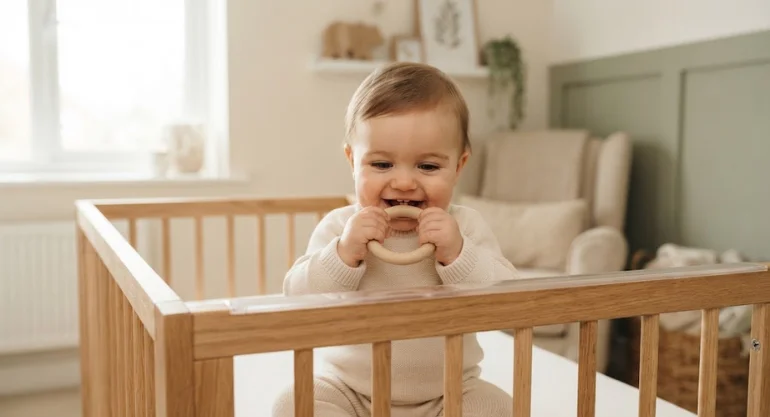
However long any individual episode lasts, a few consistent things help. Something safe to chew on genuinely eases discomfort by applying counterpressure to sore gums, and several of Babymore’s cot beds include teething rails built into the design specifically for babies who chew on the cot itself during this stage, alongside their usual teething toys.
Our guide on natural teething remedies for babies covers gentler, non-medicinal options in more depth if you’d rather start there. If your baby’s chewing has extended beyond toys and hands to furniture, our guide on what to do if your teething baby is biting the cot covers how to manage this safely.
If disrupted nights are part of the picture too, our guide on teething and sleep regression in toddlers covers how the two often overlap.
Teething is really two different timelines at once: a short, few-day episode for each individual tooth, and a much longer, roughly two-to-three-year process overall as your child’s full set of baby teeth comes in. Knowing which one you’re actually asking about, and roughly when is teething over for good, makes the whole stage feel a little less endless, even on the harder nights.
For more support through this stage, our guide on early teething signs by age is worth reading next, and Babymore’s nursery furniture range, including cot beds with built-in teething rails, is designed with exactly this stage of early childhood in mind.
This article is intended as general information and is not a substitute for medical advice. If you have concerns about your baby’s teething, development, or general health, please speak to your GP, health visitor, or dentist.