If you’ve spent the last few nights convinced a new tooth is behind your baby’s sudden refusal to sleep, you’re in good company, it’s one of the most common explanations parents reach for. Plenty of parents type the same question late at night: is teething worse at night? But the research here is genuinely more interesting, and more useful, than the usual assumption.
At Babymore, sleepless nights during the teething stage come up constantly in conversations with parents, so it’s worth looking honestly at what the evidence actually says, alongside the practical tips that help regardless of what’s really behind the wake-ups.
Parents very commonly report that teething disrupts sleep, and it’s a widely held belief among both parents and health professionals. However, a rigorous 2025 study published in the Journal of Pediatrics, using objective video-based sleep monitoring across 849 infants, found no significant difference in actual sleep metrics between teething and non-teething nights, despite over half of parents subjectively reporting disturbances.
This doesn’t mean teething never causes discomfort at night, but it does suggest that other common culprits, developmental leaps, illness, or an underlying sleep association, may be responsible more often than teething gets credit, or blame, for. Genuine teething-related night waking, when it happens, is generally short-lived, resolving within the same 3-to-8-day window as the tooth itself.
The more common pattern parents describe is less sleep, more night waking, and a harder time settling, rather than sleeping more. Genuine teething discomfort, when it is the cause, tends to make it harder for a baby to fall asleep and stay asleep, since pain and general irritability work against settling in the same way they would for anyone.
That said, if teething coincides with a rough night or two, some babies do catch up with longer or more frequent daytime naps as a result, which is really a knock-on effect of poor night sleep rather than teething directly encouraging more daytime sleep.
If you’re trying to work out where your baby actually sits in the wider teething process, our guide on how long does teething last covers the full timeline, and our guide on when babies start teething is a useful starting point if you’re not yet sure whether teething is even in play.
This is genuinely one of the more debated points in infant sleep circles, and it’s worth understanding both sides. The commonly proposed explanation is that daytime offers far more distraction, feeding, playing, being carried and entertained, all of which naturally take a baby’s attention away from gum discomfort, while night-time strips away those distractions and leaves a baby more aware of how their gums actually feel.
Lying flat is also sometimes cited as increasing blood flow and pressure to the head and gums compared to being upright, and naturally lower cortisol levels overnight, cortisol having some anti-inflammatory effect during the day, are occasionally proposed as a contributing factor too.
However, it’s worth being clear that much of this remains more theory than firmly established fact, and the same 2025 study referenced above found no objective difference in sleep disruption specifically tied to teething nights versus non-teething nights, despite parents commonly reporting a “worse at night” pattern.
So when parents ask whether does teething hurt more at night or whether it just feels that way because the house has gone quiet, the honest, balanced answer is that many parents do experience this pattern, and there are plausible explanations for why it might happen, but the strongest recent research urges some caution before assuming every rough night is teething-related, rather than something else entirely.
This isn’t purely an academic point. Researchers behind the 2025 study specifically flagged that misattributing general sleep problems to teething can lead to unnecessary or excessive use of pain relief and local anaesthetic products, when the actual underlying cause of the wake-ups might be a developmental leap, a sleep association that needs adjusting, or, if paired with other symptoms, an illness that deserves its own attention rather than being written off as teething.
This is part of a broader pattern worth being aware of, since symptoms like fever, diarrhoea, and even ear pulling also get blamed on teething far more often than the evidence actually supports. If disrupted sleep is genuinely persistent, well beyond the usual few-day window a single tooth would cause, it’s worth considering these other explanations alongside, or instead of, teething.
Many parents report exactly this pattern, increased fussiness and discomfort building through the afternoon and into the evening, though as above, the strongest recent evidence doesn’t fully confirm teething itself is the driver.
Whether or not does teething get worse in evening turns out to be strictly true, it’s worth noting that early evening is also a common window for general overtiredness and the natural build-up to bedtime fussiness in babies who aren’t teething at all, so it’s genuinely difficult to cleanly separate “worse in the evening because of teething” from “harder in the evening because most babies are harder in the evening.”
Nine months often lines up with molars or additional incisors coming through for many babies, both of which can cause more noticeable discomfort than the earlier front teeth.
Parents dealing with 9 month teething pain at night often find it helps to check for visible teething signs, drooling, gum swelling, gnawing, during the day, before assuming that’s what’s behind the wake-ups.
If night waking coincides clearly with those signs, it’s reasonable to treat it as likely teething-related and respond with the usual gum massage, a chilled teether, or appropriately dosed pain relief before bed if needed.
By 15 months, molars are frequently the culprit, and these larger teeth are commonly reported as more uncomfortable than the earlier incisors.
15 month old teething pain at night tends to respond well to the same basics that help at any age. A consistent bedtime routine, along with the standard relief methods, tends to help even when a specific tooth is clearly the cause.
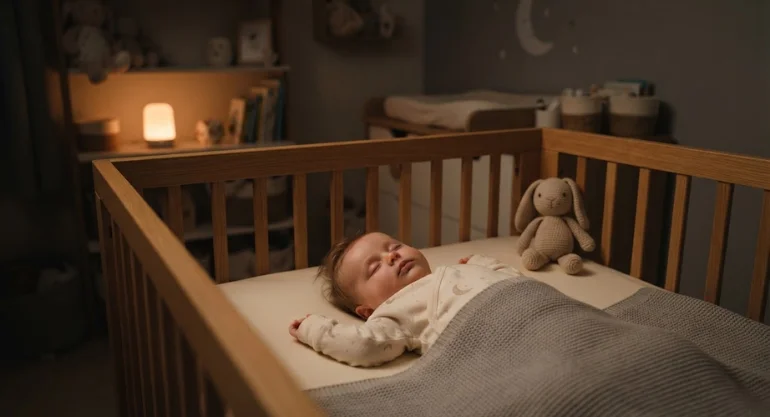
There’s no single officially endorsed best sleeping position for a teething baby, and safe sleep guidance should always take priority over any teething-specific consideration. Babies should continue to be placed on their back to sleep, in line with standard safe sleep advice, regardless of teething.
Some parents find that a slightly more upright position during settling, rather than during actual sleep, seems to help in the moments right before bed, though there’s limited formal evidence behind this specifically for teething, and it shouldn’t come at the expense of following standard back-sleeping guidance once your baby is actually down for the night.
A few things help regardless of how much of the disruption is genuinely teething-related:
A gentle, low-effort settling tool can help here too. Babymore’s Air Motion Gliding Crib responds to a baby’s own movement with a soothing glide, which some parents find useful for resettling without introducing a new rocking-to-sleep habit that’s harder to unwind later.
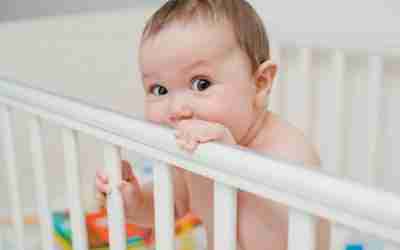
For older babies who’ve moved into a full cot, several of our cot beds include teething rails, useful if disrupted sleep comes with a baby chewing on the cot rail itself once they’re awake and looking for relief, and our guide on adjusting your cot for a teething baby covers getting the base height right as they become more mobile too.
Teething genuinely can disrupt sleep, but the strongest recent research suggests it’s blamed for more sleepless nights than it may actually cause, with other explanations often hiding behind the same assumption. Whatever the true cause on any given night, a consistent routine, appropriate relief when needed, and a bit of patience tend to get most families through it.
For more on recognising genuine teething signs during the day, our guide on early signs of teething by age is a useful companion read, our guide on soothing teething pain safely by age covers relief methods in more depth if disrupted nights are paired with clear daytime discomfort too, and once the teeth are through, our guide on looking after your baby’s teeth after teething is worth bookmarking for the next stage.
This article is intended as general information and is not a substitute for medical advice. Always follow official safe sleep guidance, and speak to your GP or health visitor if you’re concerned about your baby’s sleep or general health.