Somewhere between the baby shower gifts, the hand-me-downs, and the inevitable online order made at 2am, most new parents end up with far more baby clothes than they expected, and nowhere near enough system to find anything in a hurry. A newborn wardrobe that isn’t organised properly doesn’t just look messy, it genuinely slows you down during exactly the moments you can least afford it, a blowout nappy change at 4am, a rushed outing before the weather turns.
At Babymore, we talk to a lot of parents setting up a nursery for the first time, so here’s a practical, step-by-step way to arrange a newborn wardrobe that actually holds up once real life starts happening.
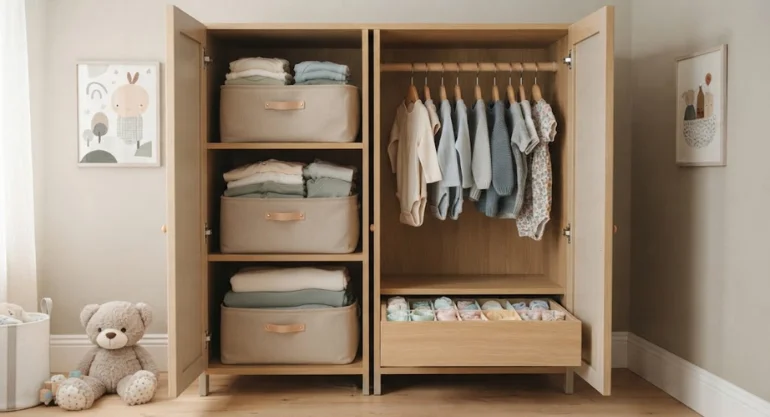
To arrange a newborn baby wardrobe effectively, start by sorting everything into three groups: clothes that fit now, clothes for future sizes, and anything to donate or pack away. From there, organise the “fits now” pile by category (bodysuits, sleepwear, outerwear), by size, and loosely by season, using drawer dividers for small items, storage bins for bulkier ones, and a hanging rail for anything that creeps or special-occasion pieces.
Keep your most-used items, bodysuits, sleepsuits, and swaddles, in the most accessible drawer or shelf, since these get reached for dozens of times a week. Re-sort roughly every three months as your baby moves into the next size bracket.
Before any actual organising happens, empty the wardrobe completely and sort every item into three groups: what currently fits, what’s for a future size, and what’s ready to donate, sell, or pack away for a potential future sibling.
This step alone does most of the heavy lifting, since it’s much easier to organise a smaller, relevant pile of current-size clothing than to work around everything at once. Give yourself permission to move quickly through this step; it doesn’t need to be perfect, just sorted.
With the “fits now” pile sorted, decide what’s going where before you start folding anything. A few storage tools genuinely earn their keep in a newborn wardrobe:
If you’re choosing a wardrobe as part of setting up the nursery from scratch, it’s worth picking one with a genuine mix of hanging rail and drawer space from the outset, rather than working around a single rail with nowhere for folded items.
Babymore’s wardrobe range is built with exactly this balance in mind, and buying it as part of a nursery furniture set alongside a matching chest changer keeps your whole storage system coordinated from day one.
Once your storage is in place, group clothing into clear categories rather than one undifferentiated pile. A workable starting set of categories for a newborn wardrobe:
Keeping one category to one drawer or shelf, rather than splitting it across two spots, makes the whole system faster to use under pressure, which matters more than it sounds during the newborn stage.
Newborns grow fast enough that size, not just category, needs its own sorting layer. Baby clothes are typically sold in roughly three-month size brackets, newborn, 0 to 3 months, 3 to 6 months, and so on, so it makes sense to label drawers or bins by these same brackets.
Keep only the current size within easy reach, and store the next size up separately, whether that’s a labelled bin on a higher shelf or a drawer further back, so you’re not sorting through clothes your baby can’t wear yet every time you’re looking for something they can.
Depending on when your baby was born, seasonal sorting can save real time. Separate lighter, breathable fabrics for spring and summer from warmer layers for autumn and winter, and keep only the current season’s clothing in your most accessible space. This matters less in the very earliest months, when indoor layering dominates regardless of the weather outside, but becomes more useful as your baby starts spending more time outdoors in weather-appropriate clothing.
Baby clothes take up surprisingly little space once hung, especially lengthwise, so a wardrobe with room for a second rail is worth using fully rather than leaving half-empty. A genuinely useful trick: hang bodysuits and rompers upside down, snapping the poppers around the hanger bar rather than pulling the hanger through the neck opening. This lets you fit two or three items on a single hanger without them slipping off, which adds up to real space savings across a full rail.
Beyond the wardrobe itself, it’s worth designating one easily reachable spot, a shelf, a basket, or the top drawer of a chest changer, specifically for a few spare bodysuits, muslins, and a change of sleepwear. This saves you from opening the full wardrobe system for every single nappy change or spit-up moment, which matters considerably more at 3am than it does on a calm Tuesday afternoon.
A newborn wardrobe needs re-sorting roughly every three months, in line with how quickly babies move through clothing sizes. When you notice your baby outgrowing their current bracket, take a few minutes to move the next size up into the accessible spot, and pack away or pass on what no longer fits. Building this into a regular habit, rather than waiting until the wardrobe is genuinely unusable, keeps the whole system working the way it’s meant to.
Beyond the organisation system itself, the wardrobe piece you choose sets the tone for the whole room. A warm oak finish, like our Luno and Veni collections, suits a natural, timeless nursery look, while a softer whitewash or cashmere tone, found across our Caro and Lux collections, works well in a more contemporary, Scandi-neutral room. Whichever finish you choose, prioritising genuine hanging and drawer capacity over style alone will make the organisation system above considerably easier to maintain long-term.
A well-arranged newborn wardrobe isn’t about achieving a picture-perfect drawer, it’s about being able to find what you need in seconds during the moments you’re least equipped to search for it. Sorting by category, size, and season, choosing the right storage tools, and rebuilding the system every few months as your baby grows will keep it working long after the initial setup.
If you’re still choosing the wardrobe itself, Babymore’s wardrobe range and nursery furniture sets are designed with genuine hanging and drawer capacity in mind, and our guides on how to arrange a newborn baby wardrobe and how to organise a baby wardrobe are worth a look too for a few more tips and tricks.