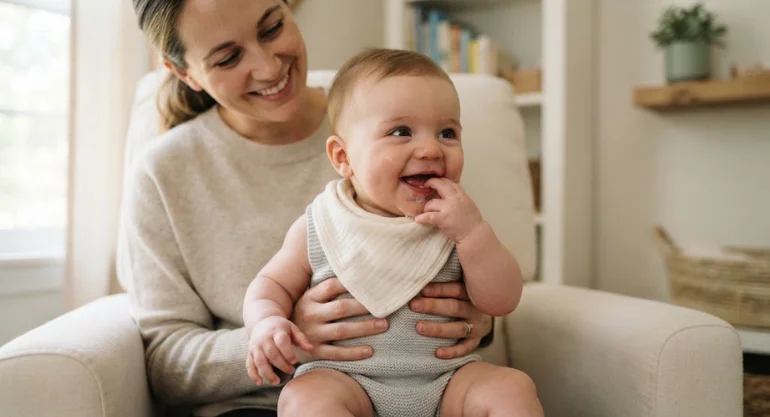
Somewhere around the three-month mark, a lot of parents notice their baby has suddenly become a small, damp fountain, or as some call it, baby dribbling far more than usual. Bibs need changing constantly, onesies feel permanently soggy, and it’s easy to start wondering whether this level of drooling is actually normal or worth mentioning to someone. At Babymore, this is a question we hear from parents constantly, usually somewhere between the second and sixth month, and the reassuring answer in almost every case is that excessive drooling is a completely expected part of early development, not a sign that something’s wrong.
Excessive baby drooling is normal and expected from around 3 months up to roughly 18 to 24 months old, since babies don’t develop full control over their swallowing and mouth muscles until around this age. Drooling typically peaks between 3 and 6 months as salivary glands mature and babies enter an intensely oral stage of development, and it often increases further from 4 to 7 months onward as teething begins, leading to excessive saliva production. Genuine medical causes of excessive drooling are far less common and are usually accompanied by other clear signs, like difficulty swallowing, breathing problems, or visible illness, rather than drooling on its own.
Newborns actually produce relatively little saliva in their first few weeks. Drooling in earnest tends to kick in around 2 to 3 months old, as a baby’s salivary glands mature and become genuinely more active than they were at birth. This isn’t random timing, it lines up with the same window babies start bringing their hands and other objects to their mouths as part of general sensory exploration, and increased saliva production goes hand in hand with that stage.
Three months sits right at the start of the most common drooling window, and it’s genuinely one of the most frequently asked questions from parents at this stage. Around this age, salivary glands are ramping up production, and babies are becoming increasingly focused on bringing objects, including their own hands, to their mouths. If your 3 month old is drooling a lot, even without any other symptoms, it’s well within the range of normal development rather than something to worry about.
0 to 2 months: Drooling is typically minimal at this stage, since salivary gland activity hasn’t fully ramped up yet.
2 to 4 months: Saliva production increases noticeably as glands mature, coinciding with babies becoming more interested in mouthing their hands and nearby objects.
3 to 6 months: This is generally when drooling peaks, driven by the combination of continued salivary gland development and an intensely oral stage of exploration, where a baby’s mouth becomes their primary way of investigating the world.
4 to 7 months: Teething often begins during this window, which drives saliva production even further, since increased drooling is one of the body’s natural responses to the discomfort of new teeth pushing through the gums. Check out our guide on when babies start teething for a full age-by-age breakdown.
Up to 18 to 24 months: Some degree of drooling remains normal throughout this period, since babies don’t develop full, mature control over their swallowing and mouth muscles until somewhere around this age. It’s genuinely common for drooling to continue on and off well into the second year, particularly during naps or when a baby is focused on something else.
Not necessarily, and this is a common point of confusion. Drooling and teething frequently overlap, since increased saliva production is a recognised part of the teething process, but drooling on its own doesn’t confirm teething is happening, and a baby can absolutely be teething without an especially noticeable increase in drool. If you’re trying to work out whether drooling specifically points to teething, look for it alongside other signs, gum swelling, increased chewing or gnawing, flushed cheeks, and general fussiness, rather than treating drool volume alone as a reliable indicator.
Some babies also pull at their ears during this stage, which can be another useful sign to watch alongside drooling.
The overwhelming majority of baby drooling is entirely typical and tied to normal development, but a few less common situations are worth knowing about. Drooling can genuinely increase temporarily during a cold or minor illness, since the body produces more mucus and saliva as part of fighting off infection. In rarer cases, difficulty swallowing, caused by an infection, an allergic reaction, or something obstructing the airway, can also lead to a sudden, more dramatic increase in drooling, and this is usually accompanied by your baby seeming genuinely unwell, distressed, or having trouble breathing, not simply producing more saliva than usual.
It’s also worth knowing that increased drooling isn’t usually paired with diarrhoea during teething, so if your baby has both, it’s worth keeping an eye on for other signs of illness. Ongoing, significant drooling beyond the toddler years, particularly alongside developmental delays, can occasionally be linked to broader neurological or muscle tone conditions, though this is a separate and considerably less common picture from the everyday drooling most babies experience in their first two years.
A few practical steps make the drooling stage easier to live with, even though there’s rarely a need to treat it as a problem to solve:
Most drooling doesn’t need medical attention, but it’s worth contacting your GP or health visitor if your baby:
A permanently damp chin is one of the most predictable features of the first two years of parenthood, and in the vast majority of cases, it’s simply a sign that your baby’s salivary glands, oral exploration, and eventually their teething are all developing exactly as expected. Keeping a good supply of bibs on hand will get you through it far more than any need to intervene.
If drooling has ramped up alongside other signs like chewing and gum swelling, our guide on teething and sleep regression is worth reading next, since the two so often show up together.