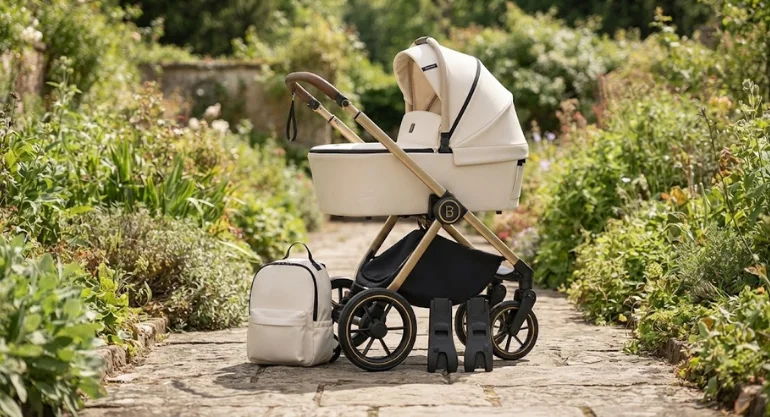
A travel system takes a genuine beating over its working life, daily kerbs, gravel paths, being folded and unfolded dozens of times a week, left out in the rain more often than anyone would like to admit. Most of that wear is entirely normal, and most of it is fixable without replacing the whole unit. The trick is knowing which parts are supposed to wear out and get swapped, and which failures actually mean it’s time to retire the pushchair altogether.
At Babymore, we’d rather help you keep a good travel system running for its full useful life than push a replacement purchase before it’s genuinely needed, so here’s the real order things tend to fail in, and what to do about each one.
Wheels and tyres are typically the first part of a travel system to show real wear, followed by harness straps and rain covers, both of which take constant daily handling and UV exposure. Fabric waterproofing fades gradually over a similar timeline. Chassis locks and the folding mechanism are the more serious, less common failure, and usually signal it’s worth weighing repair cost against replacement.
A well-maintained travel system should reasonably last 4 to 5 years covering one child from birth through toddlerhood, though UK manufacturer warranties typically only run 1 to 2 years as standard and specifically exclude normal wear and tear, which is exactly what spare parts exist to cover. Genuine spare parts are generally available directly from the manufacturer, and it’s worth avoiding unapproved third-party parts on safety-critical components like the chassis lock or harness.
With reasonable care, a good-quality travel system should comfortably last 4 to 5 years, enough to cover one child from birth through to the end of toddlerhood, and sometimes longer if a second child follows. How hard it’s used matters more than the calendar, though: a pushchair used daily on mixed terrain, gravel paths, kerbs, wears down noticeably faster than one used mostly on smooth pavements a few times a week.
Storage conditions matter too, since damp storage accelerates corrosion on metal components and speeds up fabric wear in ways daily use alone doesn’t, our guide on how to store your stroller compactly covers keeping it protected between outings. If you’re trying to work out whether your own pushchair is nearing the end of its useful life rather than just needing a part replaced, our guide on when to stop using a pram is worth reading alongside this one.
Based on how travel systems are actually used day to day, a fairly consistent pattern shows up across most brands and models.
Wheels take more direct, repeated impact than any other part of the system, kerbs, gravel, potholes, and general road grit all wear them down steadily. This is almost always the first thing to show real wear, whether that’s a wobble, uneven rolling, or visible tread damage.
Regularly checking wheel security and tyre condition is one of the core habits covered in our pushchair maintenance tips, worth building into a routine rather than only checking once a problem’s already obvious. This wear also speeds up in cold, wet conditions, so our tips on preparing your pushchair for winter adventures are worth a look before the weather turns.
Buckled and unbuckled multiple times a day, often under some tension, harness webbing wears gradually through friction and repeated washing, alongside natural UV fading if the pushchair spends much time outdoors.
This is a genuinely safety-critical part, worth checking regularly rather than waiting for obvious damage. UK trading standards guidance specifically flags checking harness webbing for fraying as one of the key safety checks on any pram or pushchair, new or used.
Thin PVC or fabric rain covers are usually the first accessory to fail outright, developing cracks or tears at fold lines and seams well before the main pushchair shows comparable wear. They’re also the cheapest and easiest part to simply replace once damaged.
Our guide on pram and pushchair accessories covers what’s worth having on hand, including a spare rain cover, before the original one actually fails on you mid-walk.
The water-repellent treatment on the main seat and canopy fabric wears down gradually with sun exposure and washing, usually noticeable as water soaking in rather than beading on the surface. This is a genuine, expected part of the lifecycle rather than a fault, and it’s addressed with reproofing rather than replacement in most cases; our guide on how to weatherproof your pushchair covers this in more depth.
This is where things get more serious. The chassis relies on primary and secondary locking mechanisms to stay safely open during use, and UK trading standards guidance specifically recommends checking that both engage and work properly, since a failing lock is a genuine safety issue, not just an inconvenience.
Chassis lock failure is less common than wheel or harness wear, but when it happens, it’s usually a sign of more significant mechanical fatigue than a simple part swap can always fix. Our guide on common chassis and folding errors is worth checking before assuming the worst, since some folding issues come down to technique rather than a genuine fault.
Brake cables and mechanisms wear more slowly than the parts above, but grit and debris buildup can cause a brake to feel stiff or fail to engage fully well before the cable itself is actually worn out, which is worth ruling out with a clean before assuming a full brake replacement is needed.
Most of what wears out on a travel system is genuinely repairable or replaceable as an individual part, and doing so is almost always cheaper and more sustainable than replacing the whole unit. Wheels, tyres, harness straps, rain covers, and fabric components all fall into this category, and our guide on how to extend the lifespan of your travel system is worth a read before you get to the point of needing any of it. Chassis lock failure and significant frame damage sit in a different bracket: if a locking mechanism won’t engage reliably even after cleaning and basic troubleshooting, or if the frame itself shows bending or cracking from an impact, it’s worth weighing the cost of a proper repair against the cost of a new travel system, since safety-critical structural issues aren’t always worth patching if the underlying mechanism is genuinely compromised.
If replacement turns out to be the right call, our travel systems range is worth browsing with the wear patterns above in mind, so the next one holds up even better, and our guide to buying baby travel systems in 2026 covers what to look for if you’re starting from scratch.
This is worth understanding clearly, since it’s a common source of frustration when a warranty claim gets declined. Most UK pushchair manufacturers offer a standard warranty period of around 1 to 2 years, sometimes extendable to 3 or 4 years through product registration, covering genuine manufacturing defects in the chassis, frame, wheels, and harness system.
What warranties consistently exclude, across virtually every major manufacturer, is normal wear and tear: worn wheels and tyres, natural fabric fading, and general wear from regular use are explicitly not covered, regardless of how early they show up. This isn’t a loophole, it’s a standard, industry-wide distinction, and it’s exactly why spare parts exist as a separate route from a warranty claim.
Generally, yes, and it’s worth sourcing them directly from the manufacturer rather than an unverified third-party seller. Genuine replacement parts are built to the exact specifications of your specific model, which matters enormously for anything safety-critical, the chassis lock, the harness, the wheel attachment points. Babymore’s own product documentation is explicit on this point: don’t use replacement parts that aren’t recommended or supplied by Babymore, since parts that aren’t a genuine match can compromise how the whole system locks, folds, or restrains your child.
If you’re still deciding which travel system suits your family in the first place, our pushchair guide is worth a read, since choosing a model with genuinely available spare parts is worth factoring into that decision too.
If you need a replacement part for a Babymore pushchair, pram, or travel system, the most reliable route is contacting Babymore customer services directly, either by phone on 020 3475 5588 or by email at customerservices@babymore.co.uk, rather than searching for third-party alternatives online. Having your model name and, where possible, a note of which specific part needs replacing ready before you get in touch makes the process considerably quicker.
This is worth doing even for parts that seem minor, a rain cover, a wheel, since getting the exact matching component is what keeps the rest of the system working, and locking, the way it’s designed to.
Most of what wears out on a travel system over its working life is entirely normal, and entirely fixable without starting over. Wheels, harness straps, and rain covers lead the way, fabric waterproofing follows a similar timeline, and chassis lock issues, while less common, are the genuine signal to look more closely at whether a repair or a replacement makes more sense.
If you need a genuine replacement part for your Babymore travel system, our customer services team is the right first call, on 020 3475 5588 or at customerservices@babymore.co.uk, and our guides on pushchair maintenance tips and how to clean a pushchair are worth reading alongside this one to help catch wear early, before it becomes a bigger repair.