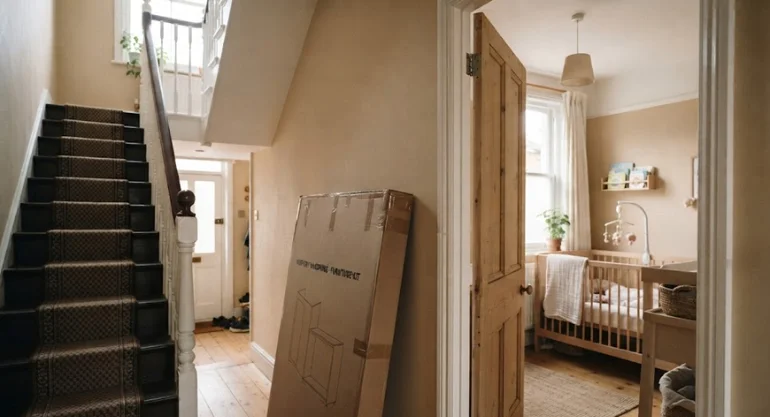
There’s a particular kind of dread that sets in when a delivery van pulls away, leaving a flat-pack wardrobe box wedged sideways in your hallway, and you realise nobody checked whether it would actually get up the stairs. Most nurseries in the UK sit in converted box rooms, terraced house second bedrooms, or flats where every square foot counts, which means the gap between “looks great online” and “fits through my actual doorway” is often narrower than people expect.
At Babymore, we field enough delivery day questions from customers in period terraces and older conversions that it’s worth setting out, properly, exactly what to measure before you commit to that cot bed or three-piece nursery set.
Will nursery furniture fit through the door? The honest answer is: it depends on more than the doorway alone. You need to check the full route, every doorway, hallway turn, staircase, and landing between the delivery van and the nursery, comparing the narrowest point along that route against the furniture’s largest dimension, not just its width. Crucially, check whether the item arrives assembled or flat-packed.
Most nursery furniture, including Babymore’s ranges, ships flat-packed for self-assembly, which sidesteps the vast majority of “will it fit” problems entirely, since individual boxed panels are far easier to manoeuvre through a tight terraced hallway than a fully built wardrobe.
Furniture retailers across the UK all point to the same recurring failure point: it’s rarely the doorway itself that causes the problem, it’s the turn just before or after it. A hallway that’s plenty wide on its own can still defeat a delivery if there’s a 90-degree turn into the stairwell with no room to pivot, and older terraced houses in particular tend to have narrower halls, tighter stair turns, and lower ceiling heights at the top of the stairs than newer builds.
If you’re furnishing a nursery in exactly this kind of property, and a huge number of UK nurseries are, it’s worth treating the measuring stage as seriously as choosing the furniture itself.
Before measuring anything, physically walk the path the furniture will take, from the front door, or wherever the delivery driver will bring it in, all the way to its final spot in the nursery. Note every point where the route narrows: front door, hallway, any internal doors, the base of the stairs, every turn on the stairs, the landing, and the nursery door itself. Professional delivery guidance is consistent on this point: measuring the room but forgetting the route is one of the most common and most avoidable causes of a failed delivery.
For each doorway along the route, measure the clear opening, the actual usable gap once the door is open and the frame is accounted for, not just the door’s nominal size. Measure at a few different heights too, since older properties can bow or lean slightly over the years, and you want to use the smallest reading as your working figure. Door height matters as much as width, particularly for anything tall like a wardrobe, since many pieces have to go through tilted rather than upright.
This is the single biggest variable in whether nursery furniture will fit, and it’s worth understanding clearly before you compare product dimensions to your doorway.
Assembled delivery means the item arrives built, or built into large sub-sections, which means you’re working against its full external dimensions, height, width, and depth, all at once. A pre-built wardrobe that’s 170cm tall and 85cm wide has to clear every doorway and turn at those dimensions or close to them.
Flat-packed delivery, which is how the vast majority of nursery wardrobes, cot beds, and changing units are shipped, including Babymore’s own ranges, arrives as individual flat panels in a box. A wardrobe that’s 170cm tall assembled might ship in a box closer to 90cm by 60cm by 15cm, which is a dramatically easier shape to get through a narrow terraced hallway or up a tight staircase turn.
If you’re checking a Babymore product page and see “flat pack, self-assembly required,” that’s genuinely good news for anyone worried about access, since you’re really only measuring the boxed dimensions against your route, not the full assembled size.
Measure the narrowest usable width along the entire staircase, not just at the bottom. Bannisters, radiators, and light fittings can all eat into the usable width partway up. Just as important is headroom, the ceiling or sloped soffit height directly above the stairs, since carrying anything long or tall up a staircase requires tilting it, and a low ceiling at a turn can stop that tilt dead. If your staircase has any bend or half-landing, that’s usually where deliveries actually get stuck, not on the straight flights.
Landings, the flat sections where a staircase changes direction, need enough depth for a piece of furniture to pivot round the corner, not just enough width to pass through. A useful way to think about it: compare the landing’s depth against the length of the item being carried. If the landing is shallower than the furniture is long, the piece physically can’t complete the turn, since there’s nowhere for it to swing into as it rotates.
This is one of the most common and most avoidable sticking points in UK deliveries, particularly in older properties where landings were never designed with modern furniture dimensions in mind.
If you live in a Victorian or Edwardian terrace, and a significant share of UK nursery deliveries do, it’s worth measuring with extra care. These properties often have narrower staircases than modern builds, tighter 90-degree turns partway up, and lower ceiling heights at the turn itself, exactly the combination that causes the most delivery problems.
The good news is that this is precisely the scenario where flat-pack delivery earns its keep. Individual panels, even for a full wardrobe or cot bed, are usually narrow and light enough to carry up a tight terraced staircase that would defeat a pre-assembled piece entirely.
Yes, and for most flat-pack nursery furniture, this is exactly the point. Rather than building the wardrobe downstairs and then trying to manoeuvre a finished, rigid unit up the stairs, you carry the individual flat panels up separately, then assemble the piece directly in the nursery. This sidesteps the doorway and staircase problem almost entirely, since you’re only ever moving flat, boxed components rather than a bulky finished shape.
It’s one of the main practical reasons flat-pack nursery furniture, including wardrobes and cot beds in Babymore’s ranges, tends to work so much more reliably in period properties and smaller UK homes than pre-built alternatives.
Product pages typically list the assembled size, useful for planning where the piece will sit in the finished room, but not always the figure you need for the delivery route itself. If a product is flat-packed, the boxed dimensions are usually smaller and easier to manoeuvre than the assembled size might suggest.
If the boxed measurements aren’t listed clearly on the product page, it’s worth contacting customer service directly before ordering, particularly if you know your access is tight, since most retailers can confirm packaging dimensions even when they’re not published upfront.
It’s worth understanding your delivery service’s policy before you order, not after a failed delivery. Standard delivery services for nursery furniture in the UK typically bring items to the front door of the property only, and for flats or multi-floor buildings, delivery is often made to the building entrance rather than an individual apartment door. If you need help getting a larger item further into the home, a premium “room of choice” delivery service, which some retailers, including Babymore, offer for a modest fee, can include carrying items up multiple flights of stairs.
Checking what level of delivery service is included, and what upgrades are available, is worth doing before ordering if you already suspect your access might be tight.
A little measuring tape work before you order saves a genuinely stressful delivery day, particularly if you’re furnishing a nursery in an older terraced property or a smaller UK home. Mapping the full route, checking clear openings rather than nominal door sizes, and understanding whether your furniture arrives flat-packed or assembled will tell you almost everything you need to know before you click buy.
If you’re planning a nursery in a smaller or older UK home, our guides on small nursery ideas and nursery storage ideas that actually save space cover how to make the most of a compact room once your furniture is safely in place. Babymore’s nursery furniture range ships flat-packed as standard, specifically to make deliveries into period properties and tighter UK homes as painless as possible.
Once your bigger pieces are safely in place, it’s worth thinking about the smaller comfort pieces too, a good nursing chair for late-night feeds is often the next thing parents look for.