Somewhere around the second or third week home with a newborn, most parents have the same realisation at roughly 3 am: standing up, mid-feed, to fetch a muslin from across the room is not a sustainable way to live. Newborns feed anywhere from eight to twelve times in twenty-four hours, and a meaningful chunk of those feeds happen while the rest of the house is asleep.
A proper night feed station, everything you need within arm’s reach of your nursing chair, is one of those small setup jobs that pays for itself almost immediately. At Babymore, we’ve spent a lot of time talking to parents about what actually gets used at 3am versus what just looks nice on a shelf, so this guide focuses on the practical, tested version rather than the aspirational one.
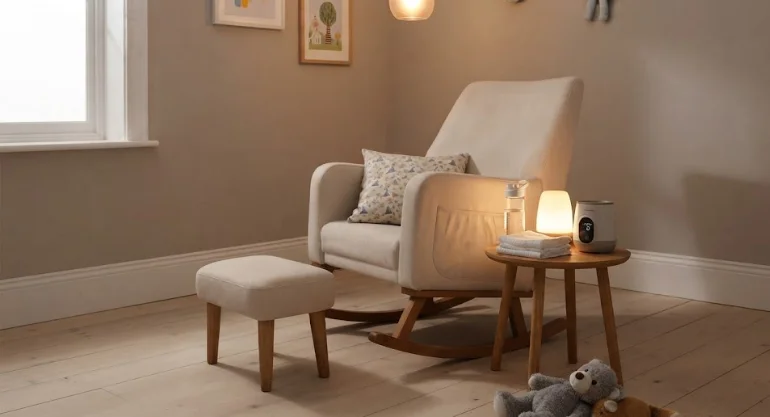
A well-set-up night feed station keeps everything you’ll need for a feed within one-handed reach of your nursing chair, so you’re never standing up, walking away, or fully waking yourself or your baby. At minimum, that means a dim, adjustable light source, a water bottle or glass within reach, burp cloths stored somewhere you can grab one without looking, and, if you’re bottle feeding, a safe way to prepare or warm milk without leaving the chair. A small side table beside the chair is what ties it together, giving you a stable surface for all of the above without cluttering the floor or reaching across your baby.
It’s tempting to assume this is just a nice-to-have, but the logic holds up. Every unnecessary movement during a night feed, standing up, walking to another room, fumbling in the dark for a muslin, is a chance to fully wake yourself and, worse, to fully wake your baby right as they were drifting back off. Feeding responsively during the night, without turning it into a fully lit, wide-awake event, is something NHS infant feeding guidance touches on directly: keeping the environment calm, dim, and low-stimulation helps signal to your baby that it’s still night-time, which supports the process of them gradually learning to settle back to sleep after feeds. A stocked station isn’t about convenience for its own sake, it’s genuinely part of how you keep night feeds feeling like night feeds rather than daytime interactions.
Before getting into what goes beside the chair, the chair itself is worth a mention, since it shapes what “beside” even means. A nursing chair with built-in arm pockets solves a surprising amount of the night feed station problem before you’ve added a single extra item. Babymore’s Freya Nursing Chair with Footstool and Lux Nursing Chair with Footstool both include storage pockets built into the arms, which means a muslin, your phone, or a water bottle can live within a few inches of your free hand without needing a table at all. A gentle glider or rocking motion also matters here, since a chair that rocks smoothly rather than jerkily is far less likely to fully rouse a baby who’s drifted off mid-feed. We go into the comfort side of this in more detail in our guide on nursing chair versus a regular chair, if you’re still deciding whether a dedicated chair is worth it.
Here’s what actually earns a permanent spot within reach of the chair, based on what gets used repeatedly rather than what sounds useful in theory.
A small side table beside your nursing chair is what turns loose items into an actual station rather than a pile on the floor. It doesn’t need to be large, just stable enough to hold a drink without tipping, and at a height you can reach without twisting your torso while holding your baby. Look for a table with a lip or raised edge if you can find one, since a flat surface is easy to knock things off in the dark. If your nursery already includes a chest changer nearby, the top surface can sometimes double as extra flat space for a lamp or spare muslins, particularly in smaller UK nurseries where a dedicated table isn’t always practical.
This is one of the most consistently recommended items across parenting and infant sleep guidance, and for good reason. Bright overhead light during a night feed doesn’t just make the room harder on your own eyes, it can suppress melatonin production in both you and your baby, making it harder for either of you to settle back to sleep afterwards. A dimmable lamp, or a soft-glow night light in a warm amber or red tone rather than white or blue light, gives you just enough visibility to check latch or bottle position without fully signalling “daytime” to your baby’s system. Position it so it lights the feeding area without shining directly into your baby’s eyes.
The single most avoidable 3am scramble is reaching for a burp cloth after the fact rather than before. A small basket, a hook on the side table, or simply the arm pocket of a chair like the Freya or Lux keeps two or three muslins accessible without looking. Keep a small pile rather than a single cloth, since a genuinely messy feed can go through more than one, and you don’t want to be standing up mid-feed to fetch a replacement.
Breastfeeding increases your fluid needs, and night feeds are exactly the moment you’re least likely to remember to hydrate on your own initiative. Keeping a filled water bottle or a glass permanently on the side table means you’re not relying on remembering to bring one in each time you sit down, particularly useful for the 2am feeds where forming that thought at all can feel like a lot to ask. A bottle with a straw or flip-top lid is worth considering specifically because it can be opened and drunk from one-handed while your other arm is occupied.
If you’re formula feeding or feeding expressed milk overnight, a bottle warmer beside the chair can genuinely cut down on how long you’re both awake, but it’s worth setting this up with safety in mind rather than just convenience. UK guidance on formula preparation is clear that milk shouldn’t be left warming for extended periods or reheated repeatedly, so the safest overnight setup is usually preparing a fresh bottle just before the feed rather than keeping one warming for a long stretch beforehand. If you use a plug-in warmer, position it somewhere the cord isn’t crossing your seating area or your baby’s sleep space, and always test the temperature on your wrist before offering the bottle, even with a warmer that claims to regulate temperature automatically.
The theme running through all of the above is that everything should be usable one-handed, since your other arm is, realistically, going to be holding a baby for the entire feed. This means: no items that need two hands to open, nothing requiring you to stand to reach it, and nothing balanced precariously enough that a sleepy, one-handed grab might knock it over. If you’re testing your setup in daylight, try reaching for everything one-handed and with your eyes closed. If anything requires two hands or a full stretch, it’s in the wrong spot.
Beyond the physical setup, a few habits make a real difference in keeping night feeds calm rather than fully waking:
Everything above applies whether you’re breastfeeding or bottle feeding, but bottle feeding adds a couple of extra logistics worth planning for. If you’re using formula, consider whether pre-measuring powder into individual portions during the day (without adding water until you’re ready to feed) can shave a step off the night routine. If you’re feeding expressed milk, keeping a small, well-insulated cool bag beside the chair, rather than making a trip to the kitchen fridge, keeps the whole process closer to one-handed and one-location.
A night feed station isn’t about buying more things, it’s about making sure the handful of things you genuinely need are exactly where your free hand expects them to be at 3am. A nursing chair with built-in storage, a small stable side table, dim rather than bright lighting, and a water bottle within reach cover most of what actually gets used night after night. The goal isn’t a picture-perfect setup, it’s one that lets you get through a feed without fully waking either of you.
If you’re still working out the rest of your night feed setup, our guide on the 2am chair and making night feeds more comfortable goes further into the wider environment, from lighting to leg support. And if you’re furnishing the nursery from scratch, our essential nursery furniture set guide covers how a nursing chair, chest changer, and side table work together as a complete space, alongside Babymore’s own range of nursing chairs and nursery furniture built with exactly this kind of overnight use in mind.