Whether you’re setting up a nursery or checking a hand-me-down cot, the questions start quickly. What size is a standard cot mattress? Is a cot bed mattress bigger? Are all baby mattresses the same size? The short answer is that UK cots are fairly standard, but the cot bed, crib and Moses basket world is not, and a mattress that is a few centimetres too small is a real safety issue. This guide explains the standard cot mattress size, the cot bed mattress size, how cribs and Moses baskets differ, how thick a mattress should be, and exactly how to measure so you know what a safe fit looks like.
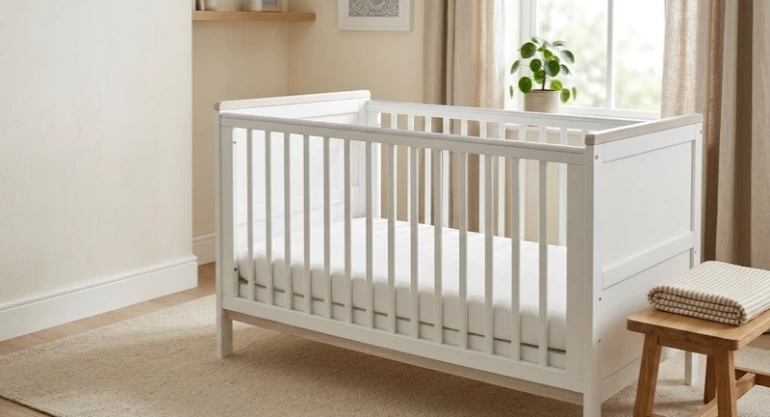
A standard UK cot mattress is 120 x 60 cm, and a standard UK cot bed mattress is usually 140 x 70 cm. Both are normally around 10 cm thick. Some cot beds are smaller and take a 120 x 60 cm mattress, so always check your cot bed’s own instructions or measure the inside of the frame. A mattress should fit snugly, with no more than a 3 cm gap between the mattress edge and the sides of the cot. Cribs, Moses baskets and travel cots use different, smaller sizes.
|
Bed type |
Standard mattress size (length x width) |
In inches |
Typical age range |
| Standard cot | 120 x 60 cm | about 47 x 24 in | Birth to around 2 years |
| Cot bed (larger) | 140 x 70 cm | about 55 x 28 in | Birth to around 5 years |
| Cot bed (smaller) | 120 x 60 cm | about 47 x 24 in | Birth to around 4 years |
| Small cot or mini cot | 100 x 50 cm | about 39 x 20 in | Birth to around 1 year |
| Crib or Moses basket | Varies by model | n/a | First few months |
| Travel cot | Varies by model | n/a | Birth onwards, for travel |
Measurements are given as length x width. “60 x 120” and “120 x 60” mean the same mattress.
The standard UK cot mattress size is 120 cm long and 60 cm wide. Most mainstream cots are built to take this size, so it is the one you’ll see sold as a “cot mattress” in most shops. Dimensions are listed as length first, then width, then thickness, for example 120 x 60 x 10 cm. Babymore’s mattress guide gives the same standard sizes: 120 x 60 cm for a cot and 140 x 70 cm for a cot bed.
If you’re searching for a “60×120 cot mattress” or a “120 x 60 cot mattress”, you’re looking for the same thing. We have a dedicated guide to the 120 x 60 cm cot mattress with every option in this size.
Most cot beds take a 140 x 70 cm mattress. That is larger than a standard cot because a cot bed is designed to last longer, converting into a toddler bed.
Not every cot bed is 140 x 70 cm. Some compact cot beds take the smaller 120 x 60 cm mattress. For example, Babymore’s Iris Cot Bed takes a 120 x 60 cm mattress, which is not included. So never buy a mattress by the words “cot bed” alone. Check the mattress size listed for your own cot bed.
Take five minutes to measure properly:
Not sure which cot bed you have? Our guide to choosing the right cot bed explains the differences.
A cot mattress should fit snugly, with no gaps where a baby’s limbs, head or face could get trapped. Babymore’s guidance is that there should be no more than a 3 cm gap between the edge of the mattress and the sides of the cot.
A quick test: push the mattress hard into one corner of the cot, then measure the gap on the opposite sides. Do the same on the other corner. If the gap is bigger than 3 cm anywhere, the mattress is too small. A mattress that is too big is no better, because it can curl up at the edges and leave the surface uneven.
If your cot is a non-standard or non-UK size, you may need a custom-sized mattress.
Most cot and cot bed mattresses are around 10 cm thick. Babymore’s mattress guide advises that about 10 cm gives good support and holds its shape, that mattresses of 7 to 8 cm are better kept for occasional use, and that a mattress shouldn’t be more than 10 cm deep, so it doesn’t leave too small a gap between the mattress and the top of the cot sides.
Look for a mattress made to BS EN 16890:2017, the standard for mattresses for cots. For more on what a mattress is made of and what suits your baby, see our mattress guide, and read about the different options in TYPES OF BABY MATTRESS and WHAT ARE BABY MATTRESSES MADE OF.
| Features |
Cot |
Cot bed |
Crib or Moses basket |
| Mattress size | 120 x 60 cm | 140 x 70 cm (some 120 x 60 cm) | Smaller, varies by model |
| Converts to a toddler bed? | No | Yes | No |
| Used from | Birth | Birth | Birth |
| Typical use | Up to around 2 years | Up to around 5 years | First few months |
| Mattress included? | Often not | Often not | Usually yes |
Cribs and Moses baskets have no standard mattress size, so always use the mattress made for yours. For example, Babymore’s Air Motion Gliding Crib comes with its own fibre mattress and takes a replacement of the same size. Do not use a standard cot mattress in a crib. For more on choosing between them, read our guide to Moses basket vs crib and the difference between a cot and a cot bed.
No. Cot mattresses in the UK are fairly standard at 120 x 60 cm, and cot bed mattresses at 140 x 70 cm. Beyond that, sizes vary:
For reference, Babymore’s cot mattresses come in three sizes: 120 x 60 cm, 140 x 70 cm and a smaller 100 x 50 cm. All four ranges are available in the standard cot and cot bed sizes:
|
Mattress range |
120 x 60 cm cot |
140 x 70 cm cot bed |
| Premium Core | Premium Core Cot Mattress | Premium Core Cot Bed Mattress |
| Pocket Sprung | Pocket Sprung Cot Mattress | Pocket Sprung Cot Bed Mattress |
| Deluxe Sprung | Deluxe Sprung Cot Mattress | Deluxe Sprung Cot Bed Mattress |
| Eco Fibre | Eco Fibre Cot Mattress | Eco Fibre Cot Bed Mattress |
The Eco Fibre range also comes in a smaller 100 x 50 cm size for smaller cots. Browse all cot mattresses, cot bed mattresses or the full baby mattress range. The pocket sprung cot mattress page explains what’s inside one.
Setting up the nursery? Our nursery furniture checklist covers the rest, and our guide to cot bed safety covers safe set-up. If you are assembling the room, our guide to assembling nursery furniture can help with the next steps.
For most UK families, the numbers to remember are 120 x 60 cm for a cot and 140 x 70 cm for a cot bed, around 10 cm thick, with no more than a 3 cm gap at the edges. But the cot’s own instructions always come first, because not every cot bed follows the standard. Measure, check, and match the mattress to the frame.
Want to go further? Our mattress guide explains firmness, materials and safety standards, and our cot mattresses and cot bed mattresses pages list what is available in each size.