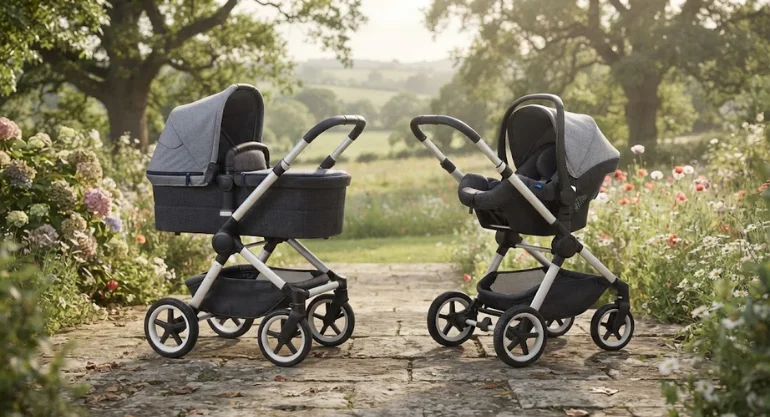
Scroll through any pushchair listing in the UK and you’ll run into the same two labels over and over: 2-in-1 and 3-in-1. They sound similar, they’re often priced close together, and it’s genuinely easy to assume one is just a slightly upgraded version of the other. It isn’t quite that simple. The number refers to exactly how many pieces of equipment you’re getting in the box, and that changes what the pushchair can actually do for you from newborn right through to toddlerhood. Here’s what each set-up includes, how they differ from a pram, and how to work out which one actually fits your family.
A 2-in-1 pushchair typically includes a carrycot and a pushchair seat unit that both attach to the same chassis; enough to take your baby from a flat, newborn-safe lying position through to sitting upright as a toddler, but with no car seat included. A 3-in-1 pushchair (often sold as a travel system) adds a compatible infant car seat to that same combination, so the full set covers carrycot, seat unit, and car seat, letting you move your baby between car and pushchair without waking them. The right choice usually comes down to whether you already own or plan to buy a car seat separately, and whether you want everything bundled together from day one.
| Feature | 2-in-1 Pram Pushchair | 3-in-1 Travel System |
|---|---|---|
| What’s included | Carrycot + pushchair seat unit | Carrycot + seat unit + car seat |
| Car seat | Not included (adapters usually provided) | Included, clips onto the same chassis |
| Best for | Families who already own a car seat, or don’t drive often | Families who want one bundled set-up covering car and pushchair use |
| Typical use | Birth to toddler, on foot | Birth to toddler, including regular car journeys |
| Upfront cost | Generally lower | Generally higher, but bundles the car seat cost in |
| Car-to-pushchair transfers | Not applicable | Car seat clicks on and off without disturbing baby |
Neither is objectively “better”; they’re built for different everyday routines. A 3-in-1 earns its extra cost back quickly for a family doing regular car journeys with a young baby, while a 2-in-1 makes more sense if the car seat isn’t the priority, whether that’s because you already have one, you’re mainly walking or using public transport, or you’d rather choose your car seat separately to match a specific car. Once your baby is old enough to sit upright and you’re deciding which way the seat unit should face, when can a baby sit in a front-facing stroller or pushchair is a useful next read, whichever set-up you go with.
Before comparing 2-in-1 and 3-in-1 set-ups, it helps to clarify the underlying terms, since “pram” and “pushchair” are often used interchangeably but technically describe two different things; our pram vs pushchair guide breaks the comparison down even further.
A pram is designed for newborns and young babies who need to lie completely flat, either as a fixed carrycot body or a lie-flat bassinet attachment. It’s rear-facing by design, since newborns need to lie flat for safe breathing and healthy spine development in these early months. If you’re not sure your baby’s ready to move from the flat, lying-down stage to an upright seat yet, when to move your baby from pram to pushchair walks through the readiness signs to look for.
A pushchair, sometimes called a buggy or stroller, is built for babies who can sit upright unsupported, generally from around six months, and typically offers a more reclined seat rather than a fully flat lying position, along with the option to face forward or toward the parent.
Most modern travel systems, including 2-in-1 and 3-in-1 set-ups, are designed to cover both stages on one chassis, which is exactly why the “how many pieces” distinction matters. If you want a fuller breakdown of how prams, buggies, pushchairs, strollers, and travel systems all relate to one another, our guide on the difference between a pram, buggy, pushchair, stroller, and travel system covers each term in turn.
A 2-in-1 pram pushchair gives you two attachments for one chassis: a carrycot for the newborn stage and a pushchair seat for when your baby is older. Both pieces click onto the same frame, so you’re not buying two separate pieces of equipment — just two interchangeable tops for one base.
Babymore’s Mimi 2 in 1 Pram Pushchair is a good example of how this works in practice. The carrycot mode supports your baby from birth up to around 6 months (or 9kg), giving a flat, newborn-safe lying position, while the seat unit takes over from roughly 6 months through to about 4 years (up to 22kg), with the option to face your baby toward you or out toward the world. It also comes with universal car seat adapters included as standard, so a compatible infant car seat can be added later; the car seat itself just isn’t part of the box.
This is the key thing to understand about a 2-in-1: it covers the newborn-to-toddler pushchair journey on a single chassis, but it stops short of including a car seat. If you don’t drive often, or you already own a car seat from a previous baby, that’s not a gap at all; it’s simply one less thing you’re paying for in the bundle. Babymore’s Memore V2 Pram Pushchair follows the same 2-in-1 structure if you’re comparing chassis styles, as do the Kai Pram Pushchair and the Chia Pram Pushchair, and our guide on what to consider when buying a pram is worth a read before settling on any specific model.
A 3-in-1 set-up, more commonly called a travel system in the UK, takes the same carrycot-plus-seat-unit combination and adds a third piece: an infant car seat that clips directly onto the same chassis.
That third piece is what makes a 3-in-1 pram set genuinely useful for anyone who drives regularly with a young baby. Rather than waking a sleeping newborn to transfer them from a car seat into a pushchair, the car seat itself clicks straight onto the frame in place of the carrycot or seat unit, so your baby stays undisturbed through the whole car-to-pushchair transition.
Babymore’s Mimi Travel System with Pecan i-Size Car Seat is built around exactly this combination, pairing the Mimi chassis with the Pecan i-Size infant carrier, while options with an ISOFIX base add a fixed, permanently installed car seat base for faster, more secure fitting each time. For families who want everything bundled from the start, including a rain cover, changing bag, and foot muff, it’s worth looking at Babymore’s full travel systems range, which covers a range of all-in-one set-ups at different price points. Once yours arrives, our guide on how to set up a travel system walks you through assembly step by step.
Both 2-in-1 and 3-in-1 pushchairs are generally designed to last from birth through to around 4 years old, using the same chassis throughout; it’s the top attachment that changes as your baby grows, not the frame itself. The carrycot or car seat typically covers the first 6 months or so, after which the pushchair seat unit takes over for the walking and toddler years. If you want a closer look at how that timeline plays out and when it’s worth upgrading components rather than replacing the whole system, our guide on how long you can use a travel system covers this in more detail.
A few practical questions tend to settle this quickly:
If you’re still weighing up pushchairs more broadly rather than just the 2-in-1 vs 3-in-1 question, our guide on how to choose a pram for your lifestyle and our complete pushchair guide cover the wider factors worth thinking through, from terrain and storage to how often you’ll be folding and lifting it. And whichever set-up you choose, it’s worth planning for the extras early, what pram or pushchair accessories you’ll actually need and how to weatherproof your pushchair both cover the add-ons that make day-to-day use easier, particularly through a UK winter.
Babymore’s pushchair and travel system category and prams and pushchairs category are both good places to compare chassis styles, seat units, and full travel system bundles side by side.
The difference between a 2-in-1 and a 3-in-1 pushchair really comes down to one thing: whether a car seat is part of the package. A 2-in-1 covers the carrycot-to-pushchair journey and leaves the car seat decision for later, while a 3-in-1 travel system bundles everything together, including the car seat, for families who need the car-to-pushchair transition to be as smooth as possible.
Ready to compare your options? Browse Babymore’s 2-in-1 prams and pushchairs and full travel systems range to find the set-up that matches how your family actually gets around.