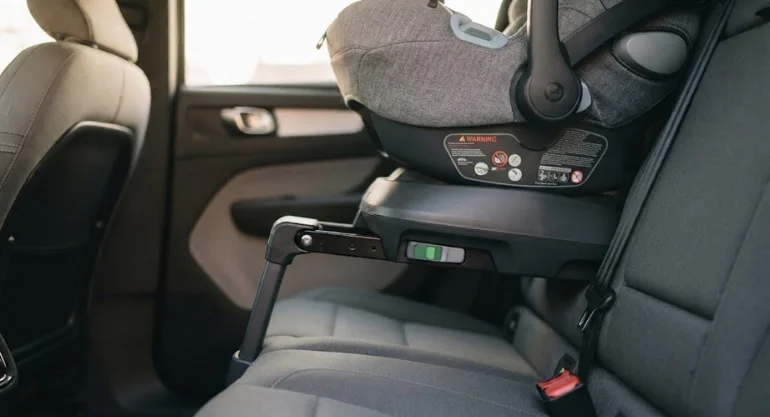
Scroll through car seat listings for more than a few minutes and you’ll notice the same question keeps coming up: buy the version with the ISOFIX base, or save money and fit the seat with the car’s seatbelt instead. It’s a genuinely reasonable thing to get stuck on, since both options are legal, both can be safe, and the marketing around ISOFIX doesn’t always make clear what you’re actually paying extra for.
At Babymore, this is one of the most common questions we get about our car seats, so here’s a straight answer, grounded in UK regulations and the real trade-offs involved.
An ISOFIX base is not a legal requirement in the UK, a correctly fitted, belt-installed car seat is just as compliant and can be just as safe in a crash. What ISOFIX genuinely offers is a significant reduction in fitting errors, since it connects the seat directly to fixed anchor points in the car rather than relying on the driver to route and tension a seatbelt correctly every time.
Research from Good Egg Car Safety found around two-thirds of car seats checked were fitted incorrectly, and most fitting mistakes happen with belt-installed seats specifically, a theme our guide on common car seat mistakes covers in more depth. An ISOFIX base costs more and makes the seat heavier and less convenient to move between cars, so it’s most worth the investment if the seat will live in one car long-term.
A belted installation remains a genuinely sound, more flexible choice if you regularly move the seat between vehicles, such as a grandparent’s car, a hire car, or a taxi.
ISOFIX is a standardised anchor system built into most cars manufactured for the UK market since 2006, with roughly 60% of all cars on the road today fitted with it. Rather than securing a car seat using the vehicle’s own seatbelt, an ISOFIX base clicks directly into two fixed metal anchor points located in the gap between the seat backrest and cushion, with some larger seats adding a third top-tether point for extra stability.
Once the base itself is installed, the infant car seat clicks on and off the base in seconds, which is where a lot of the day-to-day convenience comes from, since you’re not re-threading a seatbelt every time you get in and out of the car. Our guide on what an ISOFIX car seat actually is covers this system in more detail.
No. UK law requires that children travel in an age, weight, and height-appropriate child car seat that meets current safety standards, either ECE R44 (no longer sold new, but still legal to use if already owned) or R129, also known as i-Size. Neither of these standards mandates ISOFIX specifically.
A correctly belted car seat is fully legal and can achieve genuinely comparable crash-test performance to an ISOFIX-installed seat, provided it’s fitted properly every single time. Our guides on i-Size car seats and R44 vs R129 car seat regulations break down what these standards actually require.
The real advantage of ISOFIX isn’t a difference in the seat’s crash performance when both are installed correctly, it’s a dramatic reduction in the chance of installation error in the first place. Research by Good Egg Car Safety, testing almost 1,700 car seats, found that around 67% were fitted incorrectly, and belt-installed seats are considerably more prone to the kind of mistakes that cause this: a twisted strap, insufficient tension, or incorrect routing through the frame.
ISOFIX removes most of that risk by connecting the seat directly to the car’s structure with an audible click and a visual indicator confirming a secure fit, so there’s meaningfully less room for a well-meaning but rushed installation to go wrong. It’s also simply faster day to day, since the infant car seat clips on and off the base itself, rather than needing to be threaded through a seatbelt each time.
Our guide on whether baby car seats are hard to install looks at this in more detail, and our guide on fitting your ISOFIX car seat properly walks through the process step by step.
A belted car seat has real, practical advantages that shouldn’t be dismissed just because ISOFIX gets more attention. It’s lighter and considerably easier to move between vehicles, useful if your child regularly travels in more than one car, a grandparent’s, a partner’s, a hire car, or an occasional taxi journey.
It’s also less expensive, since you’re not paying for the additional base hardware, and it works in any car with a functioning seatbelt, including older vehicles that predate ISOFIX entirely. Provided the seat is fitted correctly every time, a belted installation is a genuinely sound choice, not a compromise.
If you’re planning to take the seat abroad or use it in a hire car, our guide on taking your car seat abroad is worth reading too.
Generally, no, and this is worth being clear about. Unless a specific seat is explicitly designed and tested to be secured using both methods simultaneously, combining ISOFIX with an additional seatbelt is typically advised against, since the seat hasn’t been crash-tested in that configuration and manufacturers can’t guarantee it won’t actually compromise safety rather than improve it. Stick to whichever single method your specific seat and base are designed for.
Our guide on common car seat issues covers other installation mistakes worth avoiding.
Check your vehicle’s owner’s manual first, since it will confirm exactly which seating positions have ISOFIX fitted. Visually, look for small ISOFIX labels or tags in the gap between the seat backrest and cushion in the rear of the car, and you can typically feel the U-shaped metal anchor bars by running your hand along that same gap. If your car was manufactured after 2006, it very likely has ISOFIX fitted as standard, though it’s always worth confirming rather than assuming.
If your car has a support leg requirement instead of or alongside ISOFIX, our guide on ISOFIX car seat support leg compatibility covers what to check.
Both Coco and Pecan, our two infant car seats suitable from birth to approximately 15 months, can be used either belted directly into most cars or paired with a matching ISOFIX base for one-button installation and release. This means you’re not locked into one approach: if the seat is staying in a single family car long-term, adding the base is a genuinely worthwhile investment in convenience and reduced fitting error.
If you know the seat will move between cars regularly, or you’re working with a tighter budget for now, going belted-only is a completely sound choice, and you can always add a compatible base later if your circumstances change.
Our guide on choosing a car seat and car seat stages in the UK can help you work out which stage you’re buying for. If you’d like a seat that lasts well beyond the infant stage, our guides on 360° rotating car seats and multi-stage car seats from birth to 12 years are worth a read. If you’re setting up a full travel system rather than buying the car seat alone, our guide on how to set up a travel system covers fitting the car seat and its adaptors to your chassis correctly.
Neither option is objectively “better” across the board, an ISOFIX base and a belted installation are both genuinely safe when used correctly, and the right choice comes down to how you’ll actually use the car seat day to day. If reduced fitting error and quick, everyday convenience matter most, the base is worth it. If flexibility across multiple cars and a lower upfront cost matter more, a belted seat is a completely sound choice.
Babymore’s car seats are available both with and without a matching ISOFIX base, and our baby travel systems range lets you build the full setup, chassis, carrycot, seat unit, and car seat, around whichever installation method suits your family.