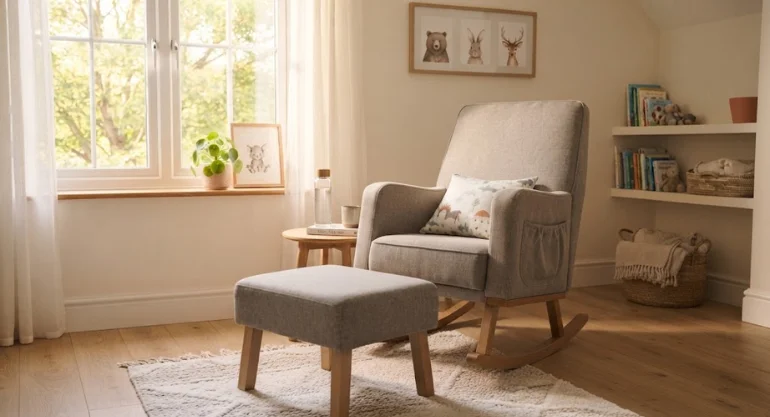
You’ll spend more hours in your nursing chair over the first year than almost any other piece of furniture in the house, feeding sessions, middle-of-the-night settles, quiet moments of just holding a sleeping baby. Working out how to choose a nursing chair and footstool that actually suits you, rather than just picking whichever looks nicest in a nursery photo, makes a genuine difference to how that time feels.
At Babymore, our nursery rocking chairs are consistently one of the first things new parents ask about once the nursery furniture and cot are sorted, so here’s what actually matters when choosing, and how our ranges compare.
The short version of how to choose a nursing chair and footstool: prioritise a firm rather than overly soft seat for better posture support, a footstool that’s genuinely proportioned to match the chair rather than a generic ottoman, storage pockets for essentials within reach, and a rocking motion to help settle your baby.
Elevating your legs on a matched footstool during long feeding sessions takes real pressure off your lower back and improves circulation in a way sitting flat-footed doesn’t. Babymore offers three nursing chair and footstool ranges, Freya, Lux, and Ida, each in soft neutral colours including grey, cream, and bouclé finishes, so there’s a genuine choice depending on your nursery’s style and how firm or plush you want the seat itself.
It’s tempting to treat the footstool as an optional accessory, but it does real, specific work that the chair alone can’t, as our guide on the benefits of using a nursing chair explains in more detail. Elevating your legs during a feed reduces pressure on your lower back and improves circulation, both genuinely useful over a session that can run twenty minutes or more, several times a day, especially in the newborn stage.
A properly matched footstool, rather than a mismatched ottoman from elsewhere in the house, also sits at the right height relative to the chair, so your knees end up properly supported rather than either too high or too low. This matters even more if you’re recovering from a C-section, where reducing strain on your core and back is a genuine priority rather than just a comfort preference; our guide on the best nursing chair after a C-section covers this in more depth, and our postpartum recovery week-by-week guide is worth a read too. It’s a small addition that does a disproportionate amount for how the whole setup actually feels after the first few weeks.
A few things genuinely separate a good choice from a disappointing one:
Babymore offers three distinct nursing chair and footstool ranges, each with its own character, so it’s worth comparing rather than assuming they’re interchangeable.
Freya offers a smooth, gentle rocking motion with a supportive, contoured backrest and cushioned armrests, paired with a matching footstool included as standard. It’s available in three neutral colours, Cream, Grey, and Off White Bouclé, so there’s a genuine grey rocking chair with footstool option here if that’s the finish you’re after. Chair dimensions are 88 x 67 x 95cm, with the footstool at 48 x 31 x 34cm.
Lux adds a lumbar cushion as standard alongside its supportive backrest, plus two storage pockets built into the arms for exactly the kind of within-reach essentials mentioned above. Its standout feature is genuine versatility: once the nursing stage is behind you, the rocking legs can be swapped for hardwood beech legs, converting the chair into a standard armchair that fits into any room in the house for years afterward.
Available in Cream and Grey, with the rocking chair measuring 101 x 64 x 90cm and the armchair configuration standing slightly taller at 78 x 64 x 97cm.
Ida brings a deep seat, curved armrests, and the same two storage pockets found on Lux, with a slightly different silhouette and a softer, more rounded profile overall. It’s available in three soft neutral tones, Ivory, Cashmere, and Bouclé, giving a slightly warmer colour palette than Freya or Lux if that suits your nursery better. Chair dimensions are 90 x 66 x 90cm, with the same footstool sizing as Freya.
If longevity beyond the nursery is a priority, Lux’s convertible leg system is worth a closer look specifically. Most nursing chairs are built with the newborn stage in mind and start to feel purely functional once that stage passes, but a chair that can genuinely convert into a standard armchair means the investment continues paying off well after your child has stopped needing night feeds altogether.
Freya and Ida remain excellent, comfortable choices if you’re not planning to relocate the chair elsewhere in the house later, and both hold up just as well for years of everyday nursery use. If your space is on the smaller side, it’s also worth reading our guide on the best nursing chair for short or tall parents, and if you’re expecting more than one baby, our guide to the best nursing chair for twins is worth a look too.
A nursing chair and footstool bought as a genuinely matched set does more for the hours you’ll spend feeding, settling, and simply sitting with your baby than most parents expect going in. Whether you’re drawn to Freya’s classic rock, Lux’s lumbar support and armchair conversion, or Ida’s deeper, softer profile, choosing the right combination of firmness, fit, and colour makes a real difference over the months ahead.
Babymore’s full nursing chair range includes Freya, Lux, and Ida, each with a matching footstool included as standard, and our guide on nursing chair versus a regular chair is worth reading next if you’re still deciding whether a dedicated nursing chair is the right investment for your nursery. If you’re furnishing the room from scratch, our guide on essential nursery furniture covers how a nursing chair fits alongside the rest of your setup, and if you’d like to know more about caring for the chair once it’s in place, our guide on renovating a nursing chair is a useful next read too.