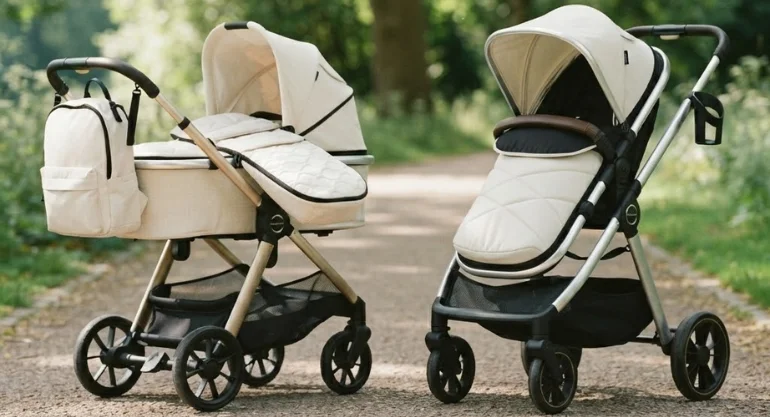
Somewhere around week thirty of pregnancy, most parents-to-be open a baby shop website and hit a wall of terminology. Pram. Pushchair. Buggy. Stroller. Travel system. 2-in-1. 3-in-1. The listings use these words as if everyone already knows what they mean, and in everyday conversation, most of us do use them interchangeably without a second thought. But when you’re actually choosing what your newborn will sleep and travel in for the next few years, the differences matter more than they first appear. At Babymore, this is one of the questions our customer service team fields most often from first-time parents, so we’ve put together a clear, UK-specific breakdown of exactly what separates a pram from a pushchair, and what that means for your buying decision.
In UK usage, a pram is designed for newborns: your baby lies fully flat in a carrycot, facing you, with no ability to sit up. A pushchair is designed for babies who can sit unaided, typically from around six months, with an upright or reclining seat rather than a flat carrycot. Most parents today don’t buy the two separately. Instead, they buy a travel system: a single chassis that takes a lie-flat carrycot for the newborn stage and swaps to a forward- or parent-facing seat unit once your baby is ready to sit up, sometimes with a compatible infant car seat as a third component. The terms buggy and stroller are generally used loosely for the same category as pushchair, particularly for lighter, more compact models.
The simplest way to think about it is age and position, not brand or price point.
A pram is built around a carrycot: a bassinet-style, fully lie-flat compartment where your newborn lies on their back, usually facing you. This isn’t just a design choice. Newborns don’t yet have the neck and spine strength to sit upright safely, and NHS guidance on safe sleep and healthy hip and spine development is part of why lie-flat positioning matters so much in the first months. Prams tend to have a sturdier frame and larger wheels than pushchairs, built for a smooth, gentle ride rather than speed or compactness.
A pushchair, by contrast, is built around a seat unit rather than a carrycot. It’s designed for a baby who can sit up unaided, generally from around six months, though this varies by child. Pushchair seats are usually forward-facing (sometimes called world-facing) or parent-facing, foldable, and considerably lighter and more compact than a traditional pram, which makes day-to-day use, buses, and car boots far more manageable.
Here’s the distinction in a single table:
| Feature | Pram | Pushchair |
| Position | Fully lie-flat carrycot | Upright or reclining seat |
| Suitable age | Newborn (0–6 months) | From around 6 months (or from birth if fully reclining) |
| Frame | Sturdier, larger wheels | Lighter, foldable, compact |
| Facing | Parent-facing | Forward-facing or parent-facing |
| Best for | Naps on the go, early months | Everyday use as baby grows |
A baby travel system is the single chassis (the wheeled frame) that different components click onto as your baby grows. Most travel systems on the UK market today combine three parts: a lie-flat carrycot for the newborn stage, a forward- or parent-facing seat unit for when your baby can sit up, and, in many cases, a compatible infant car seat that clips straight onto the same chassis.
The appeal is straightforward: you buy one frame and adapt it stage by stage, rather than buying a separate pram and then a separate pushchair a few months later. It’s also why car-to-pavement transfers without waking a sleeping baby have become such a selling point, since the car seat clicks directly onto the pushchair chassis without disturbing them.
This is where the numbering gets confusing, so it’s worth untangling directly:
Typically means the chassis, plus a carrycot and a seat unit, but without a separate infant car seat included. You get both the lie-flat pram mode and the upright pushchair mode in one purchase, but you’d need to buy or already own a car seat separately if you need one. Our Mimi 2 in 1 Pram Pushchair is a good example: it converts between pram mode and pushchair mode on the same lightweight aluminium chassis, suitable from birth right through to around four years.
Adds the infant car seat (and sometimes an Isofix base) into the same bundle, giving you carrycot, seat unit, and car seat all compatible with one chassis. This is generally the more complete, if pricier, option, and it’s the format most parents mean when they say “travel system.” Our Memore 3 in 1 Travel System bundles a chassis, seat, carrycot, i-Size car seat, and accessories like a rain cover and changing bag into a single package, which tends to work out better than buying each piece separately.
Since both attach to the same chassis on most modern travel systems, it’s worth being clear on what genuinely differs between a carrycot and a seat unit, beyond just “flat” versus “upright.”
A carrycot is a fully enclosed, bassinet-style compartment with a soft, flat mattress base. It’s designed so your newborn lies completely flat on their back, which supports healthy spine and hip development and easier breathing in the early months. Carrycots are typically rated from birth up to around 9kg or six months, and many, including Babymore’s Memore and Mimi carrycots, are safety tested for overnight sleeping, which matters if you’re planning to use it as a portable Moses basket alternative for daytime naps.
A seat unit is a more structured, harnessed seat, usually with a five-point harness, that can recline through several positions, sometimes including a lie-flat setting, but is generally used upright or semi-reclined once your baby has the head and neck control to sit. Seat units are typically rated from around six months up to 15kg or 22kg, depending on the model, taking your child through to roughly three or four years old.
The practical upshot: if you’re expecting a newborn and want to use the pushchair from day one, check specifically whether the seat unit offers a true, flat 180-degree recline, not just a steep angle marketed as “lie-flat.” Many budget seat units only recline partway, which isn’t suitable for very young babies. Our Mimi and Memore seat units include a genuine flat recline position specifically so the seat unit itself can be used from birth if you’d rather not use a separate carrycot at all.
For more on what comes next, our guides on when to move your baby from pram to pushchair and when to stop using a pram altogether are worth a read as your little one grows.
This is one of the most common questions we hear, and the honest answer is that it depends on the specific pushchair, not a fixed age.
As a general guide, most health visitors and manufacturers recommend waiting until your baby can sit upright unaided with good head control before using a standard upright pushchair seat, which tends to land somewhere around six months for most babies, though every child develops at their own pace.
That said, some pushchair seat units are built with a genuine flat recline specifically so they’re safe to use from birth, without needing a separate carrycot at all. If a seat unit is marketed as “suitable from birth,” it should offer a true lie-flat recline position, not merely a steep angle. We’ve covered this transition in more depth, including the signs to look for, in our guide on when to move your baby from pram to pushchair.
If there’s one feature worth prioritising for the newborn stage, it’s a genuine lie-flat position, whether that’s in a dedicated carrycot or a from-birth seat unit. Newborns lack the muscle strength to hold their head and torso upright, and propping them at an angle for extended periods can restrict breathing and put uneven pressure on a still-developing spine. A properly flat carrycot also gives your baby the same supported sleeping surface as a Moses basket, which is part of why so many parents use the carrycot for early daytime naps around the house, not just for outings.
Not really, and this is where UK usage gets genuinely loose. In everyday conversation, “buggy,” “stroller,” and “pushchair” are used almost interchangeably across the country, and shop listings aren’t always consistent either. If there’s a technical distinction, it’s that a buggy tends to refer to a lighter, more compact, umbrella-fold style pushchair, ideal for quick trips or travel, while “pushchair” is often used as the broader umbrella term. “Stroller” is more of an American import that’s crept into UK usage, particularly in marketing copy, but it generally means the same thing as pushchair here. Nobody is going to correct you for using any of these terms; UK parents move between them freely, and most retailers do too. We go into more detail on how pram, buggy, pushchair, stroller, and travel system all relate to each other in our broader guide, what’s the difference between a pram, stroller, buggy, pushchair, and travel system.
For most UK parents, the decision isn’t really pram versus pushchair as separate purchases anymore, it’s whether to buy a travel system that covers both stages, or to buy a standalone pushchair with a from-birth recline and add a car seat separately later.
A few questions worth asking yourself:
Pram versus pushchair isn’t really an either-or decision for most parents anymore, it’s a question of which stage of your baby’s development a product is built for, and whether a single travel system can carry you through both. A pram’s flat carrycot supports your newborn through the earliest months, while a pushchair’s seat takes over once your baby is ready to sit up and see the world. Understanding where that line sits, and checking specifically for a genuine lie-flat recline if you want to use a pushchair from birth, will save you from buying something that doesn’t actually suit your baby’s stage.
If you’re weighing up your options, Babymore’s range of prams and pushchairs and travel systems covers both 2-in-1 and 3-in-1 formats, all tested to current British and EU safety standards.